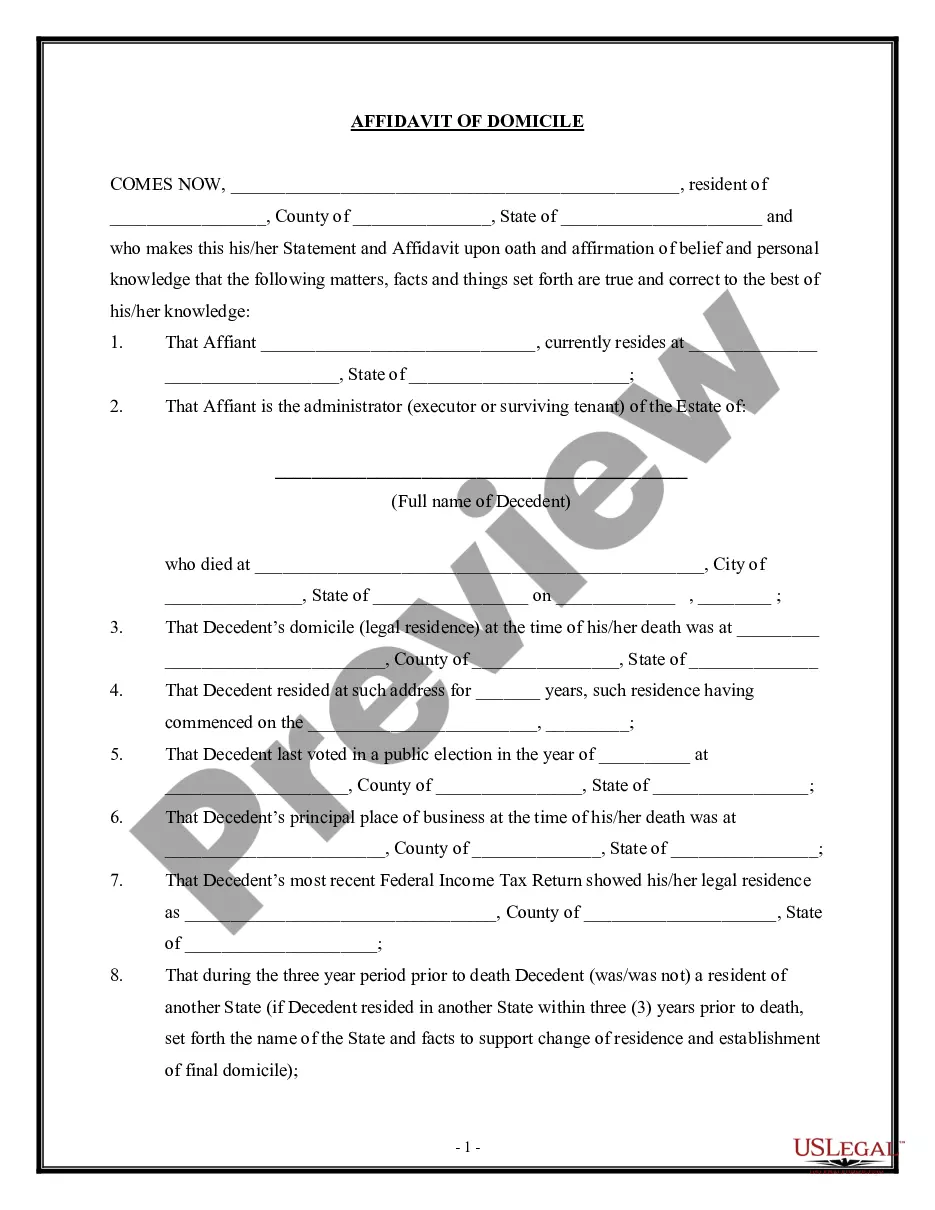
Proof Of U.s. Domicile Sample In Minnesota
Description
Get your form ready online
Our built-in tools help you complete, sign, share, and store your documents in one place.
Make edits, fill in missing information, and update formatting in US Legal Forms—just like you would in MS Word.
Download a copy, print it, send it by email, or mail it via USPS—whatever works best for your next step.
Sign and collect signatures with our SignNow integration. Send to multiple recipients, set reminders, and more. Go Premium to unlock E-Sign.
If this form requires notarization, complete it online through a secure video call—no need to meet a notary in person or wait for an appointment.
We protect your documents and personal data by following strict security and privacy standards.

Make edits, fill in missing information, and update formatting in US Legal Forms—just like you would in MS Word.

Download a copy, print it, send it by email, or mail it via USPS—whatever works best for your next step.

Sign and collect signatures with our SignNow integration. Send to multiple recipients, set reminders, and more. Go Premium to unlock E-Sign.

If this form requires notarization, complete it online through a secure video call—no need to meet a notary in person or wait for an appointment.

We protect your documents and personal data by following strict security and privacy standards.
Looking for another form?






Form popularity
FAQ
Domicile of choice can be achieved by intention and residence. This means that if an individual is living in a country and leaves it with the intention to return, then they will not have a domicile in the country they went to; instead, their domicile of origin will remain.
Your domicile is the state of your permanent home, or the state you consider your home whenever you are. elsewhere. Your domicile is an important place. It is, for example, the place that usually has the power to tax. your income or dissolve your marriage or distribute your property upon your death.
Individuals arriving on immigrant visas become LPRs when they arrive in the United States. After residing in the United States for five years (or three years in some circumstances), LPRs are eligible to apply for U.S. citizenship.
“Country of residence” refers to the country where a person currently lives and intends to stay for an extended period. For visa holders and immigrants in the USA, this is often the United States, especially if they have a long-term visa or permanent residency status.
If you are living outside the United States, you will need to prove that you have significant ties to the U.S., or that you plan to re-establish domicile. Under some circumstances, if you've been living abroad but have been working for certain U.S. organizations, you may still be eligible to claim U.S. domicile.
If you have a joint sponsor, they must also complete Form I-864. If you are using the income of other household members to qualify, then each household member who is accepting legal responsibility for supporting your relative must complete a separate Form I-864A, Contract Between Sponsor and Household Member.
A voting record in the United States. Records of paying U.S. state or local taxes. Having property in the United States. Maintaining bank or investment accounts in the United States.
A person is “domiciled” in Minnesota if they are physically present in the state, and they intend for Minnesota to be their home. Even if you are not physically present in Minnesota for 183 days of the year, you are still a resident of Minnesota if you are found to be domiciled in Minnesota.
If a fund is domiciled in the US, it means the company that holds the underlying shares is a US company and is under taxation laws of US. Unfortunately, the US has draconian estate tax (death tax) laws for non-Americans.
Domicile is physically living somewhere (or lived somewhere) and intent to remain (or intent to return if you're military). You CANNOT have a domicile for a state you have never lived in. You must have physically resided in a certain state to gain its benefits and protections.
