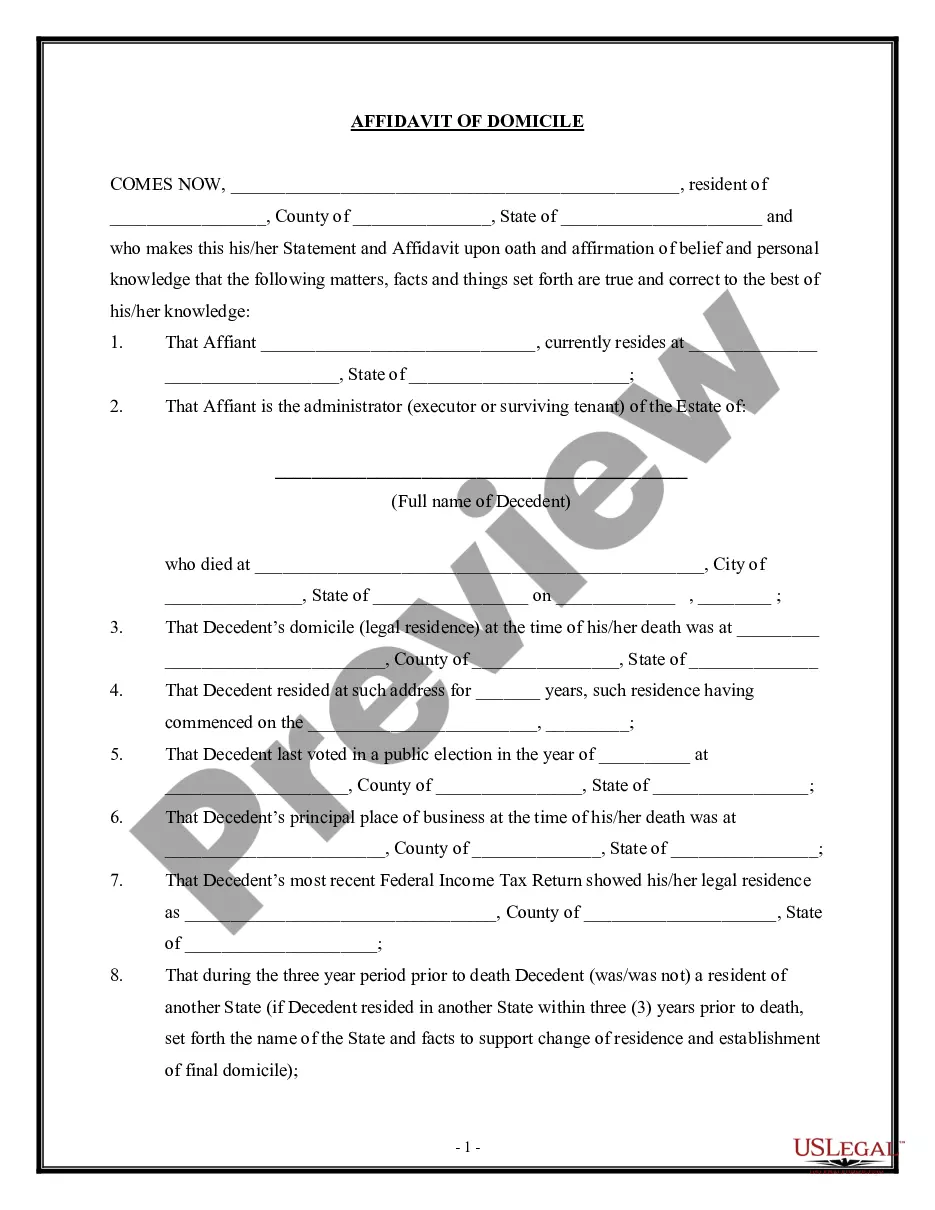
Domicile Definition In Law In Maryland
Description
Get your form ready online
Our built-in tools help you complete, sign, share, and store your documents in one place.
Make edits, fill in missing information, and update formatting in US Legal Forms—just like you would in MS Word.
Download a copy, print it, send it by email, or mail it via USPS—whatever works best for your next step.
Sign and collect signatures with our SignNow integration. Send to multiple recipients, set reminders, and more. Go Premium to unlock E-Sign.
If this form requires notarization, complete it online through a secure video call—no need to meet a notary in person or wait for an appointment.
We protect your documents and personal data by following strict security and privacy standards.

Make edits, fill in missing information, and update formatting in US Legal Forms—just like you would in MS Word.

Download a copy, print it, send it by email, or mail it via USPS—whatever works best for your next step.

Sign and collect signatures with our SignNow integration. Send to multiple recipients, set reminders, and more. Go Premium to unlock E-Sign.

If this form requires notarization, complete it online through a secure video call—no need to meet a notary in person or wait for an appointment.

We protect your documents and personal data by following strict security and privacy standards.
Looking for another form?



Form popularity
FAQ
Domicile refers to the place where you have your permanent home and to which you intend to return after any temporary absence. For Form I-864 purposes, your principal residence must be in the United States, including the District of Columbia and U.S. territories, with plans to maintain it for the foreseeable future.
States vary in their definitions of these terms, but generally agree that domicile is a subjective analysis based on a person's permanent residence (i.e., the place where an individual has his or her true, fixed, and permanent home without any present intention of leaving, and to which the individual intends to return ...
Basically the terms “domicile” and “legal residence” refer to the same place – the state you consider your permanent home. On the other hand, your “residence” is simply where you are living at a particular time.
Domicile • \DAH-muh-syle\ • noun. 1 : a dwelling place : place of residence : home 2 a : a person's fixed, permanent, and principal home for legal purposes b : the place where a corporation is actually or officially established.
Domicile refers to the place where you have your permanent home and to which you intend to return after any temporary absence. For Form I-864 purposes, your principal residence must be in the United States, including the District of Columbia and U.S. territories, with plans to maintain it for the foreseeable future.
Its meaning in English law is not statutory, but has been developed by judges in cases decided over the last two centuries. The domicile of most individuals is their domicile of origin. The general rule is that an individual's domicile of origin is whatever domicile his or her father had when he or she was born.
Briefly stated, an individual is a resident of Maryland if the individual is domiciled in Maryland on the last day of the taxable year or if the individual maintains a place of abode in Maryland for more than six months of the taxable year and is physically present in the State for 183 days or more during the taxable ...
If you were domiciled in Maryland on the last day of the tax year, or you maintained a place to live in Maryland and were physically present in Maryland for more than six months (183 days) of the tax year, then you are a legal Maryland resident.
You were physically present in the state for 183 days or more. (also known as a statutory resident)
You must present two of the following documents to establish your Maryland residential address: Maryland vehicle registration card or title. Vehicle insurance card or policy that includes your address. Utility, telephone, or cable/satellite T.V.

