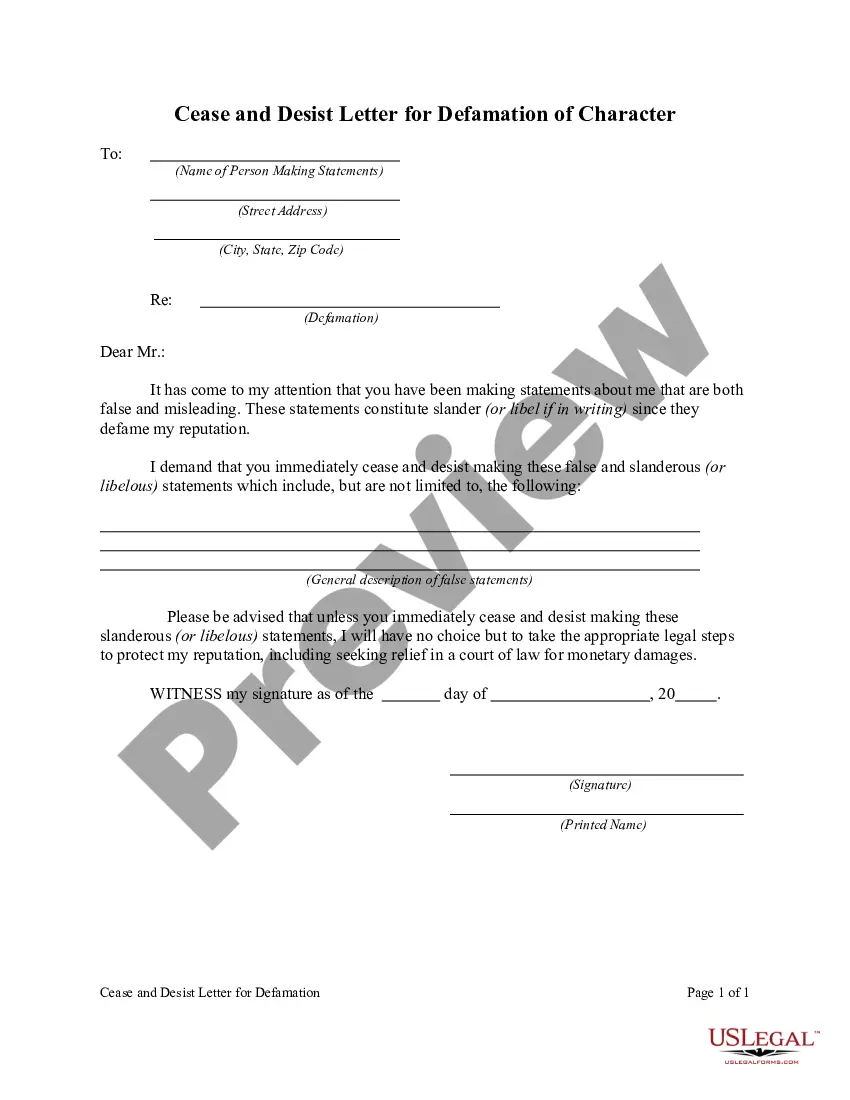
Defamation Of Character Laws In Maryland
Description
Get your form ready online
Our built-in tools help you complete, sign, share, and store your documents in one place.
Make edits, fill in missing information, and update formatting in US Legal Forms—just like you would in MS Word.
Download a copy, print it, send it by email, or mail it via USPS—whatever works best for your next step.
Sign and collect signatures with our SignNow integration. Send to multiple recipients, set reminders, and more. Go Premium to unlock E-Sign.
If this form requires notarization, complete it online through a secure video call—no need to meet a notary in person or wait for an appointment.
We protect your documents and personal data by following strict security and privacy standards.

Make edits, fill in missing information, and update formatting in US Legal Forms—just like you would in MS Word.

Download a copy, print it, send it by email, or mail it via USPS—whatever works best for your next step.

Sign and collect signatures with our SignNow integration. Send to multiple recipients, set reminders, and more. Go Premium to unlock E-Sign.

If this form requires notarization, complete it online through a secure video call—no need to meet a notary in person or wait for an appointment.

We protect your documents and personal data by following strict security and privacy standards.
Looking for another form?

Form popularity
FAQ
Defamation that causes long-term damage, particularly if it affects your career, social standing, or personal life, will result in higher damages than something short-term that might be forgotten within a year. The more severe and lasting the harm, the greater the compensation.
Starting a Defamation of Character Lawsuit Defamation is a false statement of fact that harms another's reputation. To start a defamation lawsuit: (1) decide if you have a claim, (2) calculate your damages, (3) gather evidence, (4) speak to a lawyer, and (5) file your case.
Truth is an absolute defence to defamation. The defendant must prove that the defamatory statements were, in fact, true. For instance, if the statements concern the quality of goods or services, the defendant could provide independent testing or other evidence supporting the truth of the claims.
Guarding against defamatory statements Be truthful. If your statements are true, they are not defamatory. Be clear and unambiguous. Keep in mind that statements that are technically true may still be defamatory if they are incomplete or misleading.
To prove prima facie defamation, a plaintiff must show four things: 1) a false statement purporting to be fact; 2) publication or communication of that statement to a third person; 3) fault amounting to at least negligence ; and 4) damages , or some harm caused to the reputation of the person or entity who is the ...
Maryland allows plaintiff's to file defamation suits under a provision known as defamation per se. Defamation per se means that the contested statement(s) are inherently defamatory.
In general, pursuing a defamation lawsuit may be worthwhile if: The defamatory statement(s) are demonstrably false and have caused significant harm to your reputation or career. You have strong evidence to support your claim. The potential damages are substantial enough to justify the costs and risks of litigation.
Is it hard to win a defamation case? Defamation lawsuits are challenging because they require a lot of fact-finding. It may require experts to testify on your behalf about the psychological and emotional harm you've suffered. Unless your lawyer is working on a contingency basis, it can also be quite costly.
Libel and slander are both types of defamation. Libel is an untrue defamatory statement that is made in writing. Slander is an untrue defamatory statement that is spoken orally.