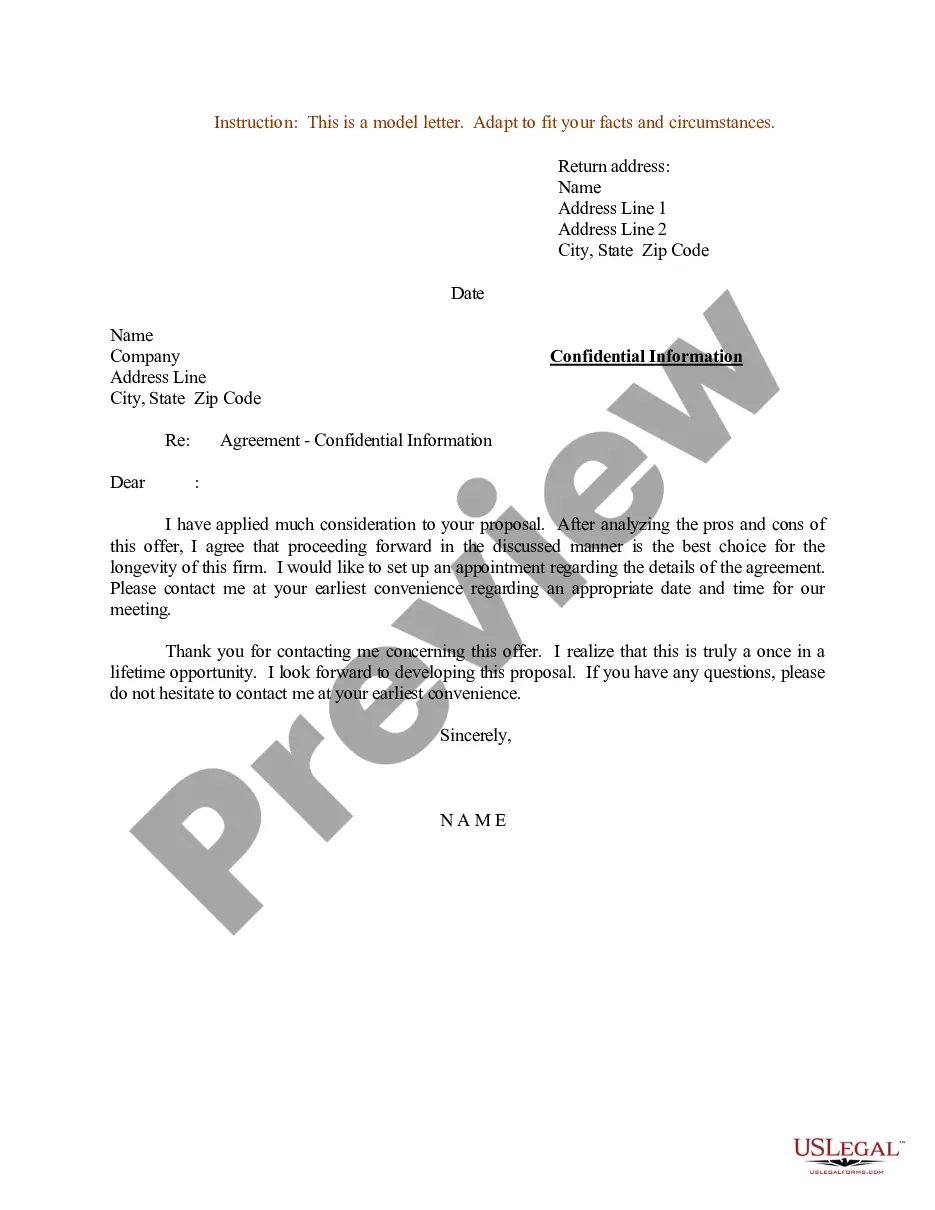
Sample Letter For Disclosing Confidential Information Without Consent In Minnesota
Description


Get your form ready online
Our built-in tools help you complete, sign, share, and store your documents in one place.
Make edits, fill in missing information, and update formatting in US Legal Forms—just like you would in MS Word.
Download a copy, print it, send it by email, or mail it via USPS—whatever works best for your next step.
Sign and collect signatures with our SignNow integration. Send to multiple recipients, set reminders, and more. Go Premium to unlock E-Sign.
If this form requires notarization, complete it online through a secure video call—no need to meet a notary in person or wait for an appointment.
We protect your documents and personal data by following strict security and privacy standards.

Make edits, fill in missing information, and update formatting in US Legal Forms—just like you would in MS Word.

Download a copy, print it, send it by email, or mail it via USPS—whatever works best for your next step.

Sign and collect signatures with our SignNow integration. Send to multiple recipients, set reminders, and more. Go Premium to unlock E-Sign.

If this form requires notarization, complete it online through a secure video call—no need to meet a notary in person or wait for an appointment.

We protect your documents and personal data by following strict security and privacy standards.
Looking for another form?

Form popularity
FAQ
In the workplace, a breach of confidence can take place when a worker, either intentionally or unintentionally, discloses or uses information that could damage the employer's business, clients, or employees. If a worker breaches confidentiality, legal action may be taken against them by their employer.
"Informed consent" means simply that the person consenting to the disclosure is aware of the confidentiality of the records, the reason the agency is seeking the information, and what use the agency will make of the information. It also includes an understanding of whether the information may be redisclosed.
Consent, for the purposes of confidentiality, means that the service user understands and does not object to: the information being disclosed or shared; the reason for the disclosure; the people or organisations the information will be shared with; and.
This Disclosure Authorisation Letter (previously known as an “Authorisation to Release Confidential Information") refers to a Confidentiality Agreement and authorises a party to that agreement to release certain information to a named party. This document is suitable for basic disclosure situations only.
What is a Tennessen warning notice? The government must give individuals notice when collecting private or confidential information from them. This is referred to as a "Tennessen warning notice." Government may also call it a "privacy notice," a "notice of collection of private/confidential data," or something similar.
The general rule under the Privacy Act is that an agency cannot disclose a record contained in a system of records unless the individual to whom the record pertains gives prior written consent to the disclosure. There are twelve exceptions to this general rule.
Consequences may extend to dismissal, criminal prosecution or civil legal action against the individual and organisation involved. information which may cause harm, or could give an unfair advantage if lost, damaged or released without authorisation.
In 2024, the Minnesota legislature passed the Minnesota Consumer Data Privacy Act, regulating businesses' use of personal data on individuals and giving Minnesotans various rights regarding their personal data. Covered businesses must comply with new data privacy and information security requirements.
Failing to protect confidential information results in breaches, eroding trust with clients and the public. It can also cause contract termination and expensive legal actions. Breaches of confidentiality happen to companies each and every day throughout the nation.
A confidentiality agreement should include the names and addresses of the parties to the contract. Consider also including: Reason for the agreement: Explain why you're sharing this information. The information disclosed: Be specific about the subject matter and what exactly is included in the agreement.