Restrictive Covenants In Real Estate In Queens
Description

Get your form ready online
Our built-in tools help you complete, sign, share, and store your documents in one place.
Make edits, fill in missing information, and update formatting in US Legal Forms—just like you would in MS Word.
Download a copy, print it, send it by email, or mail it via USPS—whatever works best for your next step.
Sign and collect signatures with our SignNow integration. Send to multiple recipients, set reminders, and more. Go Premium to unlock E-Sign.
If this form requires notarization, complete it online through a secure video call—no need to meet a notary in person or wait for an appointment.
We protect your documents and personal data by following strict security and privacy standards.

Make edits, fill in missing information, and update formatting in US Legal Forms—just like you would in MS Word.

Download a copy, print it, send it by email, or mail it via USPS—whatever works best for your next step.

Sign and collect signatures with our SignNow integration. Send to multiple recipients, set reminders, and more. Go Premium to unlock E-Sign.

If this form requires notarization, complete it online through a secure video call—no need to meet a notary in person or wait for an appointment.

We protect your documents and personal data by following strict security and privacy standards.
Looking for another form?








Form popularity
FAQ
Although New York disfavors restrictive covenants based on public policy, which respects the right of people to earn their own living, these provisions are enforced if: (1) there is a legitimate business interest in enforcement, and (2) the scope of the restriction is narrowly drawn.
One of the most common restrictive covenants is not to do or keep anything on the property that could be a nuisance to the neighbouring properties. This is general covenant that could cover a wide variety of actions, to try to keep the area a pleasant place to live.
The details of restrictive covenants are typically found in the deed to your home or in an HOA document known as the CC&R (covenants, conditions and restrictions). These CC&R agreements are legally binding, and violations may lead to fines or other consequences.
In the United States, employers generally use four types of restrictive covenants: (1) covenants not to compete for a certain period of time following the employee's termination from employment (or following a business transaction such as a sale, merger, etc.); (2) covenants not to solicit customers or clients for a ...
compete is only allowed and enforceable to the extent it (1) is necessary to protect the employer's legitimate interests, (2) does not impose an undue hardship on the employee, (3) does not harm the public, and (4) is reasonable in time period and geographic scope.
In the minority of jurisdictions, like California, courts will likewise disregard the fact that something is labelled as a covenant not to solicit customers and/or clients, and may instead deem it akin to a covenant not to compete and treat it as such.
Are restrictive covenants on property enforceable? Covenants can be unenforceable if they expire, if there is a history of the covenant being violated, or if there is no individual or group benefiting from them. Otherwise, they are generally enforceable and you could face legal action if you ignore them.
Restrictive Covenants, Explained This restricts how homeowners can manage and modify their land. Examples include restrictions on fence options, the type of animals allowed and the use of outbuildings, such as sheds.
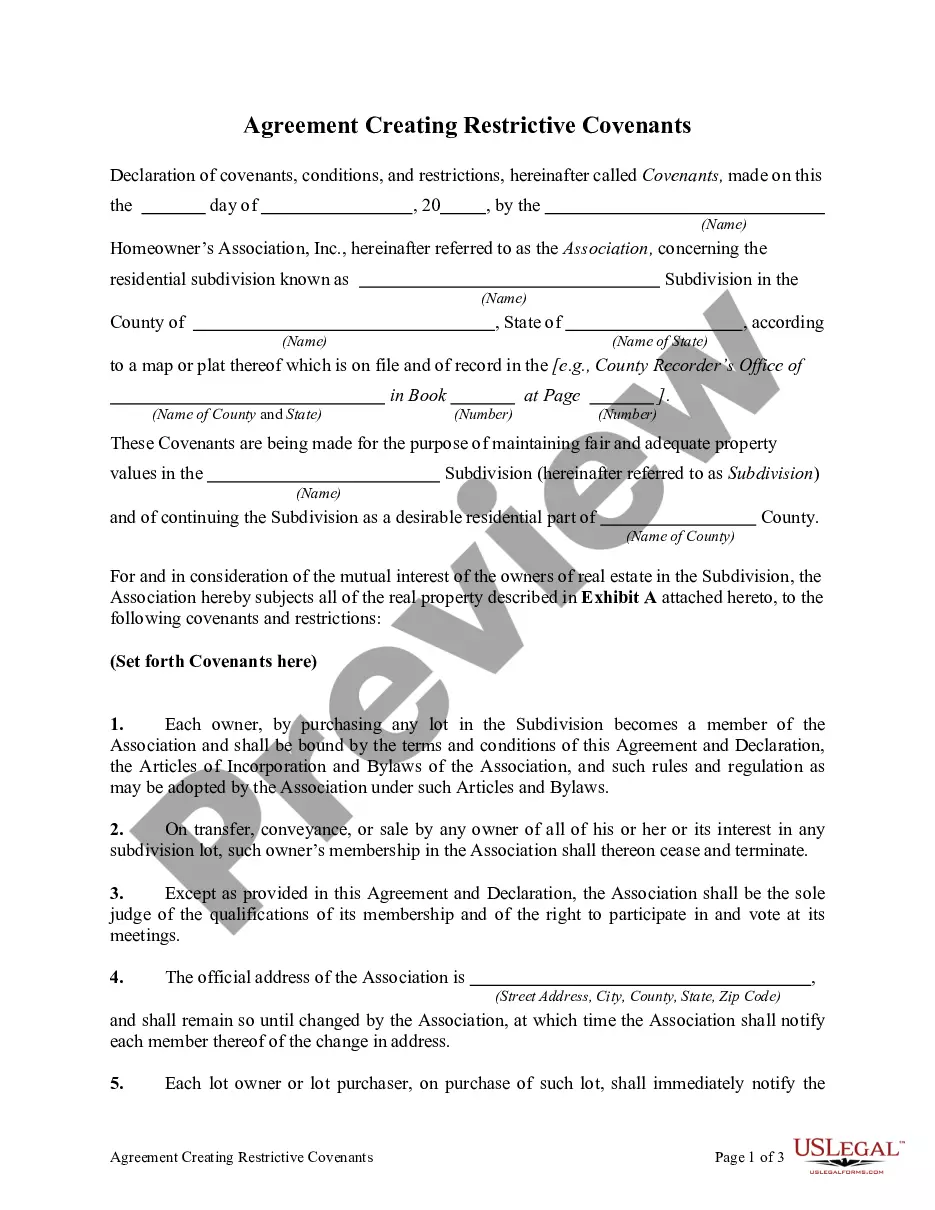
A restrictive covenant is a provision in a real property conveyance that limits the grantee's use of the property.
