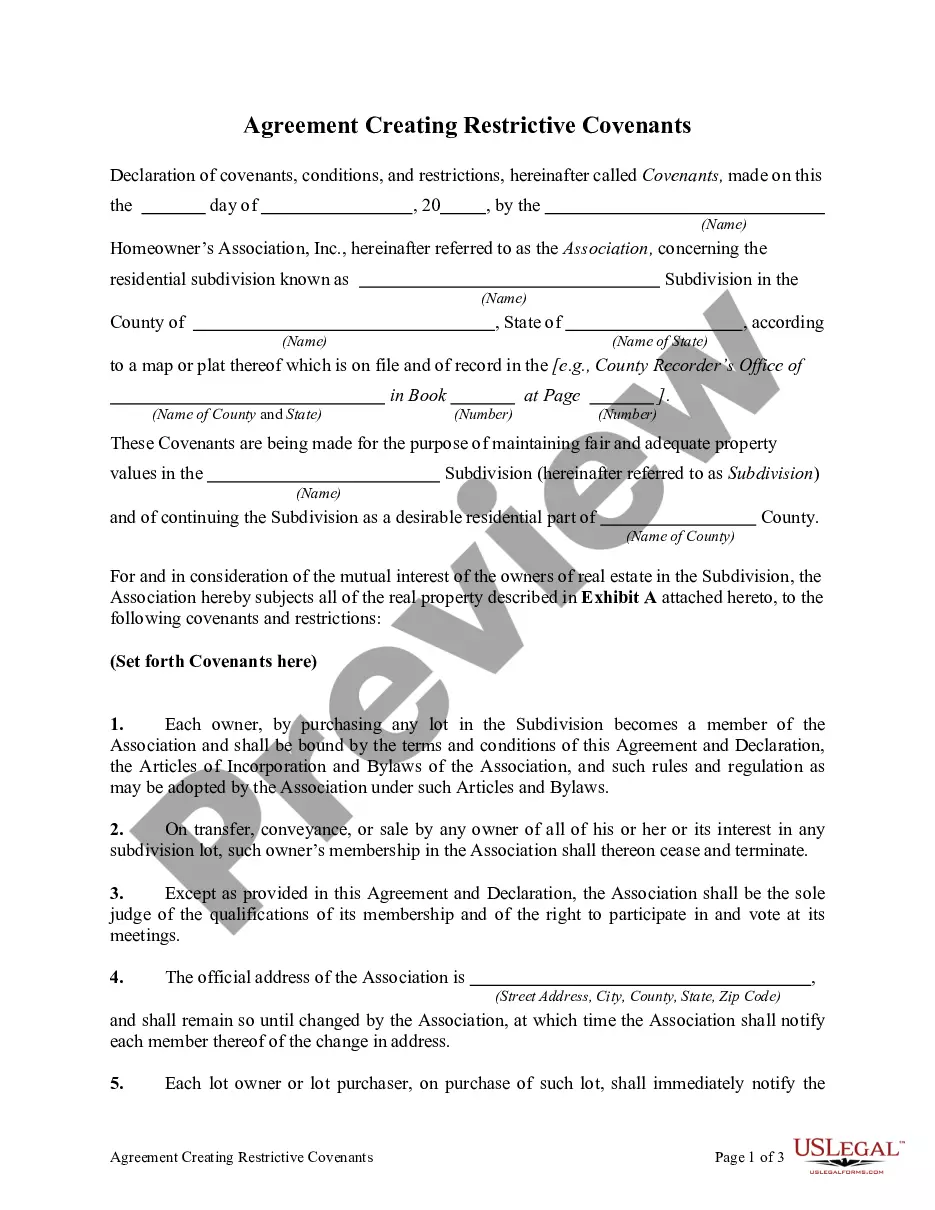
Agreements For Restrictive Covenant In Queens
Description

Get your form ready online
Our built-in tools help you complete, sign, share, and store your documents in one place.
Make edits, fill in missing information, and update formatting in US Legal Forms—just like you would in MS Word.
Download a copy, print it, send it by email, or mail it via USPS—whatever works best for your next step.
Sign and collect signatures with our SignNow integration. Send to multiple recipients, set reminders, and more. Go Premium to unlock E-Sign.
If this form requires notarization, complete it online through a secure video call—no need to meet a notary in person or wait for an appointment.
We protect your documents and personal data by following strict security and privacy standards.

Make edits, fill in missing information, and update formatting in US Legal Forms—just like you would in MS Word.

Download a copy, print it, send it by email, or mail it via USPS—whatever works best for your next step.

Sign and collect signatures with our SignNow integration. Send to multiple recipients, set reminders, and more. Go Premium to unlock E-Sign.

If this form requires notarization, complete it online through a secure video call—no need to meet a notary in person or wait for an appointment.

We protect your documents and personal data by following strict security and privacy standards.
Looking for another form?








Form popularity
FAQ
As a general rule, restrictive covenants entered into voluntarily will be enforced where the covenant is “reasonable in time and area, necessary to protect the employer's legitimate interests, not harmful to the general public and not unreasonably burdensome to the employee.” Reed, Roberts Associates, Inc.
If a deed restriction is not enforceable, you can choose to ignore it and take on the risk of a neighbor filing suit, or you can seek out a judge's ruling to have the covenant removed from the deed. Obtaining that ruling is easier when no one is actively enforcing the covenant.
Although New York State lawmakers passed a non-compete ban in 2023, Gov. Hochul vetoed the bill primarily because she wanted to see exceptions allowing non-competes in connection with the sale of a business and for high-income earners that have more negotiating power.
Yes, the general rule in NY is that lawyers can't be held to a non-compete. But the Court of Appeals has acknowledged a rare exception to that rule.
A bill introduced in the New York State Senate on Feb. 10, 2025, would prohibit nearly all non-compete agreements arising in employment. Consistent with a national trend, non-competes for healthcare professionals would be banned.
If an employee breaches a restrictive covenant, the employer may take legal action to enforce the covenant, which could result in an injunction to stop the breach or a claim for damages. Employers should act promptly if a breach occurs to protect their interests.
Although New York State lawmakers passed a non-compete ban in 2023, Gov. Hochul vetoed the bill primarily because she wanted to see exceptions allowing non-competes in connection with the sale of a business and for high-income earners that have more negotiating power.
How do I challenge a restrictive covenant? Express release: It may be possible to negotiate the release or variation of a restrictive covenant. Indemnity insurance: It is possible to obtain indemnity insurance to protect against the risk of a person with the benefit of a restrictive covenant seeking to enforce it.
5 Ways to Defeat a New York Non-Compete Agreement Fired Without Cause. If your employer is not willing to employ you, courts generally will not enforce a non-compete agreement. The Legitimate Business Interests Test. Unclean Hands – Breach of Contract by Employer. The Janitor Rule. There Is No Competition.
To officially end the restrictive covenants, it may be necessary to file a lawsuit seeking a declaration from a court that the covenants are no longer enforceable. This can be a complex legal process that may require the assistance of an attorney.