Covenant In Agreement In Clark
Description

Get your form ready online
Our built-in tools help you complete, sign, share, and store your documents in one place.
Make edits, fill in missing information, and update formatting in US Legal Forms—just like you would in MS Word.
Download a copy, print it, send it by email, or mail it via USPS—whatever works best for your next step.
Sign and collect signatures with our SignNow integration. Send to multiple recipients, set reminders, and more. Go Premium to unlock E-Sign.
If this form requires notarization, complete it online through a secure video call—no need to meet a notary in person or wait for an appointment.
We protect your documents and personal data by following strict security and privacy standards.

Make edits, fill in missing information, and update formatting in US Legal Forms—just like you would in MS Word.

Download a copy, print it, send it by email, or mail it via USPS—whatever works best for your next step.

Sign and collect signatures with our SignNow integration. Send to multiple recipients, set reminders, and more. Go Premium to unlock E-Sign.

If this form requires notarization, complete it online through a secure video call—no need to meet a notary in person or wait for an appointment.

We protect your documents and personal data by following strict security and privacy standards.
Looking for another form?









Form popularity
FAQ
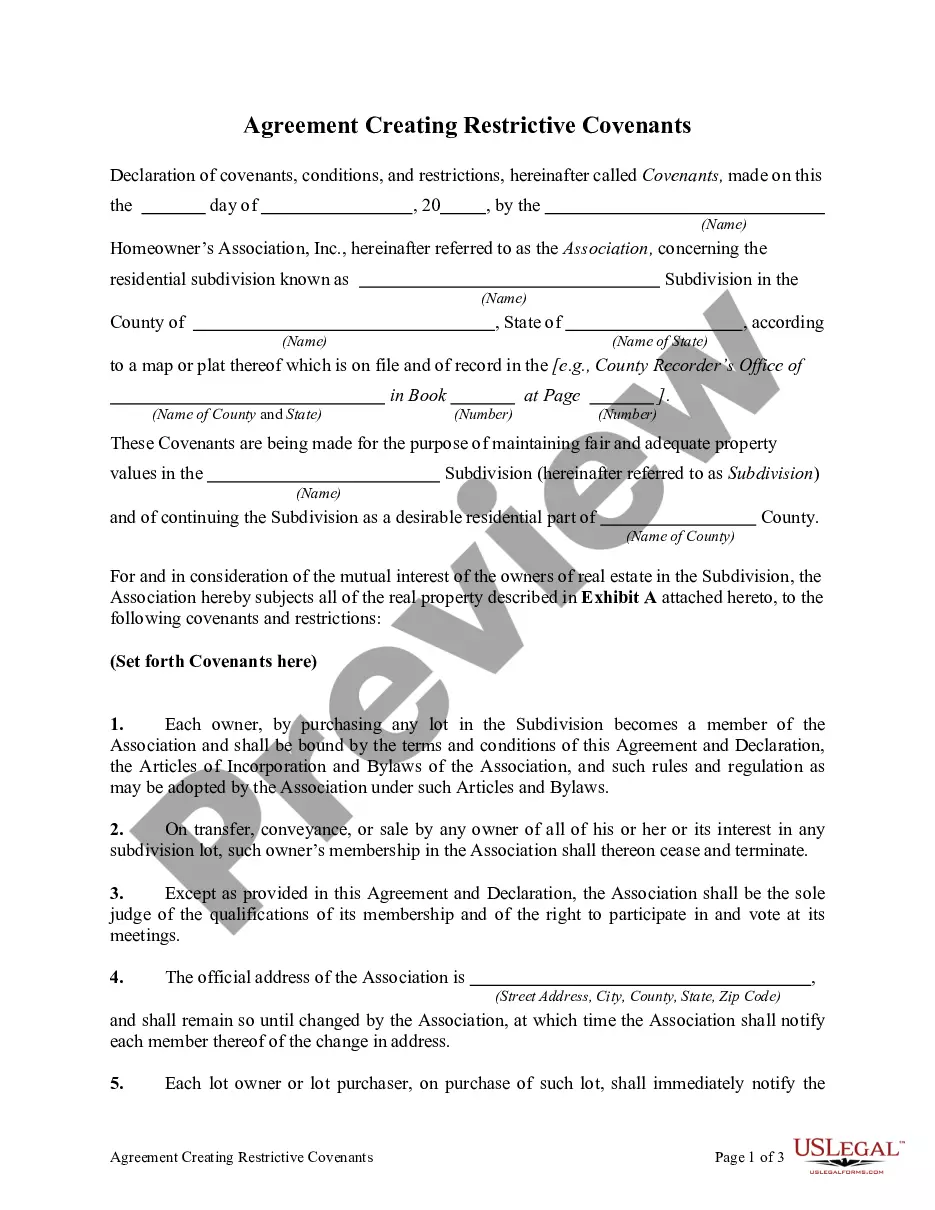
Covenants are particularly relevant in the fields of contract law and property law. An example of a contractual covenant is a non-compete agreement . Examples of common covenants in property law include agreements not to build a fence or agreements to maintain a shared driveway.
It is possible to apply to the Lands Chamber of the Upper Tribunal to have a restrictive covenant “discharged or modified”, as the statute puts it, in order to get the covenant removed or changed so that development can take place or the use of the land can be changed.
A proper “covenant relationship” with God requires five major experiences: 1) Faith, faith in Jehovah God and Jesus Christ. 2) Repentance of sins. 3) Confession of sins. 4) Baptism and 5) Obedience, effective operation of all of these means genuine conversion.
An example of a contractual covenant is a non-compete agreement . Examples of common covenants in property law include agreements not to build a fence or agreements to maintain a shared driveway.
Points to Note A single leader should lead the group through the covenant writing process. Limit your covenant to no more than 10 clauses. Keep clauses concise and specific. Begin where you are, not where you think you should be. Place the clauses in the same order they are named in the General Rule of Discipleship.
Creating a list of parties Identify all participating parties. List each party in the covenant agreement. Include the full legal name, contact information and place of business of each party. Include any other relevant information such as a description of each party's role or other relevant information.
A covenant is a formal agreement or promise , usually included in a contract or deed , to do or not do a particular act.
