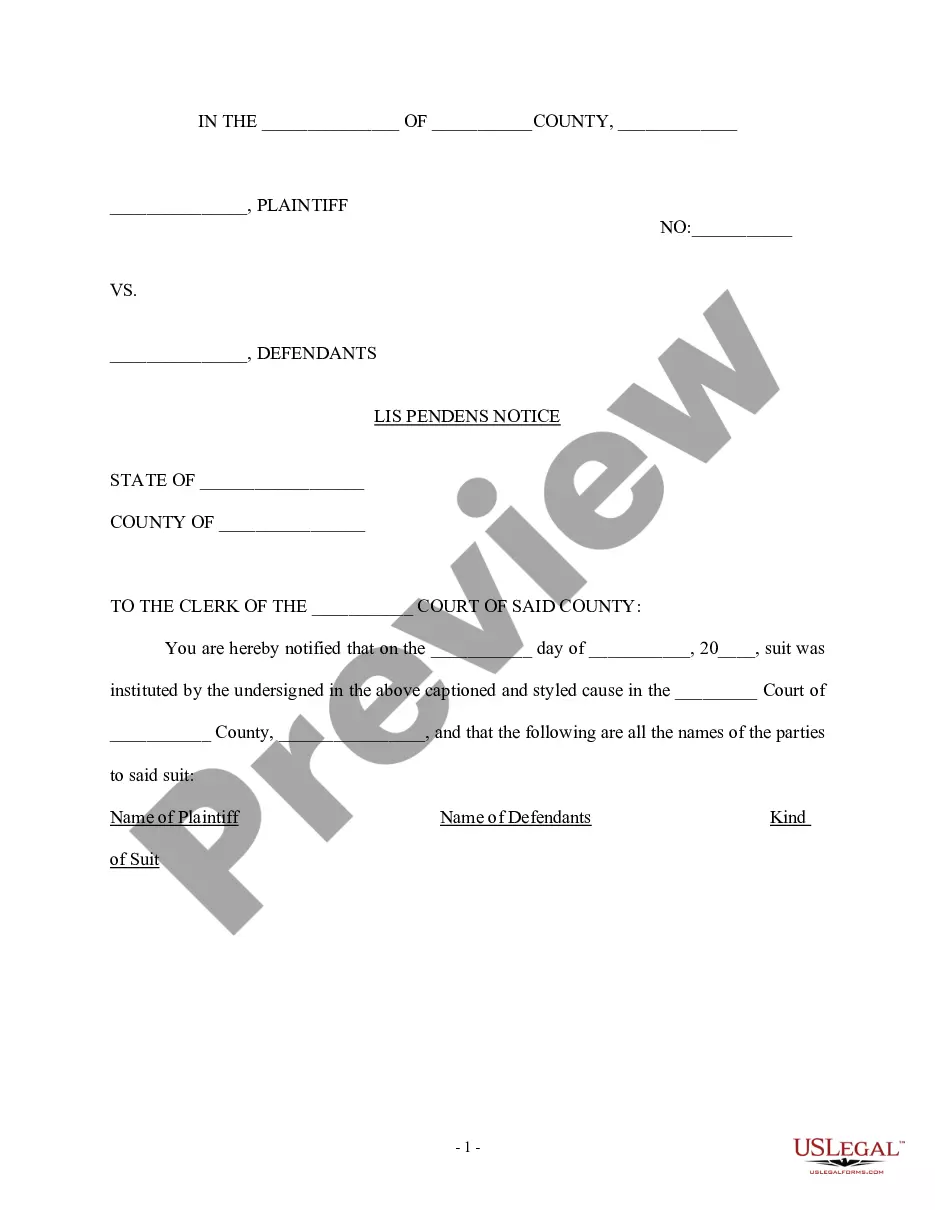
Filing Lis Pendens In Pa In Montgomery
Description

Get your form ready online
Our built-in tools help you complete, sign, share, and store your documents in one place.
Make edits, fill in missing information, and update formatting in US Legal Forms—just like you would in MS Word.
Download a copy, print it, send it by email, or mail it via USPS—whatever works best for your next step.
Sign and collect signatures with our SignNow integration. Send to multiple recipients, set reminders, and more. Go Premium to unlock E-Sign.
If this form requires notarization, complete it online through a secure video call—no need to meet a notary in person or wait for an appointment.
We protect your documents and personal data by following strict security and privacy standards.

Make edits, fill in missing information, and update formatting in US Legal Forms—just like you would in MS Word.

Download a copy, print it, send it by email, or mail it via USPS—whatever works best for your next step.

Sign and collect signatures with our SignNow integration. Send to multiple recipients, set reminders, and more. Go Premium to unlock E-Sign.

If this form requires notarization, complete it online through a secure video call—no need to meet a notary in person or wait for an appointment.

We protect your documents and personal data by following strict security and privacy standards.
Looking for another form?









Form popularity
FAQ
When is my court date? Contact your attorney or bondsman for the date and time of your court appearance. You can also search the court's docket by clicking here to search the District Clerk records.
Public access to case information is available in the Clerk of Courts' office during normal business hours: a.m. to p.m., Monday through Friday. Criminal history information is also available through Court records on the Pennsylvania Unified Judicial System website.
File the lien. Include the dollar amount, a 12-digit parcel number, and an address. File the waiver of liens with the property address or legal description. You must include the county, township, or borough where the work is being completed and the waiver must be signed by the contractor.
Records Search Montgomery County court cases may be searched online using keywords and/or case number, case type, filing type, filing date, and/or assigned judge or attorney. Copies of court records may be requested from the Clerk of Courts. Dane County court records may be accessed in several ways.
To obtain a judgment lien, you must first record the judgment with the court of common pleas in the county where the debtor owns property. The lien will stay in effect for five years, but can be renewed, if the debtor does not sell the property within that time period.
To file a lis pendens, the party filing must have or show one of two things: That there is a recorded instrument, usually some mortgage or encumbrance, or perhaps something related to a construction mechanics lien—that potentially provides the filer the right to the property on or in the document.
File the lien. Include the dollar amount, a 12-digit parcel number, and an address. File the waiver of liens with the property address or legal description. You must include the county, township, or borough where the work is being completed and the waiver must be signed by the contractor.
Steps to File a Valid Pennsylvania Mechanics Lien Send Preliminary Notice Within 30 Days. Send Pre-Lien Notice at Least 30 Days Before Filing. File Your Lien Claim at Prothonotary's Office. Serve Notice of Filing on the Owner. Start Suit to Enforce Lien Within Two Years. File a Lien Bond to Remove the Lien.
Anyone who didn't contract directly with the property owner on a private construction project in Pennsylvania needs to send a Notice of Intent to Lien (NOI) in order to secure their right to file a mechanics lien.
Recording a deed in Montgomery County is a two step process. First, bring the deed to the County Transfer/Recordation Tax Office located at: 27 Court House Square, Suite 200, Rockville, for processing. Second, visit the Courthouse at 50 Maryland Avenue, Rockville 2nd floor Recording Office.

