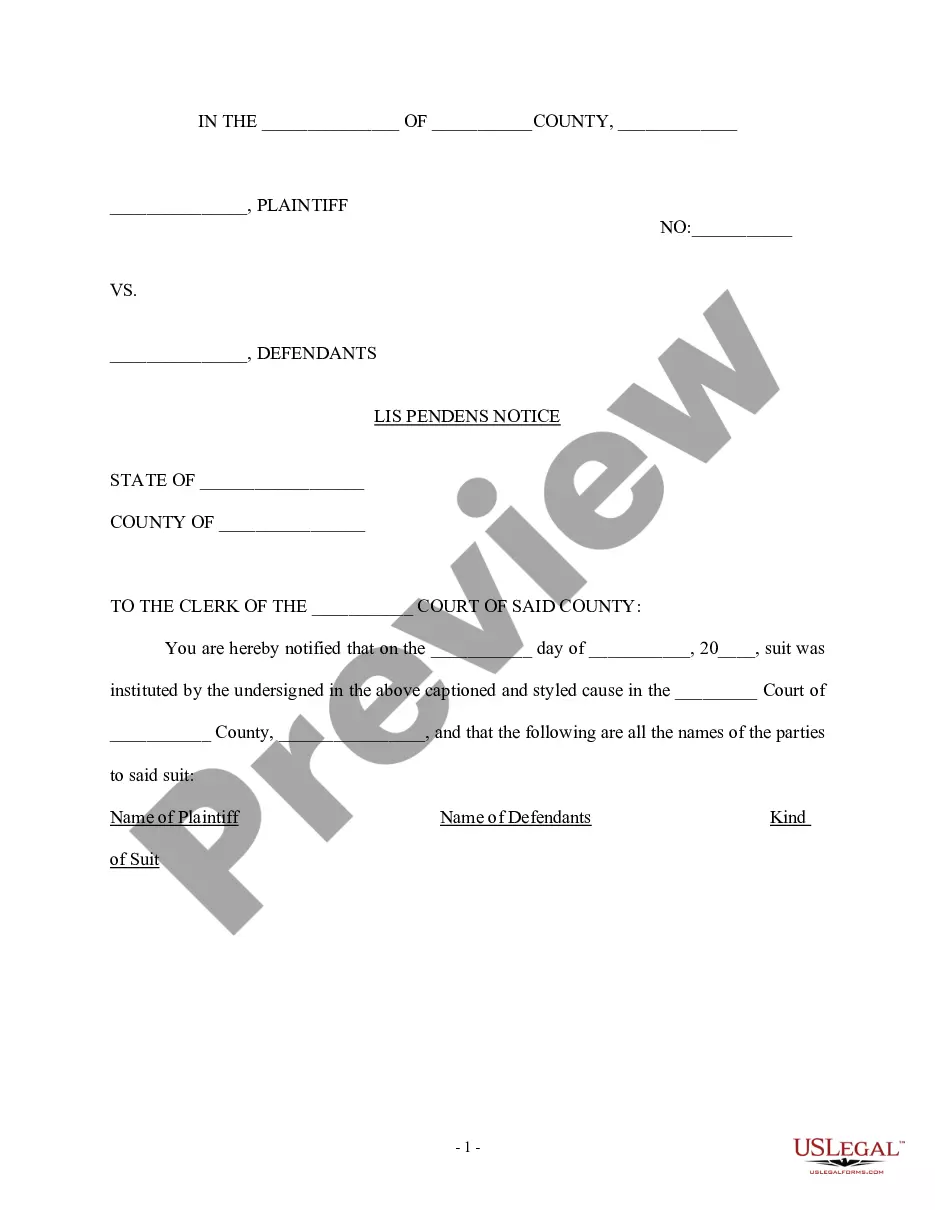
Lis Pendens In Missouri In Clark
Description

Get your form ready online
Our built-in tools help you complete, sign, share, and store your documents in one place.
Make edits, fill in missing information, and update formatting in US Legal Forms—just like you would in MS Word.
Download a copy, print it, send it by email, or mail it via USPS—whatever works best for your next step.
Sign and collect signatures with our SignNow integration. Send to multiple recipients, set reminders, and more. Go Premium to unlock E-Sign.
If this form requires notarization, complete it online through a secure video call—no need to meet a notary in person or wait for an appointment.
We protect your documents and personal data by following strict security and privacy standards.

Make edits, fill in missing information, and update formatting in US Legal Forms—just like you would in MS Word.

Download a copy, print it, send it by email, or mail it via USPS—whatever works best for your next step.

Sign and collect signatures with our SignNow integration. Send to multiple recipients, set reminders, and more. Go Premium to unlock E-Sign.

If this form requires notarization, complete it online through a secure video call—no need to meet a notary in person or wait for an appointment.

We protect your documents and personal data by following strict security and privacy standards.
Looking for another form?




Form popularity
FAQ
In Missouri, the lien claimant must file the mechanics lien with the clerk of the circuit court in the county in which the property is located – and provide the required preliminary notices. There is no requirement, however, that the lien be served on any party subsequent to its recording.
How Do You File a Quiet Title Lawsuit in Missouri? Section 527.150 of the Missouri Revised Statutes provides the statutory authority to file a quiet title suit. This process requires that the individual or entity filing the lawsuit file a petition with the circuit court of the county where the property is located.
Missouri law requires at least 10 years of continuous occupation before someone may claim a parcel of property. The basic parameters of Missouri's adverse possession law are detailed in the following table, followed by additional general information and links to related resources.
The requirements are as follows. The squatter must show proof that they have lived on the property for at least 10 years. The squatter must treat the property like the actual owner would. The squatter must live on the property exclusively. The residency of the squatter must be obvious.
Basic requirements for an adverse possession claim in Missouri Actual possession. Actual possession means squatters exercise full control over the property, treating the property as their own. Open and notorious possession. Exclusive possession. Hostile possession. Continuous possession.
Wait for the office to process your claim and receive your property. It's that simple remember toMoreWait for the office to process your claim and receive your property. It's that simple remember to check the database regularly as unclaimed property can be added at any time.
But, courts allow a maximum of 10 years to discover an injury. In cases involving wrongful death, Missouri typically gives a three-year window to file a lawsuit. The longest time limit, 10 years, is for civil suits related to fraud, rent collection, debt collection, and judgments.
Sign the lis pendens document in the presence of a notary. File the lis pendens with the courthouse in the county where the property is located. Serve a notice of the lis pendens on involved parties, such as the property owner, if required.
The titleholder can sell a property and transfer the deed to someone else while subject to a lis pendens. However, most title companies will not provide insurance for homes with a lis pendens, and closing agents may close with the lien being bonded.
Short Answer: After filing a lis pendens, property sales may stall due to legal disputes impacting the title. Misfiling can result in sanctions or slander of title damages. Removal involves court-ordered expungement or voluntary discharge.

