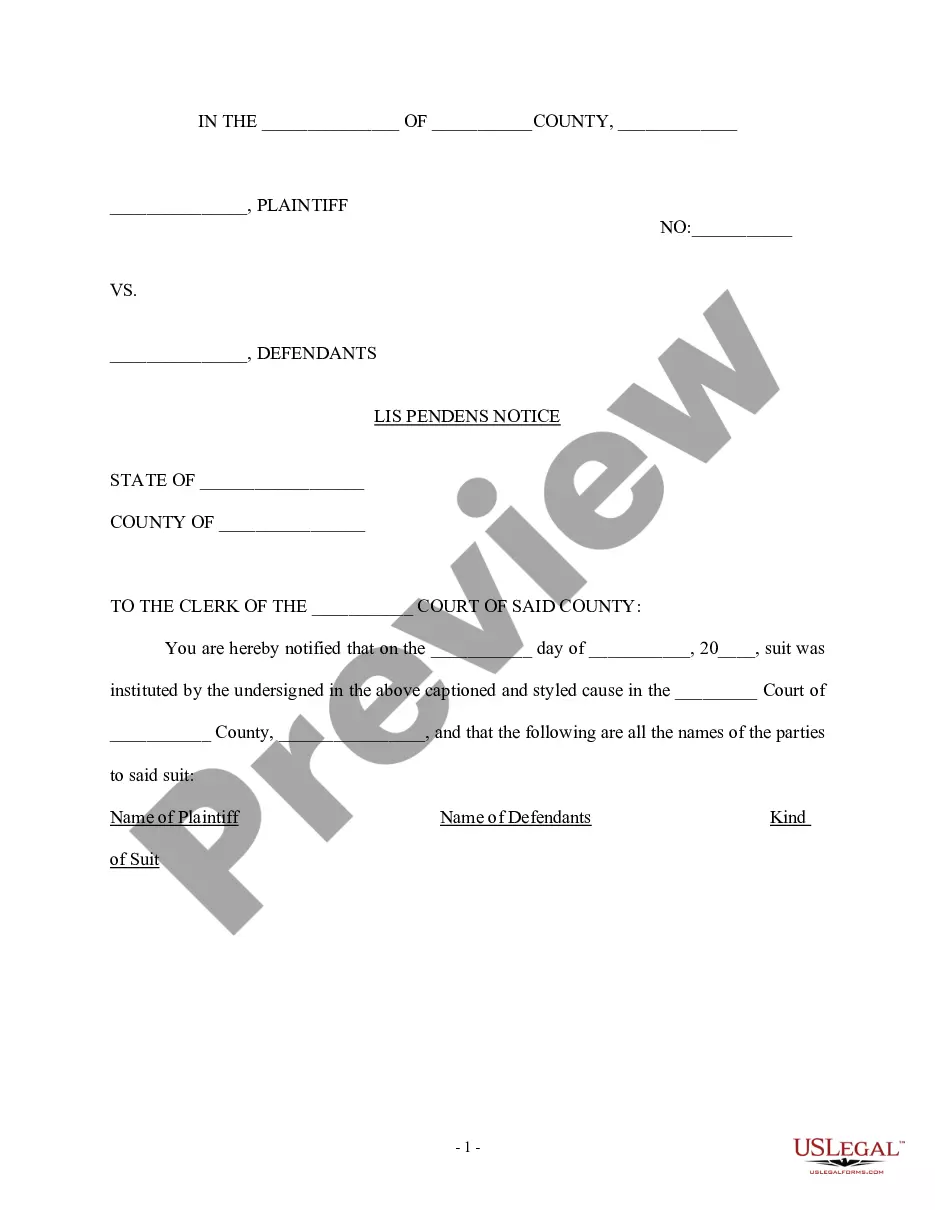
File Notice Lis Pendens Foreclosed In Chicago
Description

Get your form ready online
Our built-in tools help you complete, sign, share, and store your documents in one place.
Make edits, fill in missing information, and update formatting in US Legal Forms—just like you would in MS Word.
Download a copy, print it, send it by email, or mail it via USPS—whatever works best for your next step.
Sign and collect signatures with our SignNow integration. Send to multiple recipients, set reminders, and more. Go Premium to unlock E-Sign.
If this form requires notarization, complete it online through a secure video call—no need to meet a notary in person or wait for an appointment.
We protect your documents and personal data by following strict security and privacy standards.

Make edits, fill in missing information, and update formatting in US Legal Forms—just like you would in MS Word.

Download a copy, print it, send it by email, or mail it via USPS—whatever works best for your next step.

Sign and collect signatures with our SignNow integration. Send to multiple recipients, set reminders, and more. Go Premium to unlock E-Sign.

If this form requires notarization, complete it online through a secure video call—no need to meet a notary in person or wait for an appointment.

We protect your documents and personal data by following strict security and privacy standards.
Looking for another form?









Form popularity
FAQ
30 days after the confirmation of the foreclosure sale (see #8), the purchaser of the property has the right to take possession of the property and evict the tenants. After this point, the sheriff's office will evict the homeowner from they property if it is still occupied.
A judge in the Circuit Court of Cook County oversees the foreclosure process, which typically involves the lender filing a lawsuit against the homeowner for defaulting on the mortgage. If the Court finds in favor of the lender, it can result in the forced sale of the property to repay the outstanding mortgage debt.
Your house will be sold at a sheriff's foreclosure sale. Order confirming the sale of your property and order for eviction is entered. Order for eviction is stayed 30 days (giving you 30 days to move). Order of eviction goes to sheriff.
Eviction: Unless you vacate the property voluntarily, the new owner will obtain an eviction order and legally remove you 30 to 60 days after the confirmation hearing. If you were not listed as a party in the foreclosure complaint, the new owner may initiate a supplemental eviction proceeding to remove you.
At any time during the pendency of an action or proceeding initiated after July 1, 1959, which is constructive notice, the court, upon motion, may for good cause shown, provided a finding of specific performance is not necessary for final judgment in the action or proceeding, and upon such terms and conditions, ...
Foreclosure Complaint: In Illinois, the foreclosure process begins when a lender files a lawsuit against a homeowner after the 120-day pre-foreclosure period has ended.
In Illinois, it can take approximately 12-15 months for a foreclosure to be completed. Call your lender or a HUD-certified counseling agency as soon as you can.
Next, the lender schedules a sale with the Sheriff's Office. In most cases, there is a 30 to 90 day period after the Judgment of Foreclosure is signed by a judge, before the sale can be scheduled. This 30 to 90 day period is known as the redemption period.

