Patent Trademark Law For Scientists In Minnesota
Description





Form popularity
FAQ
How to register your trademark or service mark: Trademark Application pdf form can be found here. Submit one specimen or facsimile of the mark as you have actually used it in commerce. State the words or phrase to be registered, if any. Provide a written description of the logo design to be registered, if any.
The specification should be in conformity with the requirements of the Patents Act 1992 and Patents Rules 1992, typed or printed on single sided A4 pages with margins of 2 to 3 centimeters. These margins should be blank, and each page should be numbered. Two copies of the specification must be submitted.
How to register your trademark or service mark: Trademark Application pdf form can be found here. Submit one specimen or facsimile of the mark as you have actually used it in commerce. State the words or phrase to be registered, if any. Provide a written description of the logo design to be registered, if any.
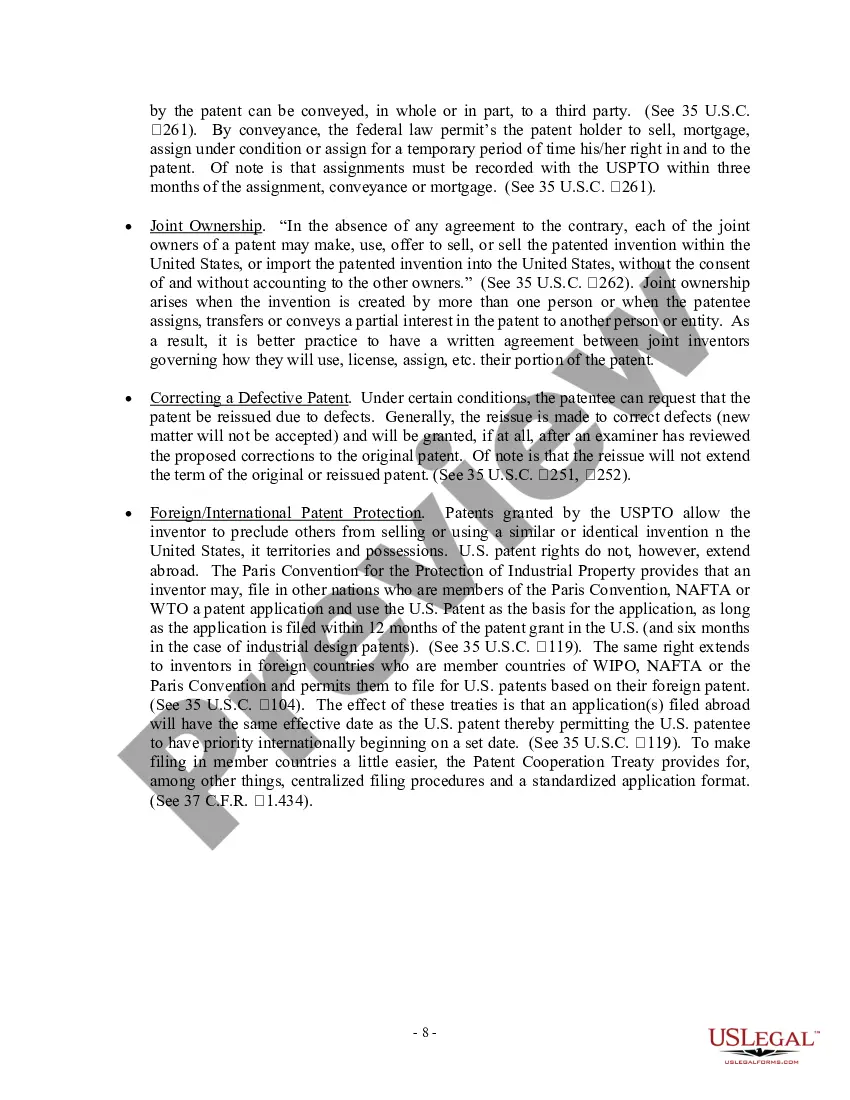
The five primary requirements for patentability are: (1) patentable subject matter; (2) utility; (3) novelty; (4) non-obviousness; and (5) enablement. Like trademarks, patents are territorial, meaning they are enforceable in a specific geographic area.
The Patent Process Determine the type of intellectual property you need. Determine if your invention is patentable. Determine what kind of patent you need. Get ready to apply. Submit your application. Work with your examiner. Receive your approval. Maintain your patent.
Trademark process Step 1: Is a trademark application right for you? ... Step 2: Get ready to apply. Step 3: Prepare and submit your application. Step 4: Work with the assigned USPTO examining attorney. Step 5: Receive approval/denial of your application. Step 6: Maintain your registration.
You do not necessarily need a trademark registration to operate in the US market, as you can do so freely. However, in case you're unknowingly copying another brand that holds rights to a trademark, they can reach out to you and ask you to stop operating in the US.
Patents serve a higher end—the advancement of science. An invention need not be as startling as an atomic bomb to be patentable. But it has to be of such quality and distinction that masters of the scientific field in which it falls will recognize it as an advance.” Id.
10 Presently, a person can invent ( create or produce for the first time) something new and obtain a patent on it, but simply to discover (find or find out) something, without creating or producing it for the first time, is unpatentable. 11 An invention is something new that is created. A discovery is something new.
Instead, patent attorneys aim to settle IP disputes outside of court through means such as cease and desist letters, opposition proceedings and revocation actions. Conversely, IP lawyers specialise in the legal and commercial issues that are associated with IP.
