Patent Use Can For Known Compound In Georgia
Description



Get your form ready online
Our built-in tools help you complete, sign, share, and store your documents in one place.
Make edits, fill in missing information, and update formatting in US Legal Forms—just like you would in MS Word.
Download a copy, print it, send it by email, or mail it via USPS—whatever works best for your next step.
Sign and collect signatures with our SignNow integration. Send to multiple recipients, set reminders, and more. Go Premium to unlock E-Sign.
If this form requires notarization, complete it online through a secure video call—no need to meet a notary in person or wait for an appointment.
We protect your documents and personal data by following strict security and privacy standards.

Make edits, fill in missing information, and update formatting in US Legal Forms—just like you would in MS Word.

Download a copy, print it, send it by email, or mail it via USPS—whatever works best for your next step.

Sign and collect signatures with our SignNow integration. Send to multiple recipients, set reminders, and more. Go Premium to unlock E-Sign.

If this form requires notarization, complete it online through a secure video call—no need to meet a notary in person or wait for an appointment.

We protect your documents and personal data by following strict security and privacy standards.
Looking for another form?




Form popularity
FAQ
What cannot be patented? a discovery, scientific theory or mathematical method, an aesthetic creation, a scheme, rule or method for performing a mental act, playing a game or doing business, or a computer program, a presentation of information,
The short answer is yes, in the US a new use for an existing product that is ``new, useful, and non-obvious'' (as the patent law requires/defines) may be patented. That is, a new use may not be precluded from being patented simply because it is a new use for an existing product.
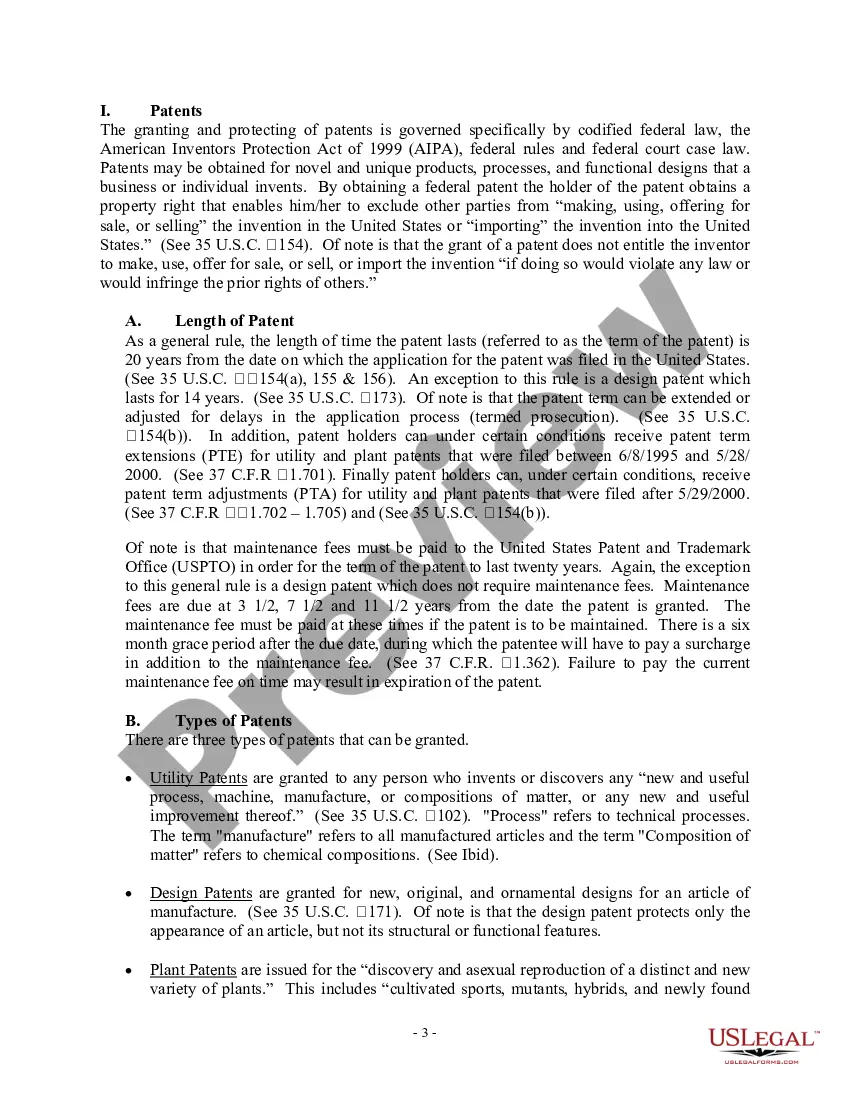
In the United States, there are three types of patents, all governed by the U.S. Patent and Trademark Office (USPTO): utility, design, and plant. Chemical patents can protect chemical compounds, compositions of matter, methods of making the chemical compound or composition, and methods of use.
Yes, You Can Patent Food Products! Companies in the food and beverage industry might overlook significant advantages by not patenting their innovations. While there's a common belief that “recipes” cannot be patented, unique formulations and other aspects of food and beverage products often can be.