Patent Trademark Law With Engineering Degree In Cook
Description




Get your form ready online
Our built-in tools help you complete, sign, share, and store your documents in one place.
Make edits, fill in missing information, and update formatting in US Legal Forms—just like you would in MS Word.
Download a copy, print it, send it by email, or mail it via USPS—whatever works best for your next step.
Sign and collect signatures with our SignNow integration. Send to multiple recipients, set reminders, and more. Go Premium to unlock E-Sign.
If this form requires notarization, complete it online through a secure video call—no need to meet a notary in person or wait for an appointment.
We protect your documents and personal data by following strict security and privacy standards.

Make edits, fill in missing information, and update formatting in US Legal Forms—just like you would in MS Word.

Download a copy, print it, send it by email, or mail it via USPS—whatever works best for your next step.

Sign and collect signatures with our SignNow integration. Send to multiple recipients, set reminders, and more. Go Premium to unlock E-Sign.

If this form requires notarization, complete it online through a secure video call—no need to meet a notary in person or wait for an appointment.

We protect your documents and personal data by following strict security and privacy standards.
Looking for another form?








Form popularity
FAQ
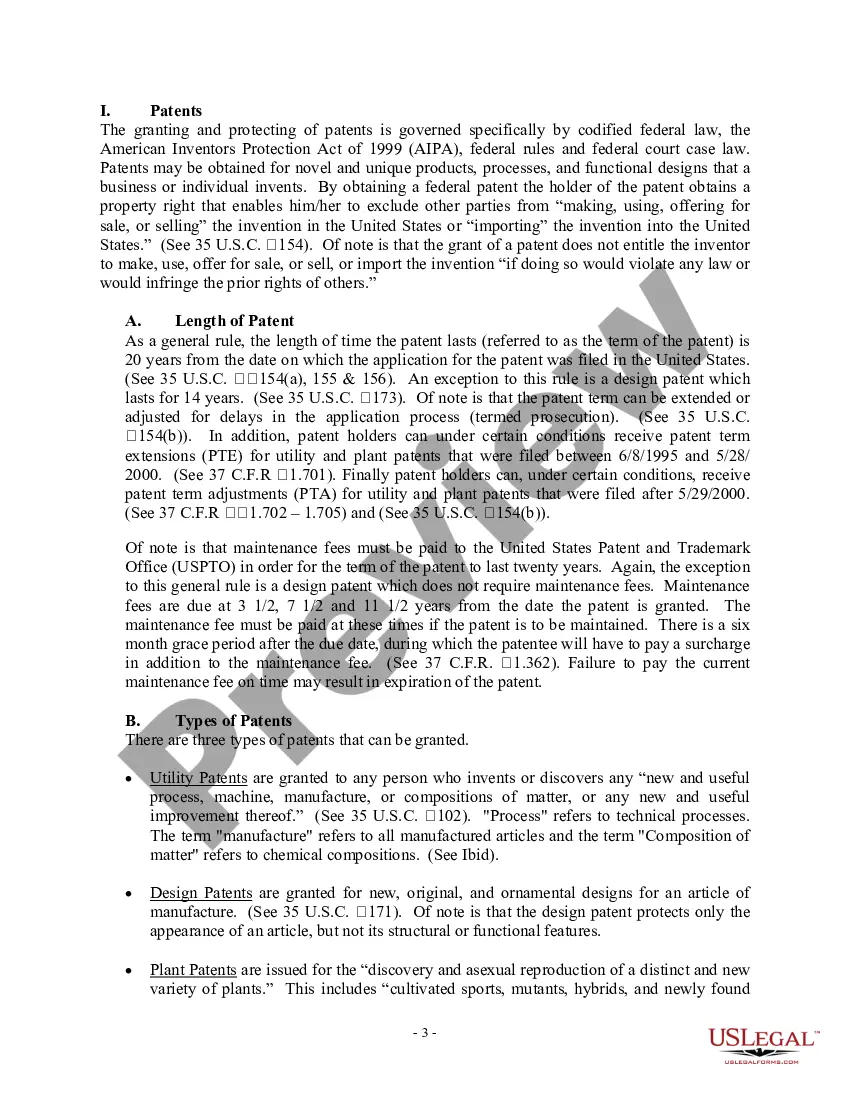
Patents protect inventions. They are administered by the United States Patent & Trademark Office and last up to twenty years from date of filing.
There are three types of patents: Utility, Design, and Plant. Most engineers will file for a Design Patent.
If you do pursue a bachelor's degree in engineering, you should take courses in mathematics, physics, chemistry, computer science, engineering, economics, business, and accounting. Students who choose to focus on IP law tend to go directly to law school after earning their bachelor's degree.
A patent engineer or patent scientist is a patent professional who is typically involved in preparing and prosecuting patent applications.
Analysis of data on the 10% of the engineers who have received patents also suggests variation in patent activity by sized Engineers in medium sized firms generate the most inventions and more inventions come from the electrical, machinery and metals industries.
But patents do a lot more than that patents serve a lot of functions. But each of those functions isMoreBut patents do a lot more than that patents serve a lot of functions. But each of those functions is useful to the working engineer.
In summary: Chemical engineering is a great major for patent attorneys. It covers a lot of the bases, including bio/chemical engineering, but it is not limited to those areas. You will find that you work on a variety of patents, not just electronics or biotech products.
A basic requirement for registration in the Swiss registry of Patent Attorneys is a recognised university diploma in engineering or natural science. The minimum requirements for these studies essentially correspond to those for the European qualifying procedure.
Patents are granted to inventions that are novel (new) and non-obvious. If an inventor believes their invention is new, they must first conduct a prior art search before they apply for a patent. "Prior art" pertains to any previous mention of the technology or device in the public domain.
