Patent Trademark Law For Engineers And Scientists Nptel In Chicago
Description





Form popularity
FAQ
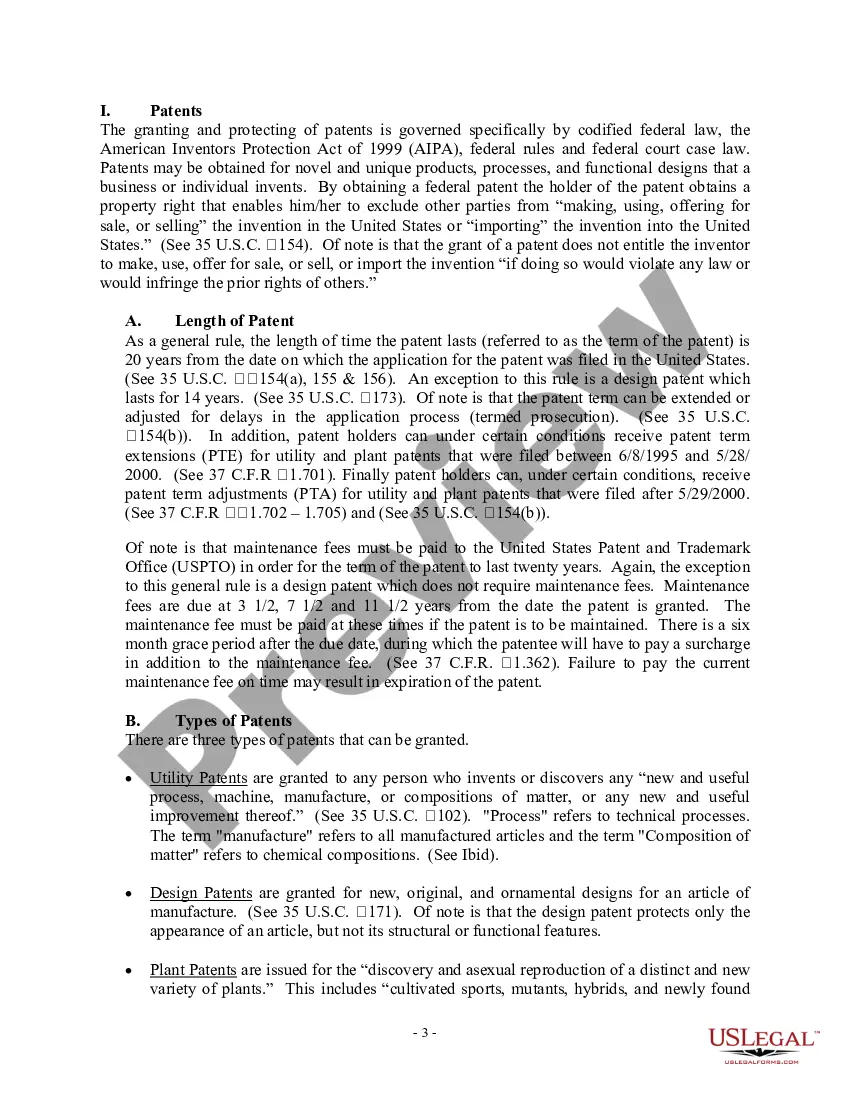
Explore the different types of patents: utility, provisional, design, and plant patents. Patents are legal protections granted for various types of inventions, ensuring inventors exclusive rights to their creations.
Some firms may prioritize practical experience and knowledge of patent law over academic credentials. In short, a PhD can enhance your qualifications, it's not always necessary, and other combinations of education and experience may also be sufficient to pursue these roles.
In summary: Chemical engineering is a great major for patent attorneys. It covers a lot of the bases, including bio/chemical engineering, but it is not limited to those areas. You will find that you work on a variety of patents, not just electronics or biotech products.
In fact, you may transition into patent law with as little as a bachelor's degree in science (e.g., physics, engineering, math, chemistry, biochemistry, cell biology, genetics, biology). But a PhD is desirable, especially in the life sciences/chemistry, and the more technical expertise you have, the better.
Although obtaining a law degree is not essential after your PhD, it is recommended, and all patent agents must pass rigorous qualifying exams. Further down the road, training in patent law offers opportunities for in-house work in biotech companies, business development, and mergers and acquisitions.
You'll first need to complete a science, engineering, or technical degree (usually 4 years), followed by law school to earn a Juris Doctor (JD) degree (about 3 years). After that, you must pass the state bar exam and the USPTO registration exam (also known as the patent bar).
You'll first need to complete a science, engineering, or technical degree (usually 4 years), followed by law school to earn a Juris Doctor (JD) degree (about 3 years). After that, you must pass the state bar exam and the USPTO registration exam (also known as the patent bar).
The detailed description should provide clear support or antecedent basis for all terms used in the claims so that the meaning of the claim terms in the claims may be ascertainable by reference to the description. It can be helpful to draft your claims first.
The written description requirement requires an inventor to write down how to make and use (i.e., enablement requirement) the invention. The written description includes the text and the drawings. By doing so, after the patent expires, the patent can be used to teach the public how to implement the invention.
The specification should be in conformity with the requirements of the Patents Act 1992 and Patents Rules 1992, typed or printed on single sided A4 pages with margins of 2 to 3 centimeters. These margins should be blank, and each page should be numbered. Two copies of the specification must be submitted.
