Patent In Trademark In Chicago
Description




Get your form ready online
Our built-in tools help you complete, sign, share, and store your documents in one place.
Make edits, fill in missing information, and update formatting in US Legal Forms—just like you would in MS Word.
Download a copy, print it, send it by email, or mail it via USPS—whatever works best for your next step.
Sign and collect signatures with our SignNow integration. Send to multiple recipients, set reminders, and more. Go Premium to unlock E-Sign.
If this form requires notarization, complete it online through a secure video call—no need to meet a notary in person or wait for an appointment.
We protect your documents and personal data by following strict security and privacy standards.

Make edits, fill in missing information, and update formatting in US Legal Forms—just like you would in MS Word.

Download a copy, print it, send it by email, or mail it via USPS—whatever works best for your next step.

Sign and collect signatures with our SignNow integration. Send to multiple recipients, set reminders, and more. Go Premium to unlock E-Sign.

If this form requires notarization, complete it online through a secure video call—no need to meet a notary in person or wait for an appointment.

We protect your documents and personal data by following strict security and privacy standards.
Looking for another form?








Form popularity
FAQ
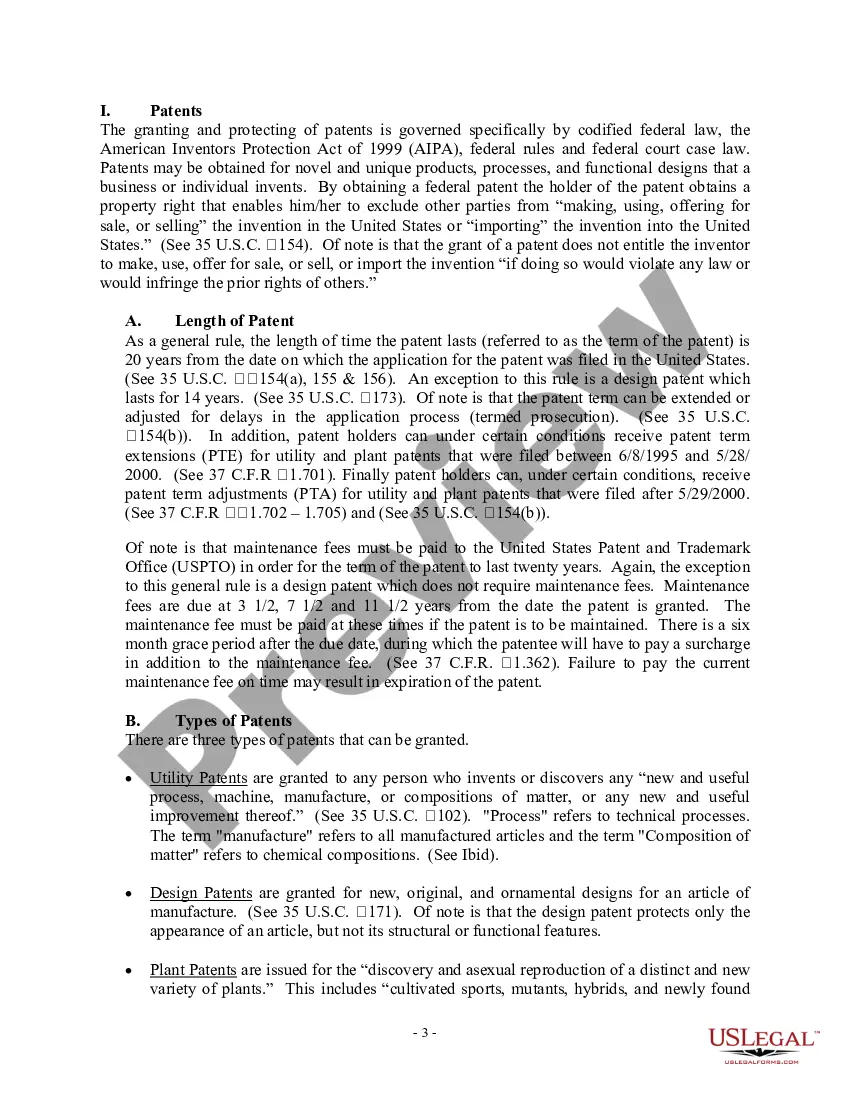
Patents are intended to protect inventions of a functional or design nature. Trademarks provide protection for indicators of the source of products and services used in commercial trade, such as words or logos. Copyrights provide protection for literary and artistic expressions.
The Coca-Cola Corp owns the trademark to the name Coca-Cola, as well as the trademark on the bottle shape, and the graphic representation of their name. These are all things that help distinguish them from other cola brands and define their individual product. Coca-Cola also owns the patent on their formula.
Before we dive in, here's a quick overview on patents and copyrights: a patent protects inventions and designs, like engines or a phone casing, and a copyright protects original artistic and literary works, like songs or books.
Chicago Manual of Style Name of patent. Country of patent. Patent number, filed (month date, year), and issued (month date, year).
You can have both a trademark and a patent, though they won't be for exactly the same thing. A trademark can protect a creation's name, for example, and a patent can protect the actual creation itself.
Understanding the different types of intellectual property is an important knowledge that all in-house counsel should master. Patents, trademarks, copyrights, and trade secrets are valuable assets of the company and understanding how they work and how they are created is critical to knowing how to protect them.
For example, the laws of nature, physical phenomena, and abstract ideas cannot be patented, nor can only an idea or suggestion. Other restrictions include the patenting of inventions exclusively related to nuclear material or atomic energy in an atomic weapon (see MPEP 2104.01).
Whether a trademark or a patent is better for you depends on what type of intellectual property you are aiming to protect. As mentioned above, trademarks protect portions of a company's branding and consumer recognition whereas a patent protects an inventor's right to their creation.
Length of Protection: Patents are granted for a limited time (typically 20 years), while trademarks can last indefinitely if used continuously and maintained properly. Who They Protect: Patents protect the rights of inventors, while trademarks protect the reputation and goodwill of a business.
Trademark/Servicemark Publications/Forms Form NumberForm NameFee TM/SM 15 Trademark or Servicemark Application $10 TM/SM 30 Trademark or Servicemark Renewal Application $5 TM/SM 35a Trademark or Servicemark Assignment Application $5 TM/SM 35b Trademark or Servicemark Application for Change of Name and/or Address of Registrant $51 more row
