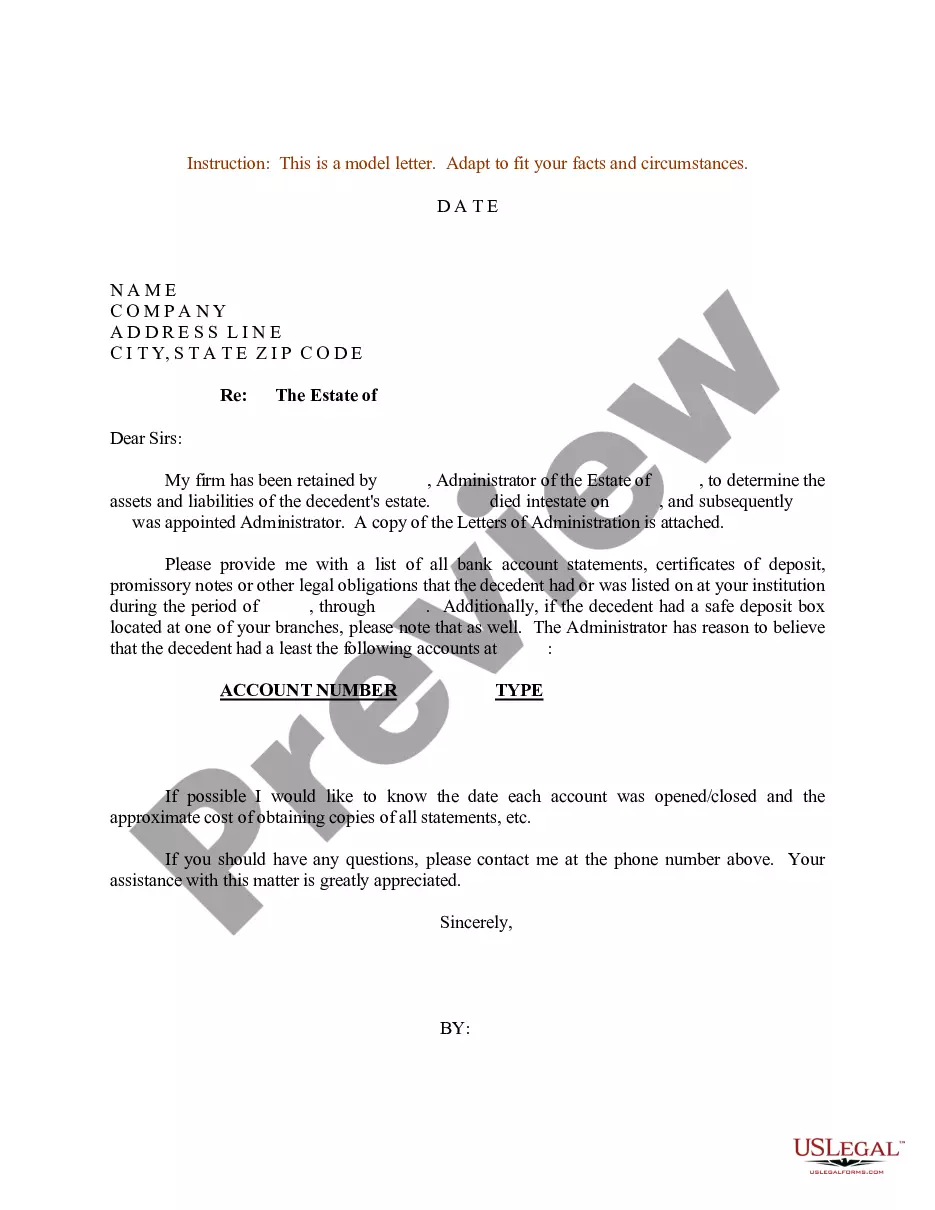
Sample Letter To Bank For Death Of Account Holder In English In Texas
Description




Get your form ready online
Our built-in tools help you complete, sign, share, and store your documents in one place.
Make edits, fill in missing information, and update formatting in US Legal Forms—just like you would in MS Word.
Download a copy, print it, send it by email, or mail it via USPS—whatever works best for your next step.
Sign and collect signatures with our SignNow integration. Send to multiple recipients, set reminders, and more. Go Premium to unlock E-Sign.
If this form requires notarization, complete it online through a secure video call—no need to meet a notary in person or wait for an appointment.
We protect your documents and personal data by following strict security and privacy standards.

Make edits, fill in missing information, and update formatting in US Legal Forms—just like you would in MS Word.

Download a copy, print it, send it by email, or mail it via USPS—whatever works best for your next step.

Sign and collect signatures with our SignNow integration. Send to multiple recipients, set reminders, and more. Go Premium to unlock E-Sign.

If this form requires notarization, complete it online through a secure video call—no need to meet a notary in person or wait for an appointment.

We protect your documents and personal data by following strict security and privacy standards.
Looking for another form?



Form popularity
FAQ
Certain types of bank accounts (called payable on death or POD accounts) allow the account holder to designate one or more beneficiaries. This allows the funds to be transferred to the beneficiaries after death without court involvement.
The next of kin must notify their banks of the death when an account holder dies. This is usually done by delivering a certified copy of the death certificate to the bank, along with the deceased's name and Social Security number, bank account numbers, and other information.
Start the letter with your introduction and the reason for writing the letter. Moreover, request the bank manager to settle the deceased account. Additionally, you have to provide details like account numbers and other documents. Signature – Use “Faithfully” or “Sincerely” as signatures and then mention your name.
In Texas, your bank accounts could be subject to probate, or they might bypass the process entirely if you've made the right arrangements. If you've named a beneficiary or set up a Payable-on-Death (POD) account, those funds can often be transferred directly to your heirs without going through probate.
They must notify the bank about the death by furnishing death certificate, ID proof, and account details (if they know).
The deceased person is likely to have ongoing standing orders and direct debits, so it's best to notify these organisations of the death as soon as possible to avoid receiving letters demanding outstanding payments.
