Sample Letter To Close Trust Account With Bank In Ohio
Description




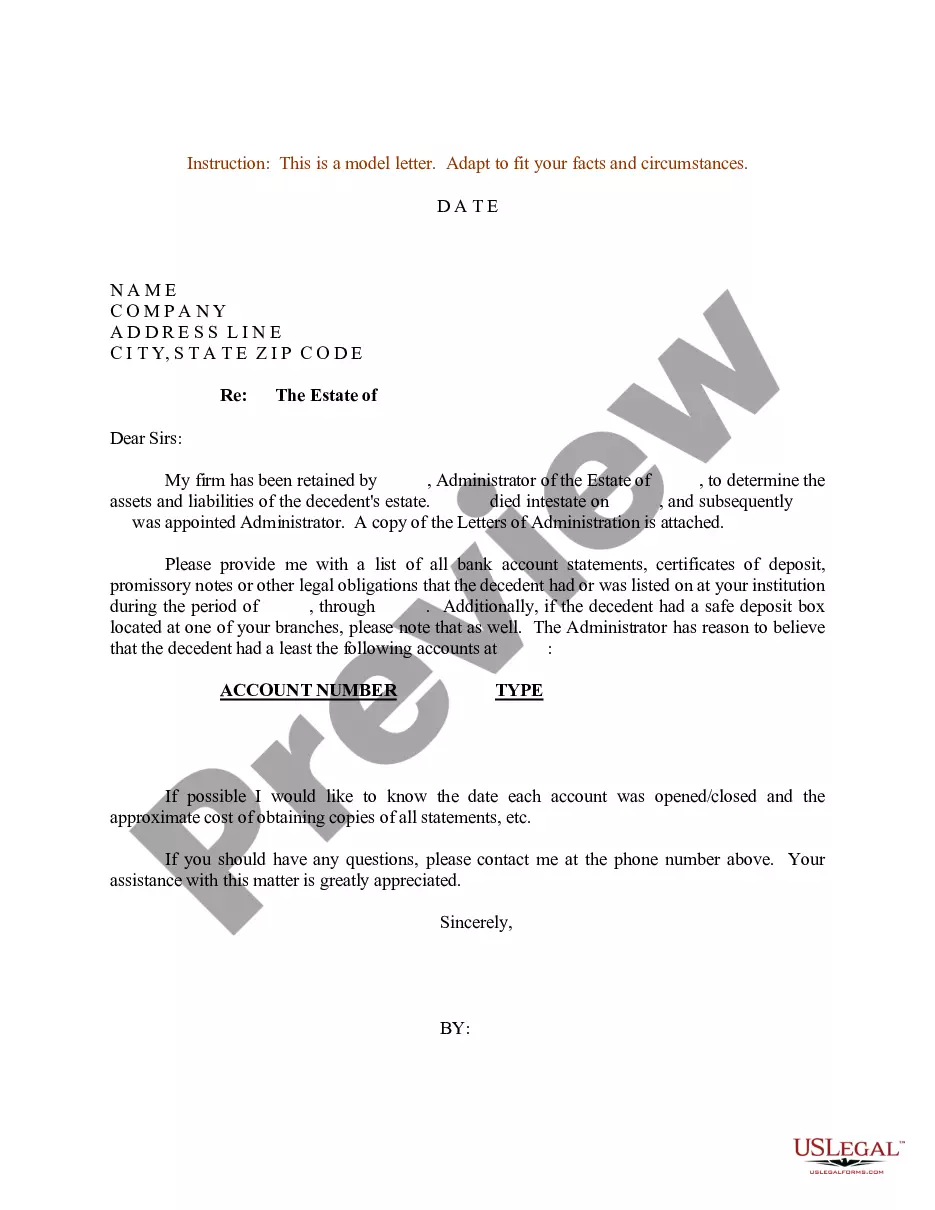
Get your form ready online
Our built-in tools help you complete, sign, share, and store your documents in one place.
Make edits, fill in missing information, and update formatting in US Legal Forms—just like you would in MS Word.
Download a copy, print it, send it by email, or mail it via USPS—whatever works best for your next step.
Sign and collect signatures with our SignNow integration. Send to multiple recipients, set reminders, and more. Go Premium to unlock E-Sign.
If this form requires notarization, complete it online through a secure video call—no need to meet a notary in person or wait for an appointment.
We protect your documents and personal data by following strict security and privacy standards.

Make edits, fill in missing information, and update formatting in US Legal Forms—just like you would in MS Word.

Download a copy, print it, send it by email, or mail it via USPS—whatever works best for your next step.

Sign and collect signatures with our SignNow integration. Send to multiple recipients, set reminders, and more. Go Premium to unlock E-Sign.

If this form requires notarization, complete it online through a secure video call—no need to meet a notary in person or wait for an appointment.

We protect your documents and personal data by following strict security and privacy standards.
Looking for another form?










Form popularity
FAQ
There are several methods for terminating trusts in Ohio, termination by court order, termination via private agreement, and termination by discretionary distribution.
I am writing to request the closure of my bank account with the number (Account Number). I would like this account to be closed effective immediately. Please transfer any remaining balance to my new account at (New Bank Name and Account Details). Kindly confirm the closure of the account in writing.
Irrevocable Trusts in Ohio. Ohio law mandates that a grantor be a legal adult and of sound mind when creating the terms of the trust. You must indicate your intent to establish a trust, name a beneficiary and a trustee, and then assign duties to this fiduciary.
A common goal is to avoid "probate." Assets within a "living trust" will generally not be subject to the jurisdiction of the probate court, either while the grantor is living or following the grantor's death. Assets owned in individual name and not contractually payable on death will generally be subject to probate.
(E) A trust is not invalid because a person, including, but not limited to, the creator of the trust, is or may become the sole trustee and the sole holder of the present beneficial enjoyment of the corpus of the trust, provided that one or more other persons hold a vested, contingent, or expectant interest relative to ...
Selecting the wrong trustee is easily the biggest blunder parents can make when setting up a trust fund. As estate planning attorneys, we've seen first-hand how this critical error undermines so many parents' good intentions.
Respected Sir/Madam, I am writing to you with a heavy heart to inform you of the demise of my husband, Mr. Rajeev Singh, who had a savings account in your esteemed bank. It is a difficult time for our family, and I need to settle his financial affairs.
The execution of a valid trust requires that the settlor have capacity and intent to create a trust, the trust must have a definite beneficiary, and a trustee must be designated and given duties to perform. A trust does not need to be witnessed or notarized.
Contact your old bank: With your funds safely transferred, reach out to your old bank to inform them of your decision to close the account. You can typically do this via a formal letter, a visit to the branch, or in some cases, through an online process.
(B) A noncharitable irrevocable trust may be terminated upon consent of all of the beneficiaries if the court concludes that continuance of the trust is not necessary to achieve any material purpose of the trust.
