Decedent Account Bank Format In Los Angeles
Description




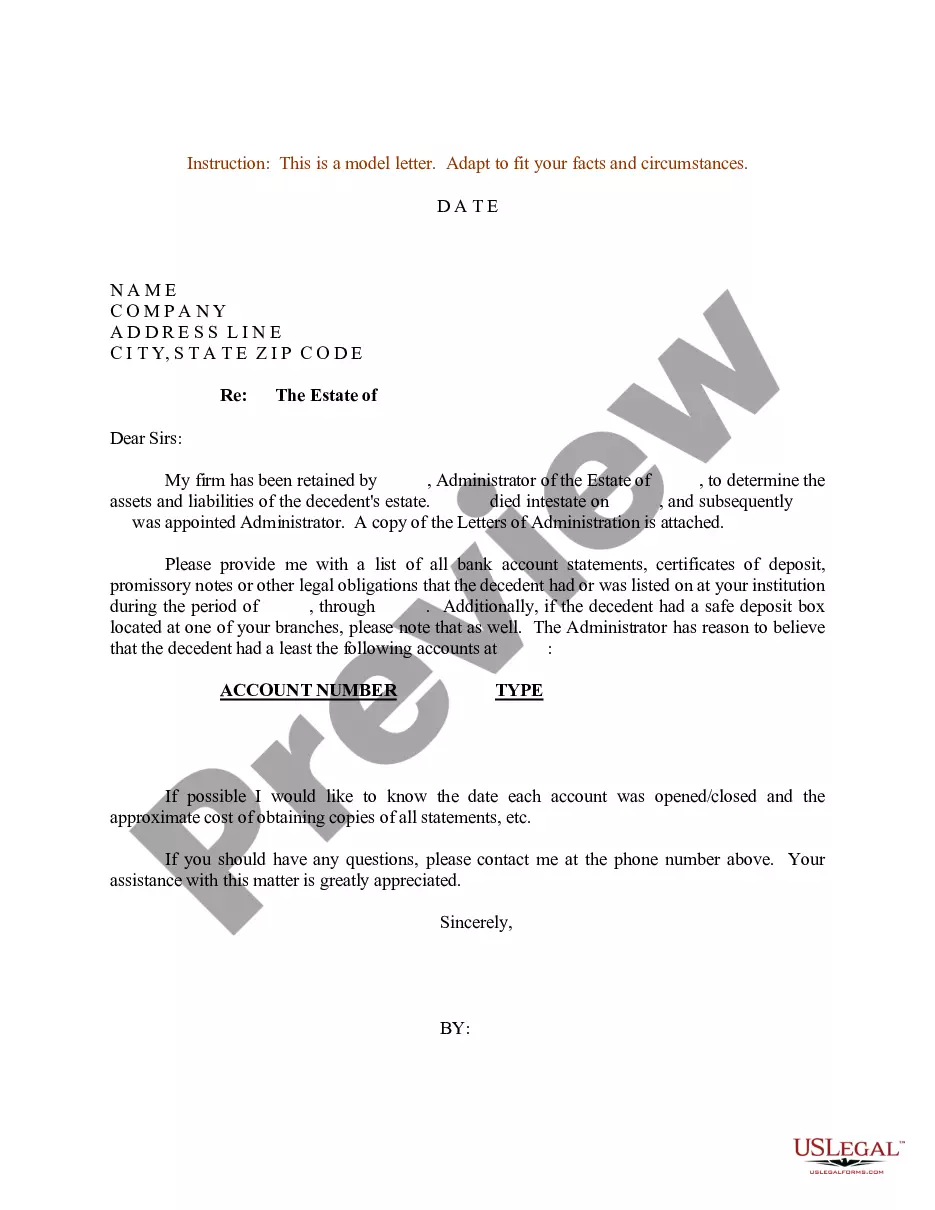
Get your form ready online
Our built-in tools help you complete, sign, share, and store your documents in one place.
Make edits, fill in missing information, and update formatting in US Legal Forms—just like you would in MS Word.
Download a copy, print it, send it by email, or mail it via USPS—whatever works best for your next step.
Sign and collect signatures with our SignNow integration. Send to multiple recipients, set reminders, and more. Go Premium to unlock E-Sign.
If this form requires notarization, complete it online through a secure video call—no need to meet a notary in person or wait for an appointment.
We protect your documents and personal data by following strict security and privacy standards.

Make edits, fill in missing information, and update formatting in US Legal Forms—just like you would in MS Word.

Download a copy, print it, send it by email, or mail it via USPS—whatever works best for your next step.

Sign and collect signatures with our SignNow integration. Send to multiple recipients, set reminders, and more. Go Premium to unlock E-Sign.

If this form requires notarization, complete it online through a secure video call—no need to meet a notary in person or wait for an appointment.

We protect your documents and personal data by following strict security and privacy standards.
Looking for another form?



Form popularity
FAQ
Once you've been appointed executor or personal representative by the probate court, you'll probably want to open a bank account in the name of the estate. Usually, an account for an estate is registered in this or a similar way: "Estate of Gerald S. Smith, Deceased, Pamela S. Smith, executor."
Typically, a beneficiary can claim the proceeds from a payable-on-death account—sometimes called a “POD” account—by going to the bank with a death certificate and proof of identification.
It's best to open an estate account with the decedent's bank in the state where they lived.
How to open an estate account Step 1: Begin the probate process. The steps for beginning this process depend on the state in which the deceased person resided. Step 2: Obtain a tax ID number for the estate account. Step 3: Bring all required documents to the bank. Step 4: Open the estate account.
They generally will need to present to the bank with a certified copy of the decedent's death certificate, their own government-issued ID, and the trust instrument (or a certification of trust) in order for the asset to be released to them, although the documentation needed can vary from bank to bank, so it is best to ...
Six Steps of the Probate Process Step 1: File a petition to begin probate. You'll have to file a request in the county where the deceased person lived at the time of their death. Step 2: Give notice. Step 3: Inventory assets. Step 4: Handle bills and debts. Step 5: Distribute remaining assets. Step 6: Close the estate.
Once you've been appointed as the personal representative of a loved one's estate, you should open an estate checking account. An estate checking account serves as a temporary account to manage the estate's financial affairs.
The executor of the estate needs to follow these basic steps. Step 1: Begin the probate process. Step 2: Obtain a tax ID number for the estate account. Step 3: Bring all required documents to the bank. Step 4: Open the estate account.
Typically, it's best to open an estate account with the same financial institution the decedent used in the same state where they resided. Since the decedent was already a member of that bank, it can make for a more seamless transition and provide easier access to all their accounts and estate funds.
They generally will need to present to the bank with a certified copy of the decedent's death certificate, their own government-issued ID, and the trust instrument (or a certification of trust) in order for the asset to be released to them, although the documentation needed can vary from bank to bank, so it is best to ...
