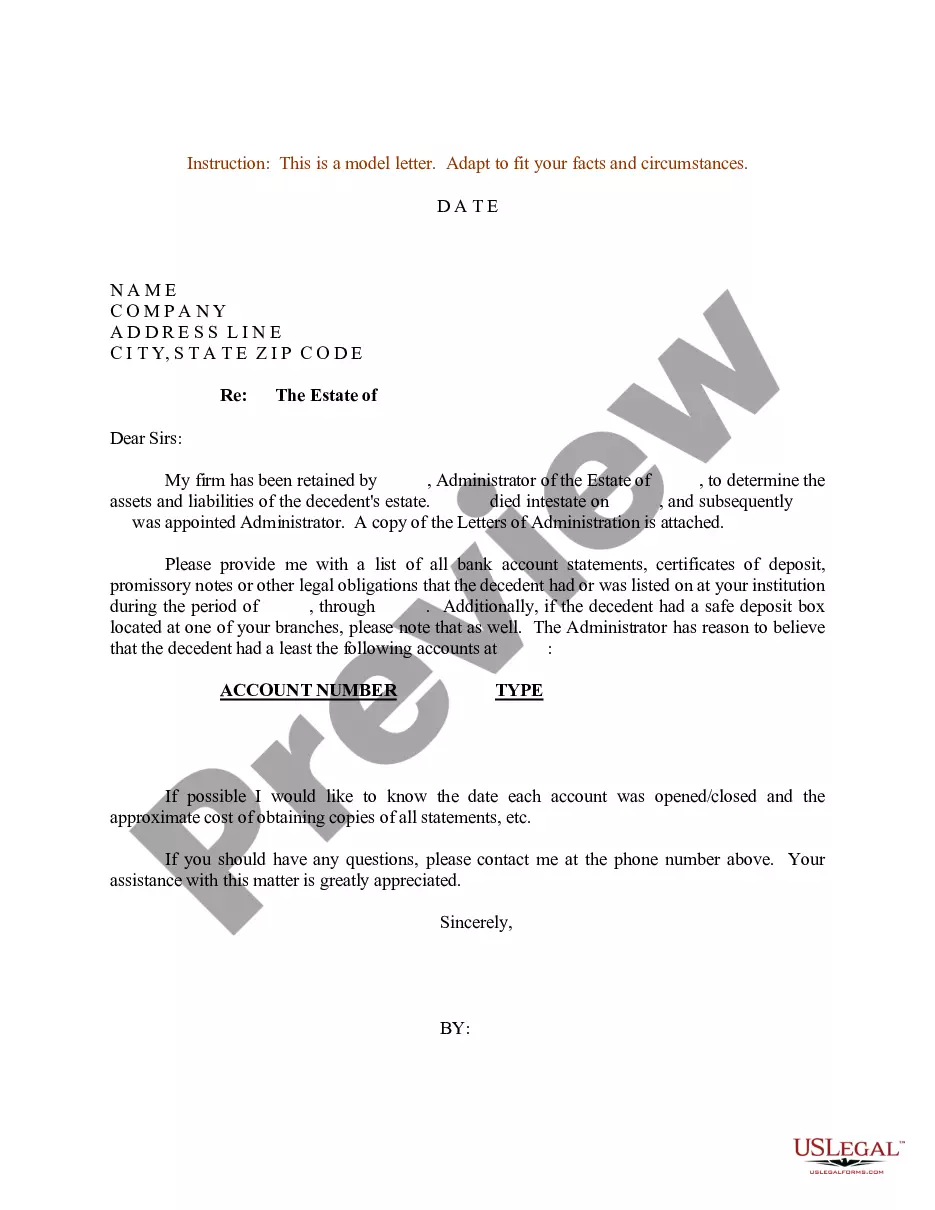
Decedent Account Bank Format In Cuyahoga
Description




Get your form ready online
Our built-in tools help you complete, sign, share, and store your documents in one place.
Make edits, fill in missing information, and update formatting in US Legal Forms—just like you would in MS Word.
Download a copy, print it, send it by email, or mail it via USPS—whatever works best for your next step.
Sign and collect signatures with our SignNow integration. Send to multiple recipients, set reminders, and more. Go Premium to unlock E-Sign.
If this form requires notarization, complete it online through a secure video call—no need to meet a notary in person or wait for an appointment.
We protect your documents and personal data by following strict security and privacy standards.

Make edits, fill in missing information, and update formatting in US Legal Forms—just like you would in MS Word.

Download a copy, print it, send it by email, or mail it via USPS—whatever works best for your next step.

Sign and collect signatures with our SignNow integration. Send to multiple recipients, set reminders, and more. Go Premium to unlock E-Sign.

If this form requires notarization, complete it online through a secure video call—no need to meet a notary in person or wait for an appointment.

We protect your documents and personal data by following strict security and privacy standards.
Looking for another form?








Form popularity
FAQ
These include: Bank accounts. Retirement accounts. Stocks and bonds. Some life insurance policies. Real estate. Motor vehicles, such as cars, motorcycles, and RVs. Personal property, such as jewelry and household furnishings.
Probate ensures that, after death, assets are divided per the decedent's will or, if there isn't a will, with the laws of intestacy. In Ohio, assets owned solely by the deceased sometimes require the probate process.
Summary release from the administration: Avoids probate entirely if either: The estate's worth less than $40,000 and the surviving spouse is the sole heir. The estate's worth less than $5,000 and/or the decedent's final expenses total no more than $5,000.
A: An exemption from probate in California is not limited to individual asset amounts. To avoid probate, the total for the calculable assets must be below $166,250. If the total assets are greater than this number, then the estate must go through the probate process.
If you're the executor for your recently deceased spouse, you may think you don't need an estate account, especially if you have joint accounts. But it may still be a good idea, since it makes it easier to keep the estate's funds and your own funds separate.
However, the court system does not require an attorney in order for a Will to be probated. You especially don't need an attorney if you are the only beneficiary of the estate, the estate's property only contains common assets, and the Will itself is simple and straightforward to follow.
How to open an estate account Step 1: Begin the probate process. The steps for beginning this process depend on the state in which the deceased person resided. Step 2: Obtain a tax ID number for the estate account. Step 3: Bring all required documents to the bank. Step 4: Open the estate account.
Visit Banks in Their Area You will need to provide documentation to prove both that the account holder died and you have the legal authority (as a designated beneficiary, joint account holder or executor/administrator) to access the account.
You must be a designated beneficiary or joint account owner on the accounts, or your parents should have specifically devised the accounts to go to you in their will or trust. You may also be entitled to inherit them by way of intestate succession if your parents died without a will.
How to open an estate account Step 1: Begin the probate process. The steps for beginning this process depend on the state in which the deceased person resided. Step 2: Obtain a tax ID number for the estate account. Step 3: Bring all required documents to the bank. Step 4: Open the estate account.
