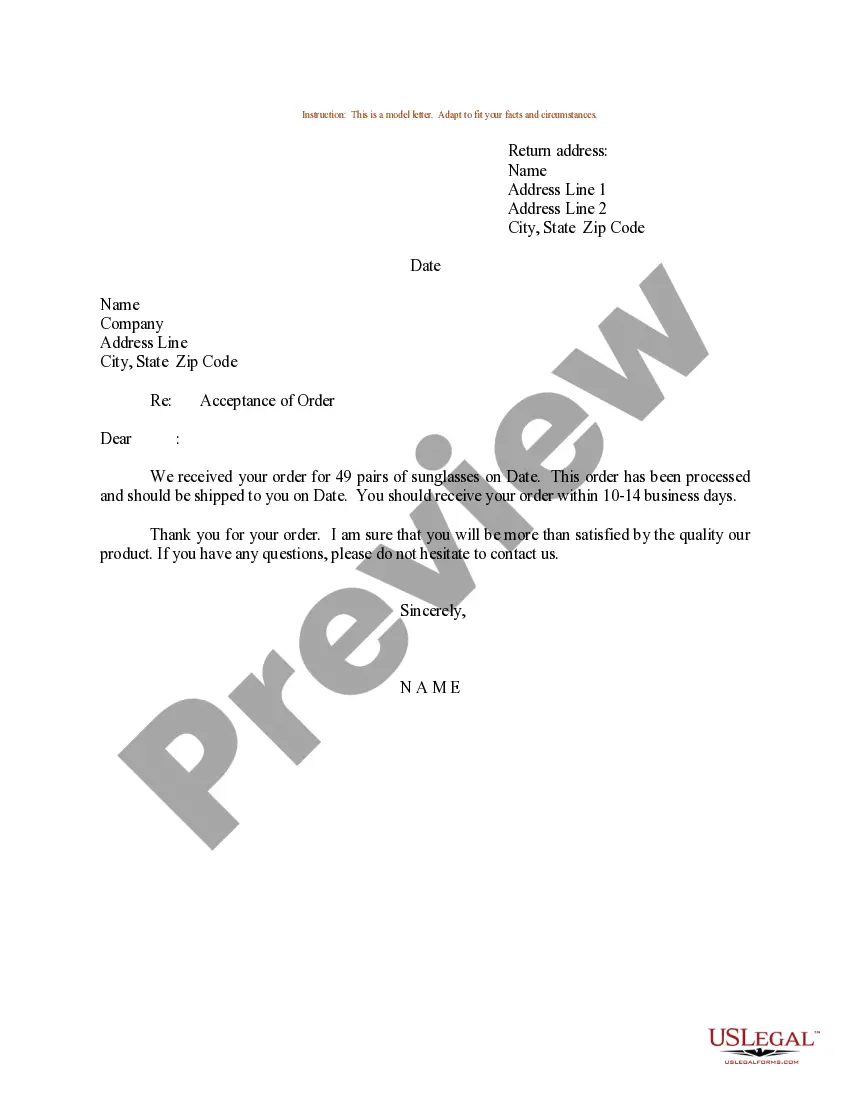
Sample Acceptance Order With Early Release In Arizona
Description

Get your form ready online
Our built-in tools help you complete, sign, share, and store your documents in one place.
Make edits, fill in missing information, and update formatting in US Legal Forms—just like you would in MS Word.
Download a copy, print it, send it by email, or mail it via USPS—whatever works best for your next step.
Sign and collect signatures with our SignNow integration. Send to multiple recipients, set reminders, and more. Go Premium to unlock E-Sign.
If this form requires notarization, complete it online through a secure video call—no need to meet a notary in person or wait for an appointment.
We protect your documents and personal data by following strict security and privacy standards.

Make edits, fill in missing information, and update formatting in US Legal Forms—just like you would in MS Word.

Download a copy, print it, send it by email, or mail it via USPS—whatever works best for your next step.

Sign and collect signatures with our SignNow integration. Send to multiple recipients, set reminders, and more. Go Premium to unlock E-Sign.

If this form requires notarization, complete it online through a secure video call—no need to meet a notary in person or wait for an appointment.

We protect your documents and personal data by following strict security and privacy standards.
Looking for another form?





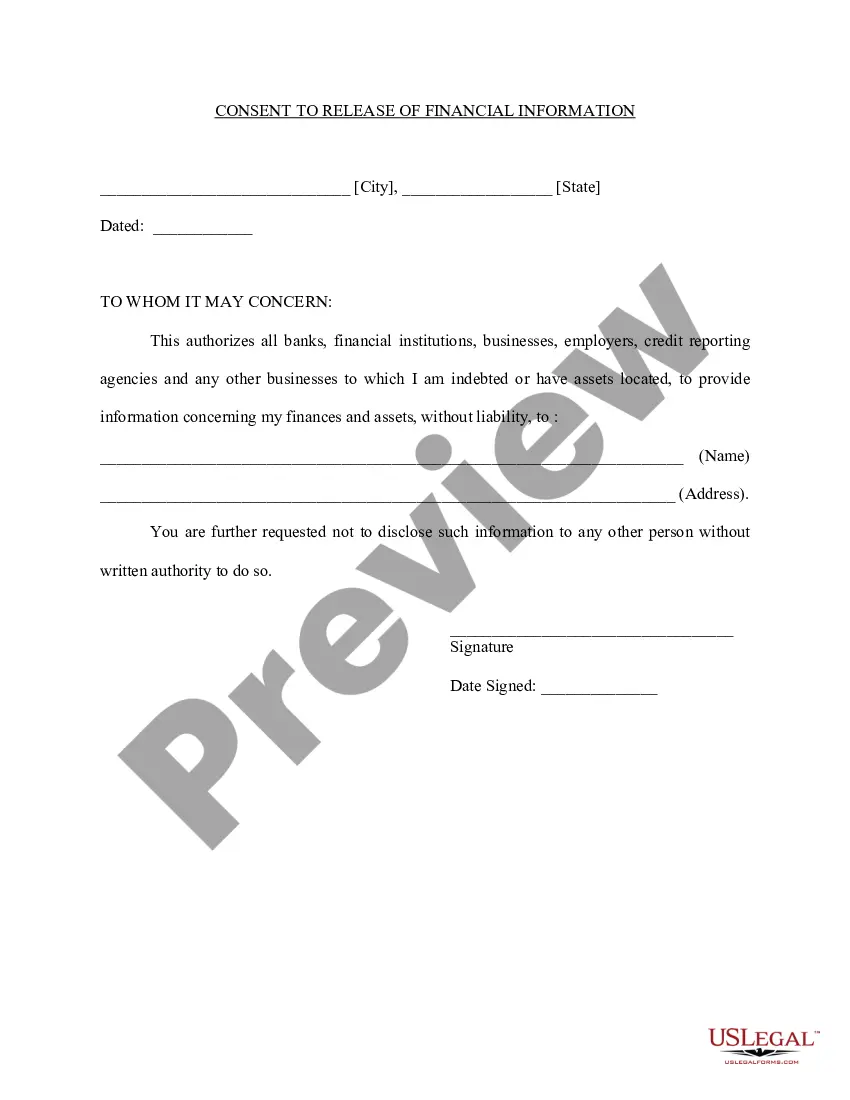

Form popularity
FAQ
Under specific rules established by the director for the selection of inmates, the director may also authorize furlough, temporary removal or temporary release of any inmate for compassionate leave, for the purpose of furnishing to the inmate medical treatment not available at the prison or institution, for purposes ...
Final answer: The responsibility for deciding whether an inmate receives early release lies with the Parole Board. They assess factors such as the inmate's reintegration potential and the risks to society. Other authorities like judges and prison wardens do not have direct control over parole decisions.
Inmates MAY be released 90 days prior to a designated released date. All inmates eligible for a TR or CSBD may be granted at the discretion of the Director of ADC and it must be approved by the Community Corrections Division. It is granted for the purpose of preparing inmates to return to the community.
RUMOR: Arizona has passed a law to allow sentences to be 50% for non-violent offenders and 65% for violent offenders. TRUTH: No, no such law has passed.
A compassionate release letter should include a statement of intent, reference to the specific provision under which the inmate is applying, an explanation of how the inmate meets the criteria, supporting background information, and a release plan. Examples of successful letters can provide valuable guidance.
Early in its history, Arizona adopted the doctrine of prior appropriation to govern the use of surface water. This doctrine is based on the tenet of “first in time, first in right” which means the person who first puts the water to a beneficial use acquires a right that is senior to later appropriators of the water.
Temporary release programs refer to programs which allow release of a prisoner from the place of his/her imprisonment for a limited period.