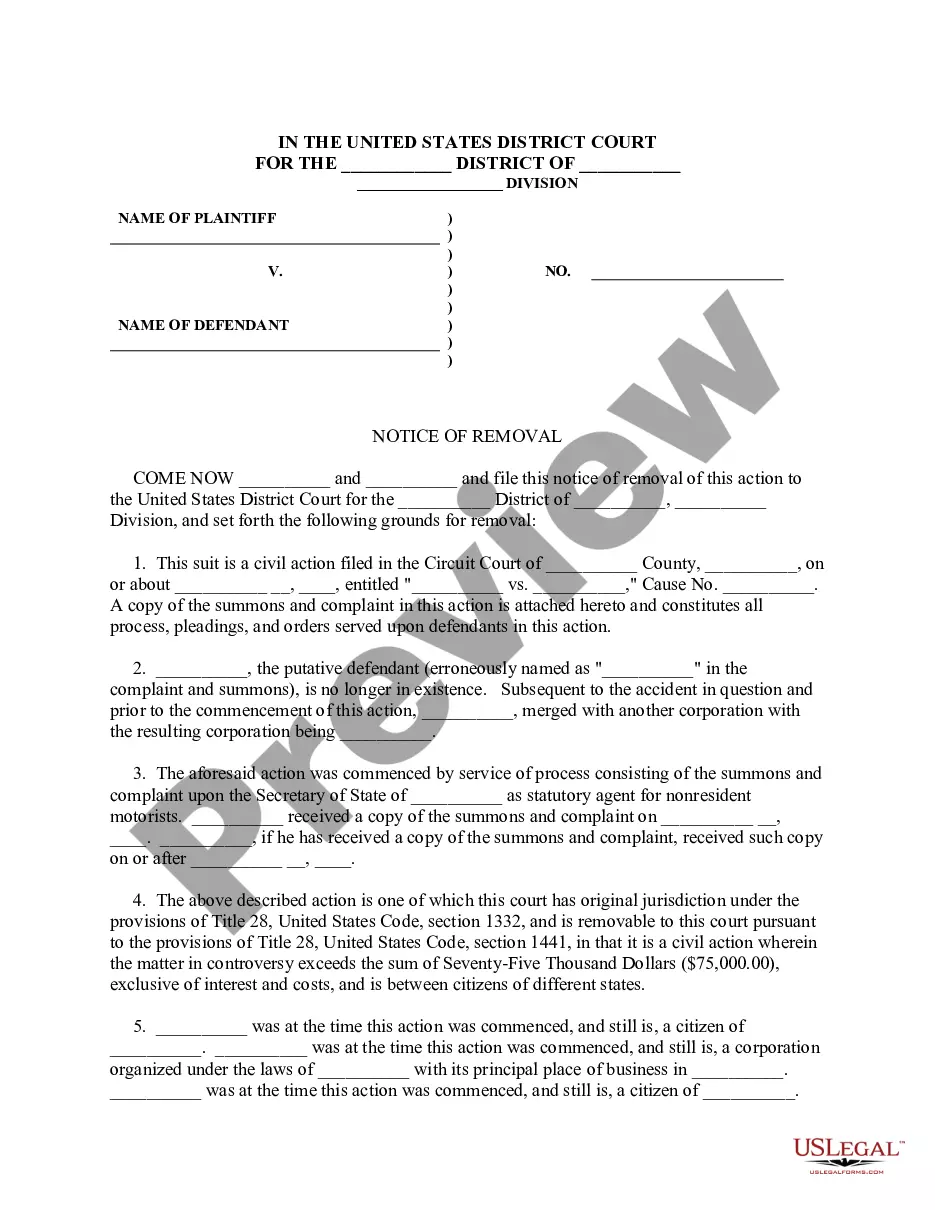
Notice Of Removal Template With Signature Required In North Carolina
Description
Get your form ready online
Our built-in tools help you complete, sign, share, and store your documents in one place.
Make edits, fill in missing information, and update formatting in US Legal Forms—just like you would in MS Word.
Download a copy, print it, send it by email, or mail it via USPS—whatever works best for your next step.
Sign and collect signatures with our SignNow integration. Send to multiple recipients, set reminders, and more. Go Premium to unlock E-Sign.
If this form requires notarization, complete it online through a secure video call—no need to meet a notary in person or wait for an appointment.
We protect your documents and personal data by following strict security and privacy standards.

Make edits, fill in missing information, and update formatting in US Legal Forms—just like you would in MS Word.

Download a copy, print it, send it by email, or mail it via USPS—whatever works best for your next step.

Sign and collect signatures with our SignNow integration. Send to multiple recipients, set reminders, and more. Go Premium to unlock E-Sign.

If this form requires notarization, complete it online through a secure video call—no need to meet a notary in person or wait for an appointment.

We protect your documents and personal data by following strict security and privacy standards.
Looking for another form?
Form popularity
FAQ
Service upon the attorney or upon a party shall be made by delivering a copy to the attorney or party or by mailing it to the attorney or party at the attorney's or party's last known address or, if no address is known, by leaving it with the clerk of the court.
A4: Under Rule 2.1 of the General Rules of Practice for the Superior and District Courts, the Chief Justice of the Supreme Court of North Carolina has discretion to designate any case as an “exceptional” or “complex business” case.
Rule 5. Service and filing of pleadings and other papers. (a) Service of orders, subsequent pleadings, discovery papers, written motions, written notices, and other similar papers - When required.
Rule 3. Commencement of action. (a) A civil action is commenced by filing a complaint with the court. The clerk shall enter the date of filing on the original complaint, and such entry shall be prima facie evidence of the date of filing.
Rule 5(d) is amended to provide that disclosures under Rule 26(a)(1) and (2), and discovery requests and responses under Rules 30, 31, 33, 34, and 36 must not be filed until they are used in the action. “Discovery requests” includes deposition notices and “discovery responses” includes objections.
The notice of removal of a civil action or proceeding shall be filed within 30 days after the receipt by the defendant, through service or otherwise, of a copy of the initial pleading setting forth the claim for relief upon which such action or proceeding is based, or within 30 days after the service of summons upon ...
– On motion and upon such terms as are just, the court may relieve a party or his legal representative from a final judgment, order, or proceeding for the following reasons: (1) Mistake, inadvertence, surprise, or excusable neglect; (2) Newly discovered evidence which by due diligence could not have been discovered in ...
No attorney who has entered an appearance in any civil or criminal action shall be permitted to withdraw an appearance, or have it stricken from the record, except on order of the Court or when the attorney has provided notice of substitution of counsel by an attorney who is a member of the withdrawing attorney's law ...
Generally, removal jurisdiction exists only if, at the time plaintiff filed the action in state court, the federal court had a basis for exercising subject-matter jurisdiction over the action, such as diversity of citizenship of the parties or where plaintiff's action involves a claim under federal law.