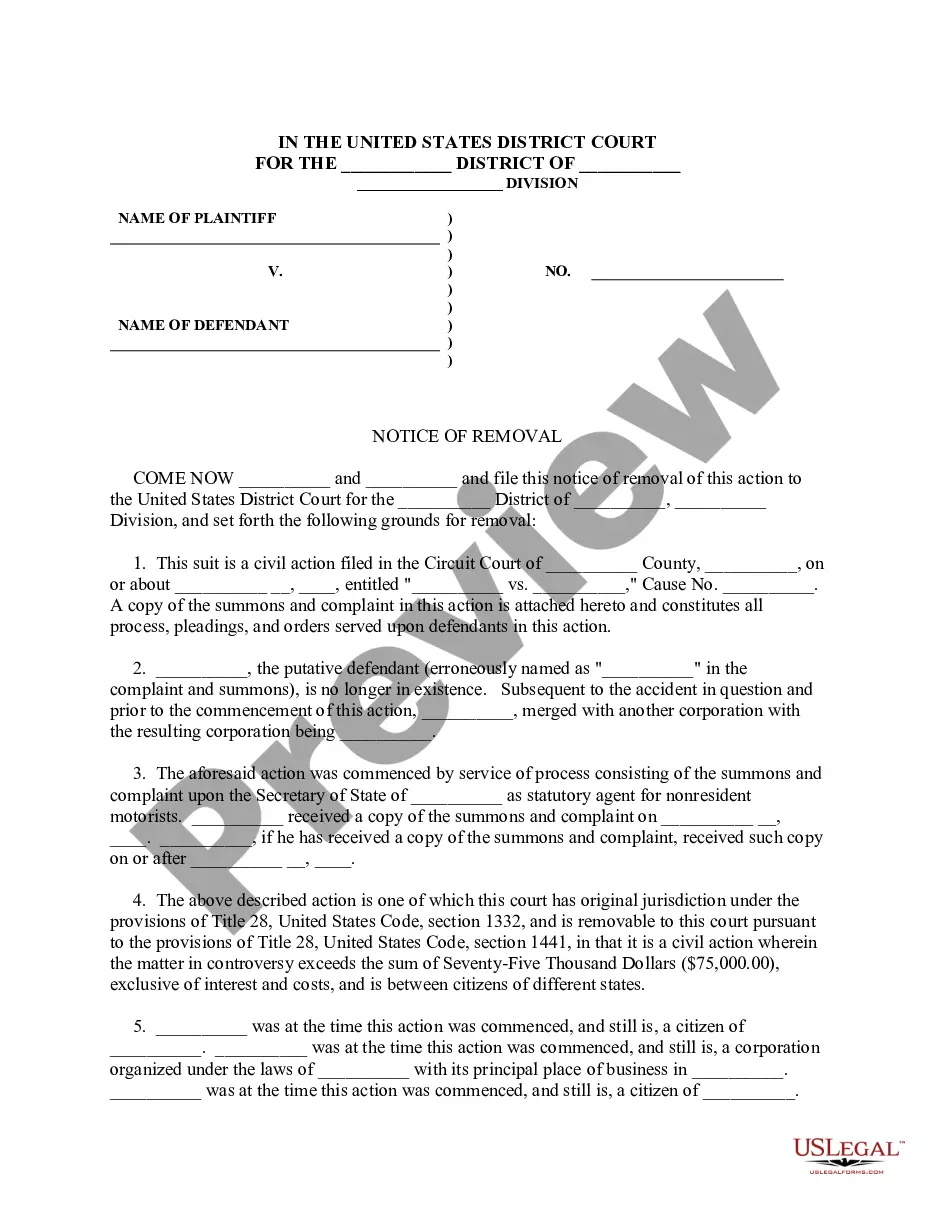
Notice Of Removal Template Foreclosure In Nevada
Description
Get your form ready online
Our built-in tools help you complete, sign, share, and store your documents in one place.
Make edits, fill in missing information, and update formatting in US Legal Forms—just like you would in MS Word.
Download a copy, print it, send it by email, or mail it via USPS—whatever works best for your next step.
Sign and collect signatures with our SignNow integration. Send to multiple recipients, set reminders, and more. Go Premium to unlock E-Sign.
If this form requires notarization, complete it online through a secure video call—no need to meet a notary in person or wait for an appointment.
We protect your documents and personal data by following strict security and privacy standards.

Make edits, fill in missing information, and update formatting in US Legal Forms—just like you would in MS Word.

Download a copy, print it, send it by email, or mail it via USPS—whatever works best for your next step.

Sign and collect signatures with our SignNow integration. Send to multiple recipients, set reminders, and more. Go Premium to unlock E-Sign.

If this form requires notarization, complete it online through a secure video call—no need to meet a notary in person or wait for an appointment.

We protect your documents and personal data by following strict security and privacy standards.
Looking for another form?




Form popularity
FAQ
The safest way to remove a guest from your property is to use the court process. There are several reasons why it may be a bad idea to use self-help eviction to remove a guest from your home. You may be risking your personal safety if the guest becomes angry or violent during or after the eviction.
If the person refuses to leave, you may need to take legal action. Depending on the laws in your area, you may need to go through a formal eviction process. This will involve filing a lawsuit and going to court to get a judge to order the person to leave your property.
How can I stop the foreclosure proceedings? One way to temporarily halt the foreclosure proceedings is to request mediation through Nevada's Foreclosure Mediation program. You can also file a Chapter 13 bankruptcy if you have the ability to enter into a payment plan to cure default.
Overview. There is a Nevada law that protects a tenant who is renting a home that is foreclosed upon and sold. NRS 40.255 requires the new owner after foreclosure to serve the tenant with a notice of change of ownership. The tenant can stay on the property for the period of the notice, which is typically sixty days.
Cause Termination Notice to Vacate 1st can be used when a tenant is not bound by a lease. In most cases, this type of notice requires a minimum of 30 days for the first notice and 5 judicial days for the second notice. Refer to NRS 40.251 for additional information on no cause evictions.
A notice to vacate is written when either party decides to end the relationship (for a good or bad reason or none at all). An eviction requires court action to remove the tenant from the property.
As such, you can terminate this tenancy by giving written notice of at least 30 days. If they do not leave voluntarily, under Nevada law, you will then need to give a 5-Day Notice to Quit... meaning they must vacate the premises within that period or face formal eviction.
A person who takes up residence in an uninhabited or vacant dwelling and knows or has reason to believe that such residency is without permission of the owner of the dwelling or an authorized representative of the owner is guilty of unlawful occupancy.
If you have not moved within the 3 days (not including court holidays and weekends), then the new owner must file with the court for eviction---this is known as an unlawful detainer action in Nevada. This eviction process will take 2 to 3 weeks.