Corporate Resolution Without Meeting In Phoenix
Description

Get your form ready online
Our built-in tools help you complete, sign, share, and store your documents in one place.
Make edits, fill in missing information, and update formatting in US Legal Forms—just like you would in MS Word.
Download a copy, print it, send it by email, or mail it via USPS—whatever works best for your next step.
Sign and collect signatures with our SignNow integration. Send to multiple recipients, set reminders, and more. Go Premium to unlock E-Sign.
If this form requires notarization, complete it online through a secure video call—no need to meet a notary in person or wait for an appointment.
We protect your documents and personal data by following strict security and privacy standards.

Make edits, fill in missing information, and update formatting in US Legal Forms—just like you would in MS Word.

Download a copy, print it, send it by email, or mail it via USPS—whatever works best for your next step.

Sign and collect signatures with our SignNow integration. Send to multiple recipients, set reminders, and more. Go Premium to unlock E-Sign.

If this form requires notarization, complete it online through a secure video call—no need to meet a notary in person or wait for an appointment.

We protect your documents and personal data by following strict security and privacy standards.
Looking for another form?









Form popularity
FAQ
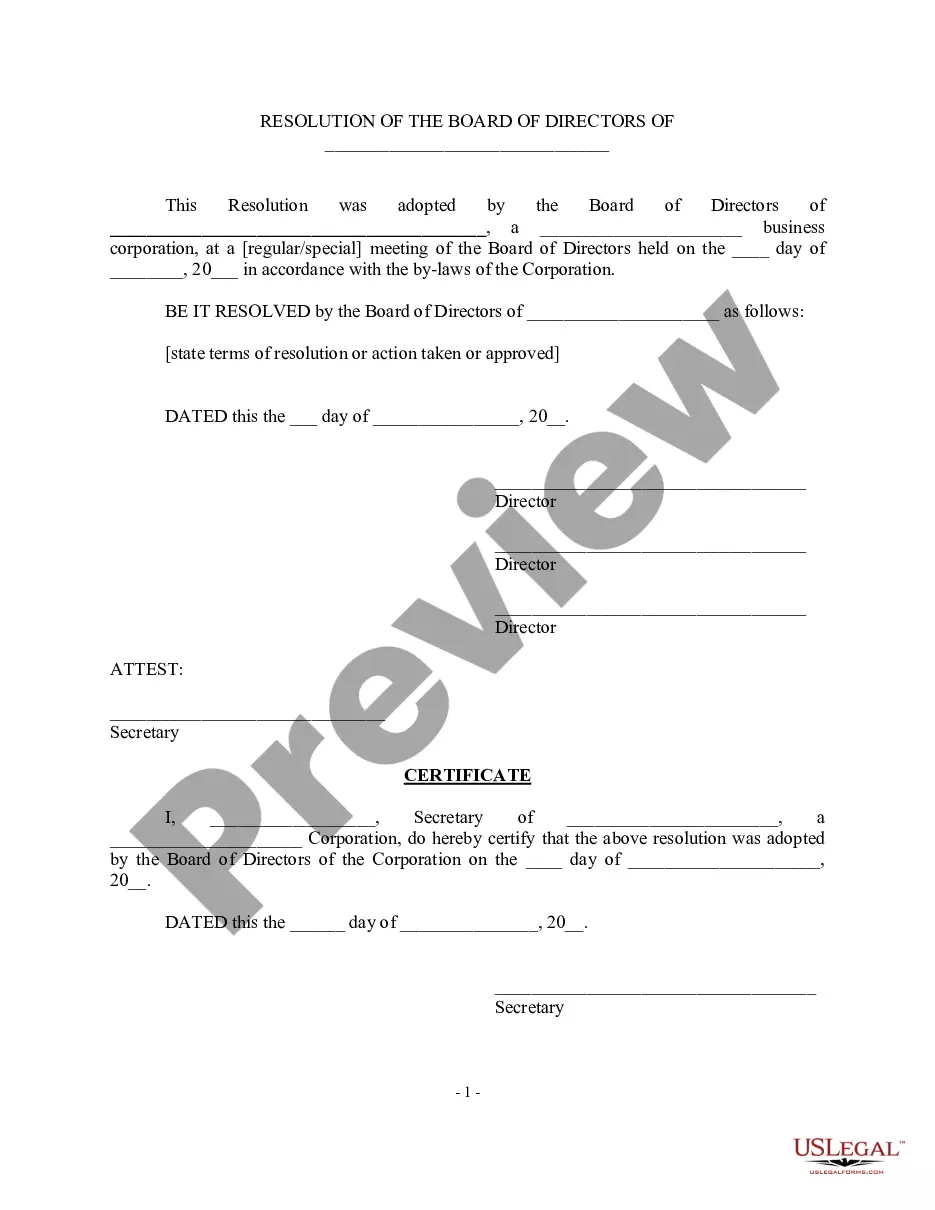
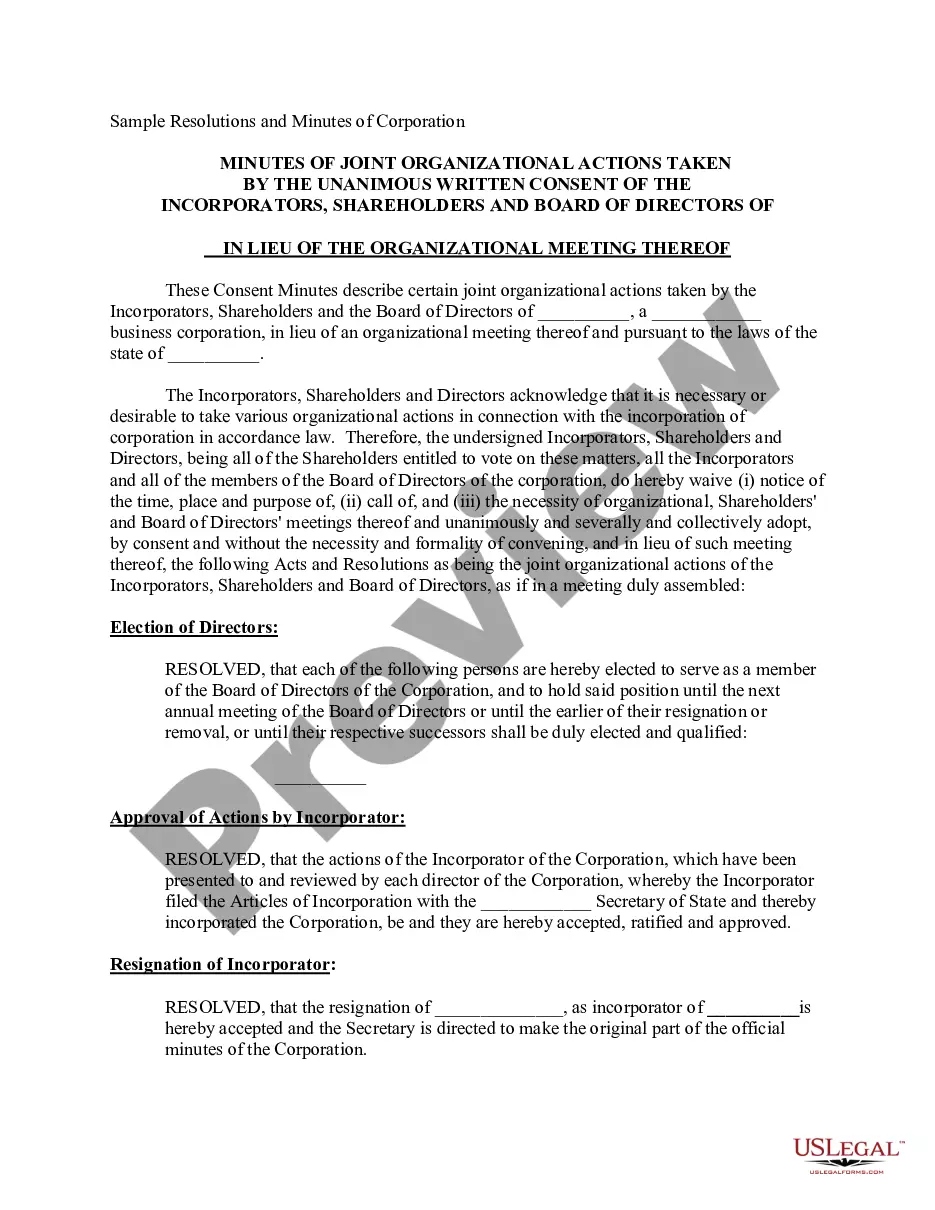
What is "Consent to Action Without Meeting"? Consent to Action Without Meeting is a written document describing an action that has been authorized by the board of directors of a corporation.
Outlined below is a detailed description of the process to guide you to produce legally binding corporate resolution documents. Write the Company's Name. Indicate Further Legal Identification. Include Location, Date, and Time. List the Board Resolutions. Sign the Document and Write the Document.
Typically, a board of directors will create corporate resolutions and sign them at a board meeting. Before the meeting, all board members should receive a meeting agenda that includes any decisions or actions to be resolved. Resolutions must follow a format approved by the state where the business is registered.
Guidelines for Valid Corporate Resolutions. The certification must bear an original signature by an officer of the corporation, (preferably the secretary), and this signature must be someone other than the person who signed the RFP, RFQ, RFI, etc.
Unlike corporations, LLCs don't need to file business resolutions with the state. Single-member LLCs (SMLLCs) can also use business resolutions, even though there is no chance of disagreement among the members.
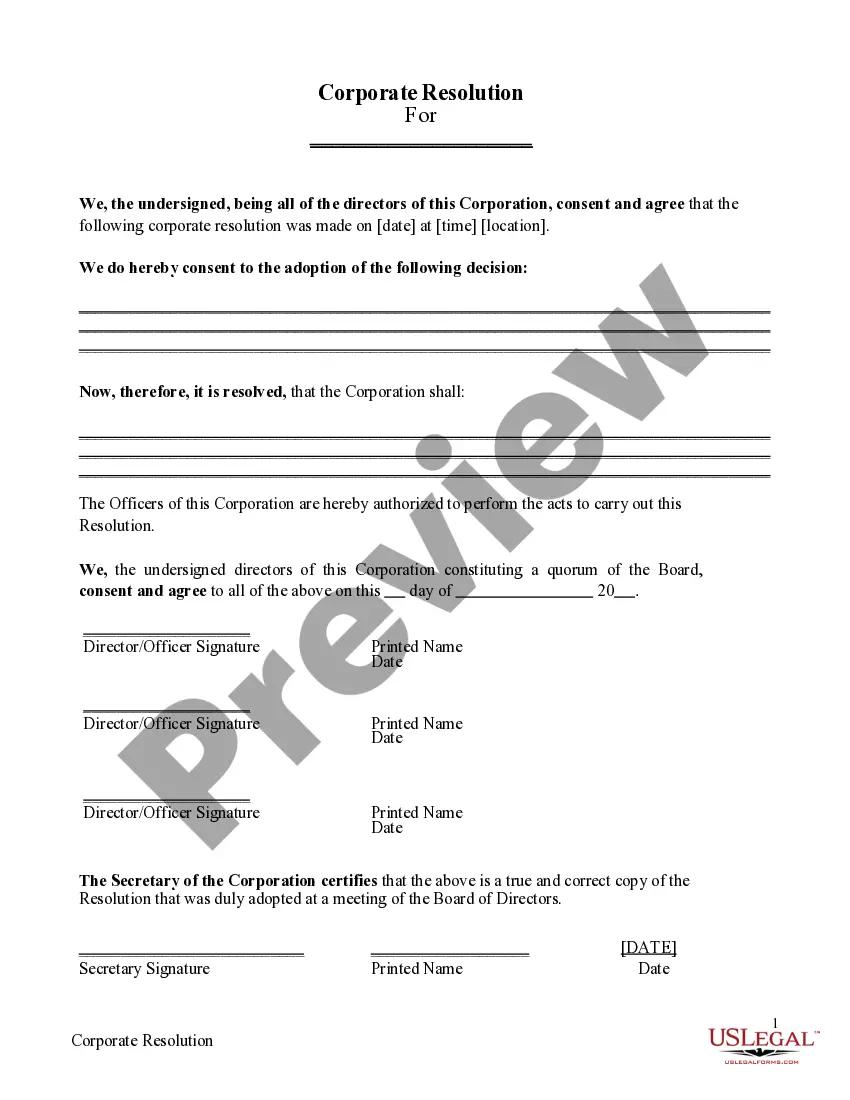
Resolutions can be passed by directors without holding a directors' meeting. These are called circulating resolutions. Check the rule book to see how this can be done. All directors entitled to vote on the resolution must sign a statement that says they are in favour of the resolution set out in the document.
A corporate resolution is a written document created by the board of directors of a company detailing a binding corporate action. A board of directors is a group of people that act as a governing body on behalf of the shareholders of a company.
A shareholders' resolution can either be passed during a formal meeting of the shareholders or in writing (without holding an actual meeting). Regardless of the method, the resolutions must be passed in ance with certain statutory, and possibly contractual, requirements.
Resolutions can be passed by directors without holding a directors' meeting. These are called circulating resolutions. Check the rule book to see how this can be done. All directors entitled to vote on the resolution must sign a statement that says they are in favour of the resolution set out in the document.
A resolution is required to record a formal decision, whether made during a meeting or through a written process without holding a meeting. The company's constitution should be consulted to determine if written resolutions are permissible for the specific decision.