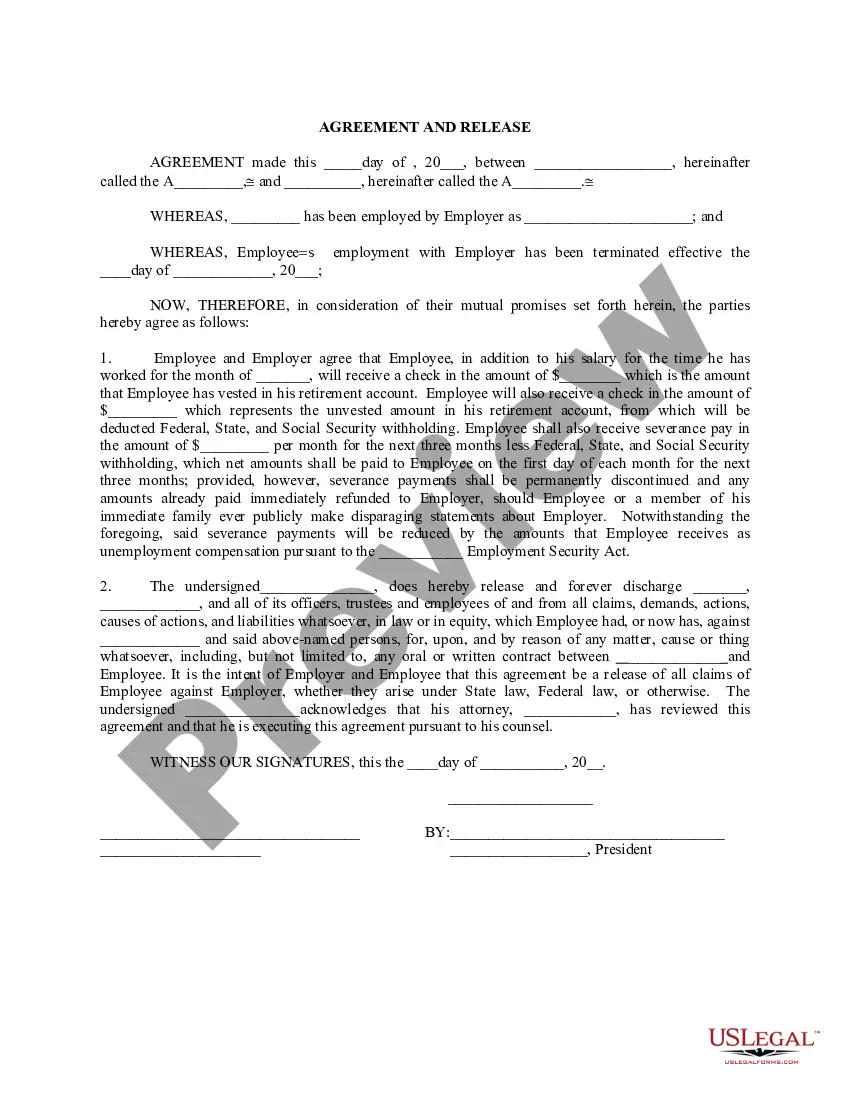
Suing Employer For Severance In Washington
Description




Form popularity
FAQ
Intentional Injury You can sue your employer or a co-worker if the conduct that caused your injuries was intentional. Known as an “employer intentional tort” claim, the injured worker must be able to prove: The employer had actual knowledge the injury would occur; and. They wilfully disregarded this knowledge.
You can file a lawsuit against your employer for several reasons, including retaliation, wrongful termination, discrimination, or unpaid wages.
File a Worker Rights Complaint online. Download and mail a completed Worker Rights Complaint form (F700-148-000). Visit your nearest L&I office.
Yes, you can sue your employer for emotional distress if you can prove that their actions or negligence caused severe emotional harm. Emotional distress damages and workplace stress usually constitute mental distress or mental health issues caused by workplace stress.
Keep it friendly. Don't hint that you may sue or are looking to make their lives difficult. Respond to the severance email or reach out to HR directly saying you'd like to discuss the severance agreement. Come prepared with research.
Your termination could be wrongful if your employer fired you: Due to discrimination. In violation of a federal or state labor law. Because you reported and refused to participate in harassment.
While multimillion awards are possible, it is crucial to keep in mind that federal laws limit the amount of punitive and compensatory damages awarded in cases involving wrongful termination. They cannot exceed $50,000 – $300,000, depending on the number of employees working for the employer's business.
Examples of wrongful termination in Washington state include: Firing an employee in retaliation for exercising their legal rights, such as filing a complaint with a government agency or taking medical leave under the Family and Medical Leave Act (FMLA).
Yes, you can sue your employer for wrongful termination in Washington state. Wrongful termination is a common-law claim in Washington state, meaning it's a judge-created law. While most employment protections are memorialized in statutes, wrongful termination is not.
What is the downside to severance? The downside to severance includes financial drawbacks such as loss of steady income, potential loss of benefits, and uncertainty about future job prospects, as well as the impact on retirement savings and benefits.