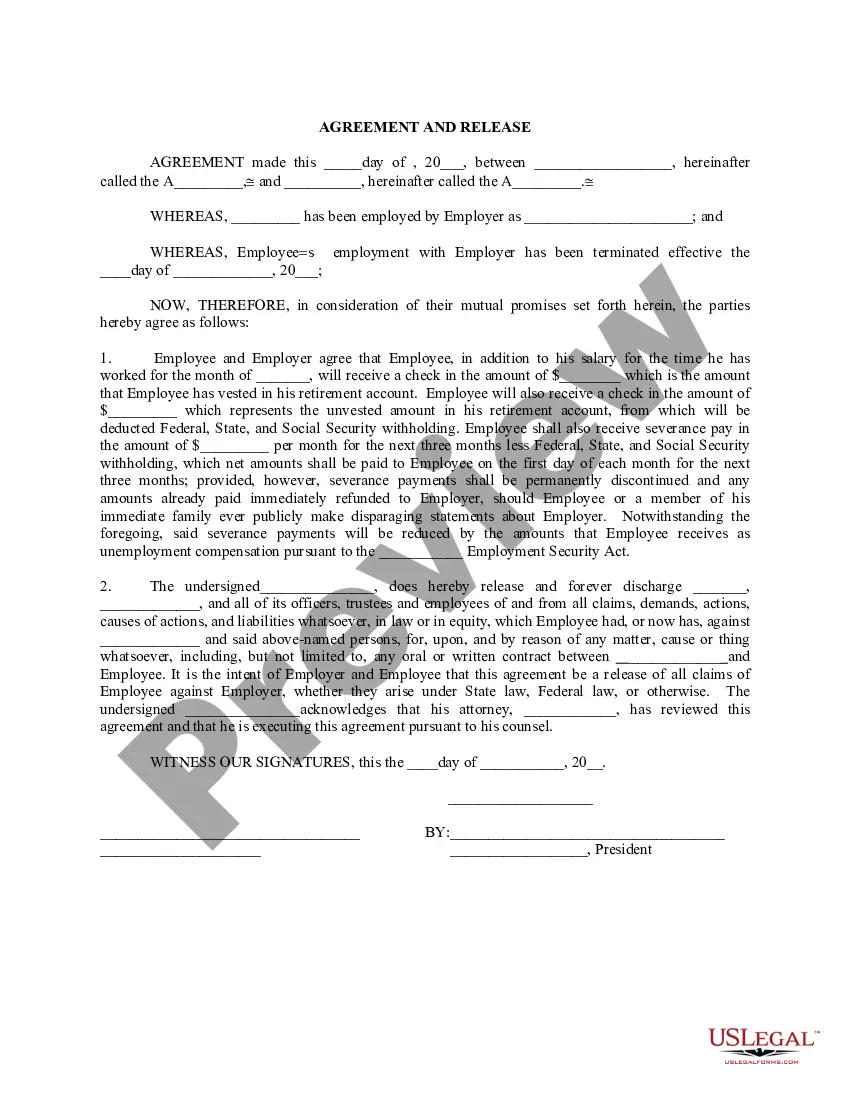
Severance Agreement Form With Non-disparagement Clause In Washington
Description

Get your form ready online
Our built-in tools help you complete, sign, share, and store your documents in one place.
Make edits, fill in missing information, and update formatting in US Legal Forms—just like you would in MS Word.
Download a copy, print it, send it by email, or mail it via USPS—whatever works best for your next step.
Sign and collect signatures with our SignNow integration. Send to multiple recipients, set reminders, and more. Go Premium to unlock E-Sign.
If this form requires notarization, complete it online through a secure video call—no need to meet a notary in person or wait for an appointment.
We protect your documents and personal data by following strict security and privacy standards.

Make edits, fill in missing information, and update formatting in US Legal Forms—just like you would in MS Word.

Download a copy, print it, send it by email, or mail it via USPS—whatever works best for your next step.

Sign and collect signatures with our SignNow integration. Send to multiple recipients, set reminders, and more. Go Premium to unlock E-Sign.

If this form requires notarization, complete it online through a secure video call—no need to meet a notary in person or wait for an appointment.

We protect your documents and personal data by following strict security and privacy standards.
Looking for another form?








Form popularity
FAQ
Only employees or independent contractors who earn more than the thresholds established by law can be held to non-competition agreements. If an employee or independent contractor has earnings less than the threshold specified under law, the non-compete agreements is considered void and unenforceable under RCW 49.62.
So if you were laid off and signed a separation agreement even before the February ruling, your former employer won't be able to enforce any overly broad confidentiality, non-disclosure, and non-disparagement clauses in your original agreement.
The Act (codified as RCW 49.44. 211) makes it illegal for employers in an agreement to prohibit employees from discussing conduct the employee reasonably believed to be an illegal act of discrimination, harassment, retaliation, wage and hour violation, or sexual assault.
Washington's Silenced No More Act limits all Washington employers' use of nondisclosure and nondisparagement provisions in employment agreements.
In California, Government Code § 12964.5 makes it unlawful for employers to include a non-disparagement clause without clear language that preserves your right to disclose unlawful conduct.
In 2022, Washington state Governor Jay Inslee signed into law the Silenced No More Act (HB 1795), which limits the use of workplace non-disclosure and non-disparagement agreements, commonly known as NDAs.
If a non-disparagement clause doesn't explicitly state that it doesn't apply to unlawful acts, it's unenforceable in California.
This provision is commonly found in: Settlement agreements. Severance agreements. Stock or benefits agreements.
The Act (codified as RCW 49.44. 211) makes it illegal for employers in an agreement to prohibit employees from discussing conduct the employee reasonably believed to be an illegal act of discrimination, harassment, retaliation, wage and hour violation, or sexual assault.