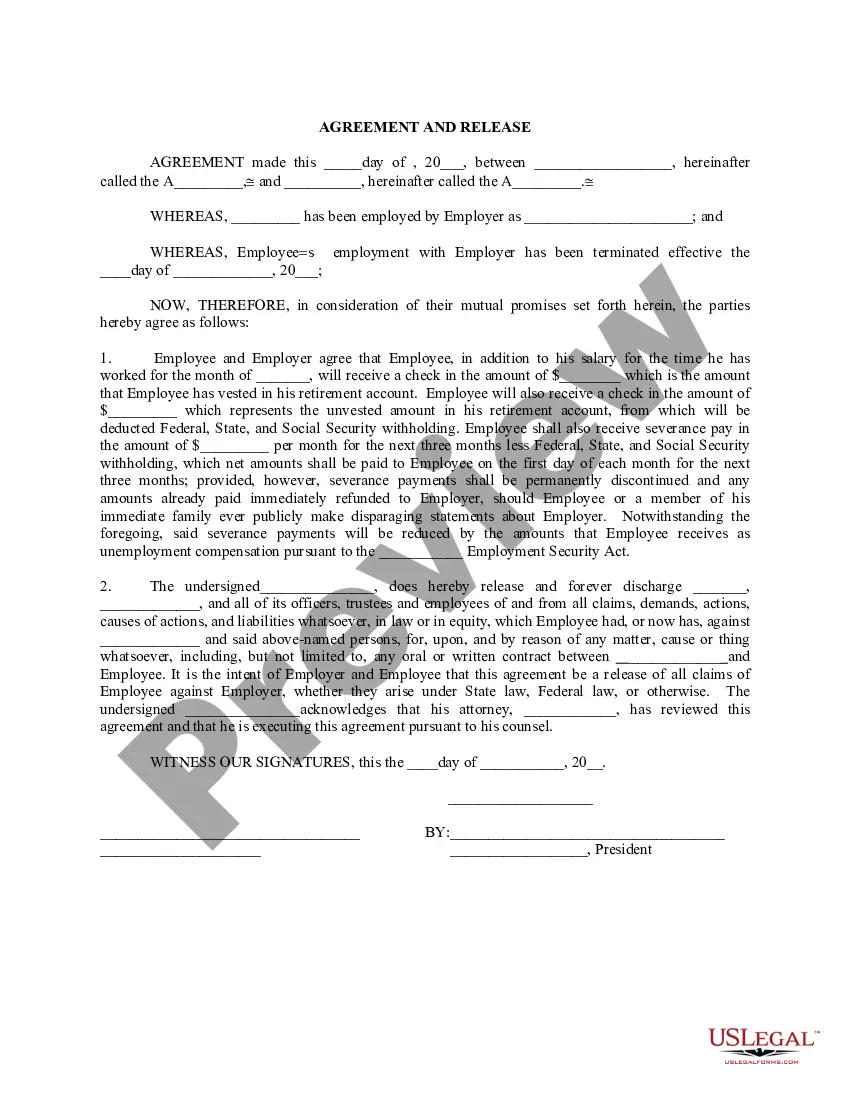
Employer Withholding Severance Pay In Nassau
Description

Get your form ready online
Our built-in tools help you complete, sign, share, and store your documents in one place.
Make edits, fill in missing information, and update formatting in US Legal Forms—just like you would in MS Word.
Download a copy, print it, send it by email, or mail it via USPS—whatever works best for your next step.
Sign and collect signatures with our SignNow integration. Send to multiple recipients, set reminders, and more. Go Premium to unlock E-Sign.
If this form requires notarization, complete it online through a secure video call—no need to meet a notary in person or wait for an appointment.
We protect your documents and personal data by following strict security and privacy standards.

Make edits, fill in missing information, and update formatting in US Legal Forms—just like you would in MS Word.

Download a copy, print it, send it by email, or mail it via USPS—whatever works best for your next step.

Sign and collect signatures with our SignNow integration. Send to multiple recipients, set reminders, and more. Go Premium to unlock E-Sign.

If this form requires notarization, complete it online through a secure video call—no need to meet a notary in person or wait for an appointment.

We protect your documents and personal data by following strict security and privacy standards.
Looking for another form?









Form popularity
FAQ
Section 29 provides a minimum code to facilitate such a termination without cause. Once an employer complies with that provision to bring an employment to an end there is no unfair dismissal claim that would lie, unless the employee has better terms under his contract of employment for termination without cause.
Section 24 of the Employment Act mandates that deductions cannot be made without explicit provisions. The Act specifies the circumstances for lawful deductions in Sections 24(2) to (6). Certain deductions, like overpayment recovery, indemnity, and wage advances, do not require an employee's request.
Grounds for Termination Misconduct: Serious breaches of the employment agreement or company policies, such as gross negligence or insubordination, dishonesty or theft, and violence or harassment. Poor Performance: Consistent failure to meet performance standards after reasonable opportunities for improvement.
Employers. Employers are required by law to withhold employment taxes from their employees. Employment taxes include federal income tax withholding and Social Security and Medicare Taxes.
To receive your New York Withholding Identification Number, you must file the New York State Employer Registration for Unemployment Insurance, Withholding and Wage Reporting Form (Form NYS-100N) if you haven't already done so. The form can be filed online through New York Business Express.
New York State Employer Registration for. Unemployment Insurance, Withholding and Wage Reporting form. Use the NYS 100 form to register for Unemployment Insurance, withholding and wage reporting if you are a: • Business Employer, or • Household Employer of domestic services.
Update Tax Withholdings You can submit your federal Form W-4 (federal withholdings) and NYS Form IT-2104 (state and local withholdings). NOTE: New employees must submit paper W-4 and IT-2104 forms through their agency's Office of Human Resources or Payroll Office when initially employed by New York State.
If you are an employer as described in federal Publication 15, Circular E, Employer's Tax Guide, and you maintain an office or transact business within New York State, whether or not a paying agency is maintained within the state, you must withhold personal income tax.
To receive your New York Withholding Identification Number, you must file the New York State Employer Registration for Unemployment Insurance, Withholding and Wage Reporting Form (Form NYS 100) if you haven't already done so. The form can be filed online through New York Business Express.