Severance Agreement Form With Non Compete In Cuyahoga
Description

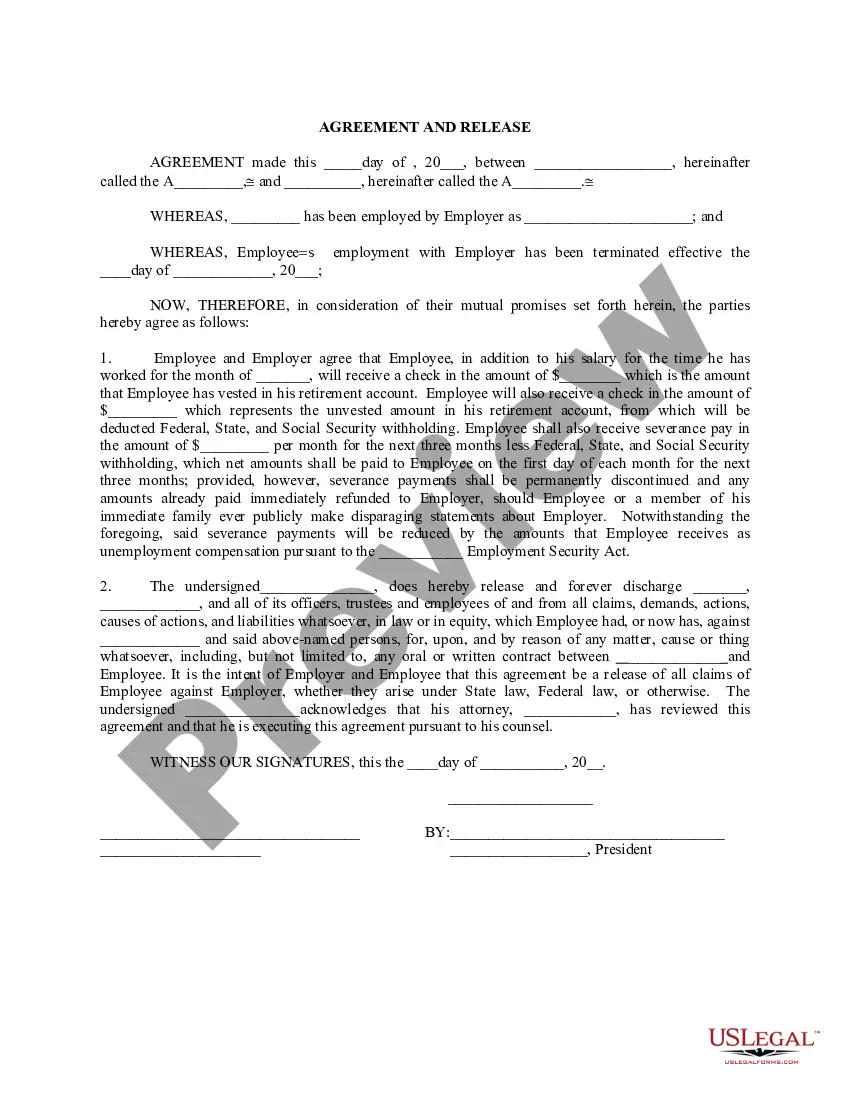
Get your form ready online
Our built-in tools help you complete, sign, share, and store your documents in one place.
Make edits, fill in missing information, and update formatting in US Legal Forms—just like you would in MS Word.
Download a copy, print it, send it by email, or mail it via USPS—whatever works best for your next step.
Sign and collect signatures with our SignNow integration. Send to multiple recipients, set reminders, and more. Go Premium to unlock E-Sign.
If this form requires notarization, complete it online through a secure video call—no need to meet a notary in person or wait for an appointment.
We protect your documents and personal data by following strict security and privacy standards.

Make edits, fill in missing information, and update formatting in US Legal Forms—just like you would in MS Word.

Download a copy, print it, send it by email, or mail it via USPS—whatever works best for your next step.

Sign and collect signatures with our SignNow integration. Send to multiple recipients, set reminders, and more. Go Premium to unlock E-Sign.

If this form requires notarization, complete it online through a secure video call—no need to meet a notary in person or wait for an appointment.

We protect your documents and personal data by following strict security and privacy standards.
Looking for another form?










Form popularity
FAQ
Severance agreements can be challenged on grounds of unconscionability or duress. Unconscionability refers to terms that are so one-sided or oppressive that they shock the conscience.
The following are the most common ways to get out of a non-compete agreement: Determine that the terms of the contract do not in fact prevent you from a desired course of action. Recognize when a non-compete contradicts the law. Negotiate a release agreement with the involved parties. Ignore the agreement.
It is generally unlawful in California for an employer's severance agreement to state that you may not compete against the employer in a future job.
Ohio is currently one of fewer than a dozen states without legislation on noncompetes, such as prohibiting them, requiring notice, limiting them to high-wage earners, or other similar limitations. Instead, the enforceability of noncompetes in Ohio remains governed by the 1975 Ohio Supreme Court case Raimonde v.
Yes, a non-compete agreement stands even if the company lays you off. Under the Florida Statute, these agreements are enforceable if they protect legitimate business interests.
compete clause is fairly standard in severance packages for key employees. The employer asks the employee to agree not to work for competing businesses, poach clients, or recruit existing employees for a period of time or in a certain geographic area. Be careful that this clause is not too large or vague.
North Carolina This state adheres to the strict blue pencil doctrine, such that courts may not rewrite the covenant, but sever overbroad provisions and enforce the remainder. Ohio This state follows the “reasonable alteration” approach, in which courts have discretion to modify an overbroad covenant.
Most noncompetition agreements have a time restriction ranging between six months and two years. Ohio courts tend not to enforce non competition clauses lasting more than two years, although some Ohio courts have done so. Second is the geographic scope of the agreement.
The final rule defines “non-compete clause” as “a term or condition of employment that prohibits a worker from, penalizes a worker for, or functions to prevent a worker from (1) seeking or accepting work in the United States with a different person where such work would begin after the conclusion of the employment that ...
Noncompete agreements (often referred to as noncompetes) are postemployment restrictions that prohibit departing employees from joining or starting a competing enterprise, typically within time and geographic boundaries (for examples, see Figures OE1, OE2, and OE3 in the Online Appendix).