Employer Withholding Severance Pay In Contra Costa
Description

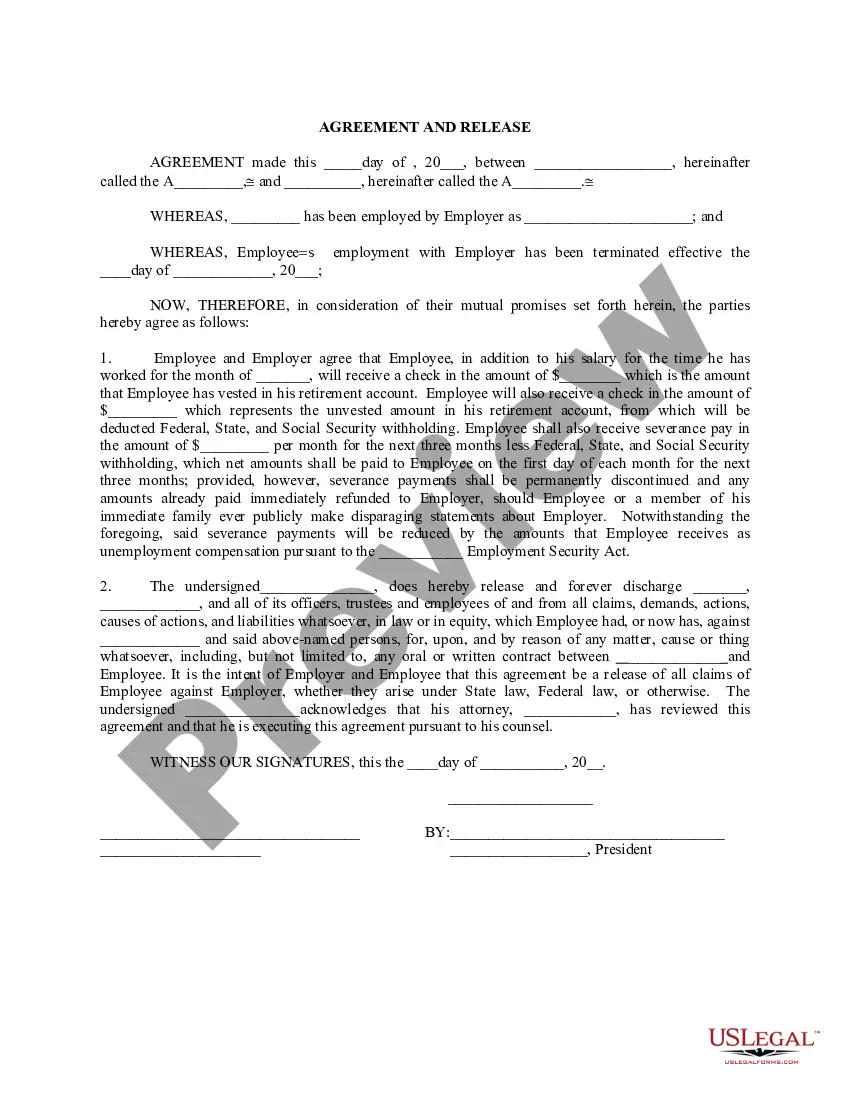
Get your form ready online
Our built-in tools help you complete, sign, share, and store your documents in one place.
Make edits, fill in missing information, and update formatting in US Legal Forms—just like you would in MS Word.
Download a copy, print it, send it by email, or mail it via USPS—whatever works best for your next step.
Sign and collect signatures with our SignNow integration. Send to multiple recipients, set reminders, and more. Go Premium to unlock E-Sign.
If this form requires notarization, complete it online through a secure video call—no need to meet a notary in person or wait for an appointment.
We protect your documents and personal data by following strict security and privacy standards.

Make edits, fill in missing information, and update formatting in US Legal Forms—just like you would in MS Word.

Download a copy, print it, send it by email, or mail it via USPS—whatever works best for your next step.

Sign and collect signatures with our SignNow integration. Send to multiple recipients, set reminders, and more. Go Premium to unlock E-Sign.

If this form requires notarization, complete it online through a secure video call—no need to meet a notary in person or wait for an appointment.

We protect your documents and personal data by following strict security and privacy standards.
Looking for another form?










Form popularity
FAQ
The new rule mandates that businesses inform their employees that they have at least five days to review any separation or severance arrangements.
Your wages can only be garnished for whichever is less: 25% of your disposable earnings for a week, or. 50% of the amount that your weekly earnings exceed 40 times the state or local minimum wage. If your weekly earnings are less than $560 (40 x $14 state minimum wage), your wages can't be garnished at all.
How much of an employee's wages can be garnished? 25% of disposable earnings -or- The amount by which disposable earnings are 30 times greater than the federal minimum wage.
Federal law limits wage garnishments to 25% of your disposable income (15% for federal student loans) or the amount exceeding 30 times the federal minimum wage, whichever is less. Individuals with a child support order can garnish up to 65% of disposable earnings for child support.
No assignment of wages is valid in California unless certain conditions are met. In addition, only a certain percentage of an employee's disposable wages can be withheld from each paycheck. Unlike a garnishment order, which is required to be honored by law, an employer has no obligation to honor an assignment.
The strongest steps to stop wage garnishment in California include: File a Claim of Exemption. Complete Claim of Exemption (WG-006) and Financial Statement (WG-007/EJ-165) forms. Negotiate With Creditors. Request a payment plan or settle the debt for a reduced amount. Challenge the Garnishment in Court. File for Bankruptcy.
Under California law, as of September 1, 2023, the most that can be garnished from your wages is the lesser of: 20% of your disposable earnings for the workweek or. 40% of the amount your weekly disposable earnings exceed 48 times the state hourly minimum wage.
Statute of Limitations on Debts Generally, it ranges from 3 to 6 years for most consumer debts. After this period, creditors can't sue you to collect the debt. However, this doesn't automatically prevent wage garnishment if a judgment was obtained before the statute expired.