Severance Termination For Cause In Arizona
Description

Get your form ready online
Our built-in tools help you complete, sign, share, and store your documents in one place.
Make edits, fill in missing information, and update formatting in US Legal Forms—just like you would in MS Word.
Download a copy, print it, send it by email, or mail it via USPS—whatever works best for your next step.
Sign and collect signatures with our SignNow integration. Send to multiple recipients, set reminders, and more. Go Premium to unlock E-Sign.
If this form requires notarization, complete it online through a secure video call—no need to meet a notary in person or wait for an appointment.
We protect your documents and personal data by following strict security and privacy standards.

Make edits, fill in missing information, and update formatting in US Legal Forms—just like you would in MS Word.

Download a copy, print it, send it by email, or mail it via USPS—whatever works best for your next step.

Sign and collect signatures with our SignNow integration. Send to multiple recipients, set reminders, and more. Go Premium to unlock E-Sign.

If this form requires notarization, complete it online through a secure video call—no need to meet a notary in person or wait for an appointment.

We protect your documents and personal data by following strict security and privacy standards.
Looking for another form?





Form popularity
FAQ
Termination for cause ensues when the employees' actions are against policy and may lead to serious repercussions for the company, clients and other employees. Termination of employee services with cause may be necessitated by a violation of the company's code of conduct or continuous poor performance.
Precise statistics showing the win rates on wrongful termination cases each year compared to the overall number of wrongful termination lawsuits are hard to come by. Nevertheless, estimates range from as low as 30% of wrongful termination cases being successful to as high as 90% of cases succeeding.
Under California and federal employment law, proving a wrongful termination case is not easy. It requires thorough investigation and evidence to support the employee's claim. Note: The burden of proof is on the employee to prove that the termination was wrongful and that he or she suffered damages as a result.
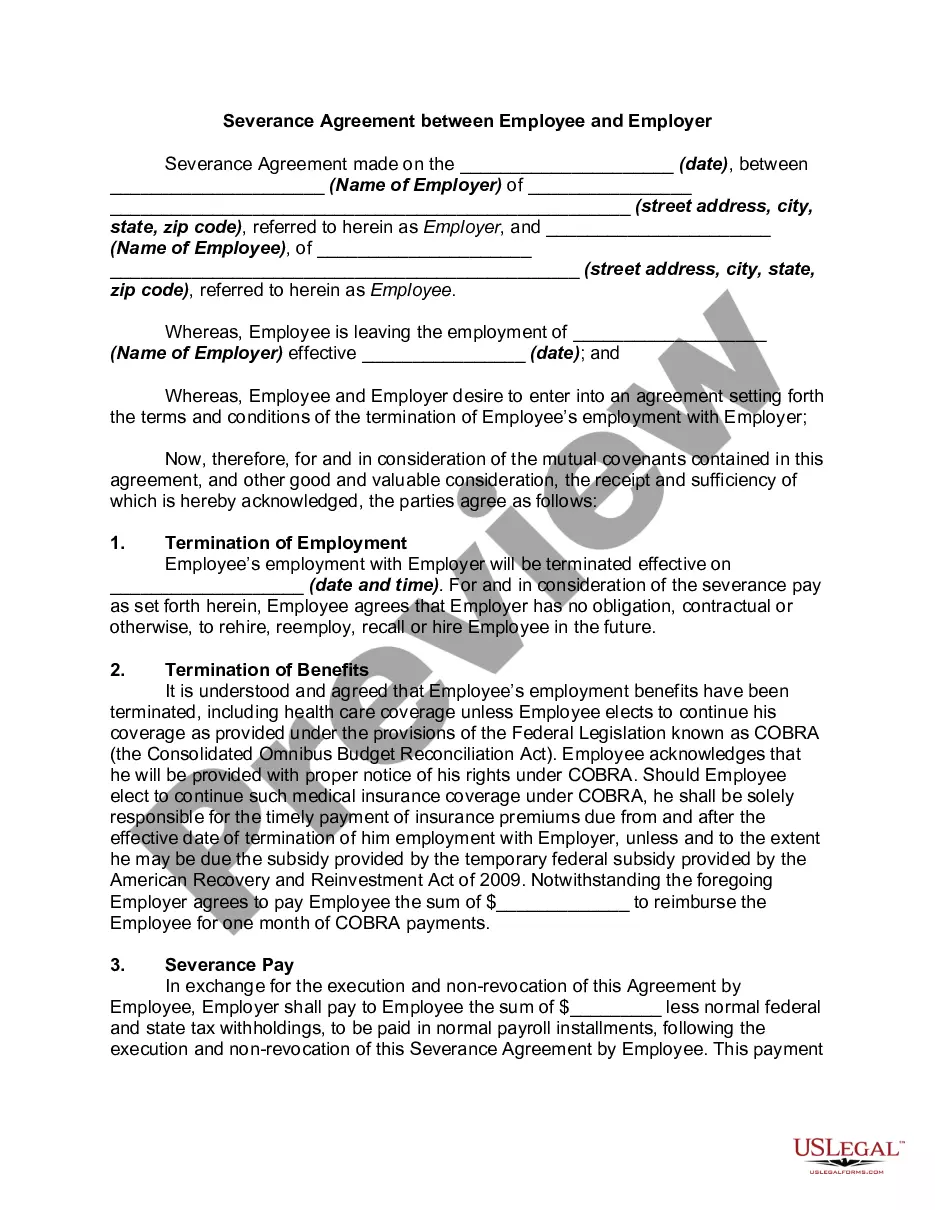
The one catch is that severance often does not apply to employees fired “for cause” due to misconduct like violence, harassment, or policy breaches. However, questionable or wrongful claims of cause can be disputed with the help of an employment lawyer.
In California, understanding your employment rights is essential, especially regarding termination. California is an “at-will” employment state, which means that employers can terminate employees without needing a specific cause or proof.