Employment Law Without A Contract In Salt Lake
Description















Get your form ready online
Our built-in tools help you complete, sign, share, and store your documents in one place.
Make edits, fill in missing information, and update formatting in US Legal Forms—just like you would in MS Word.
Download a copy, print it, send it by email, or mail it via USPS—whatever works best for your next step.
Sign and collect signatures with our SignNow integration. Send to multiple recipients, set reminders, and more. Go Premium to unlock E-Sign.
If this form requires notarization, complete it online through a secure video call—no need to meet a notary in person or wait for an appointment.
We protect your documents and personal data by following strict security and privacy standards.

Make edits, fill in missing information, and update formatting in US Legal Forms—just like you would in MS Word.

Download a copy, print it, send it by email, or mail it via USPS—whatever works best for your next step.

Sign and collect signatures with our SignNow integration. Send to multiple recipients, set reminders, and more. Go Premium to unlock E-Sign.

If this form requires notarization, complete it online through a secure video call—no need to meet a notary in person or wait for an appointment.

We protect your documents and personal data by following strict security and privacy standards.
Looking for another form?
Form popularity
FAQ
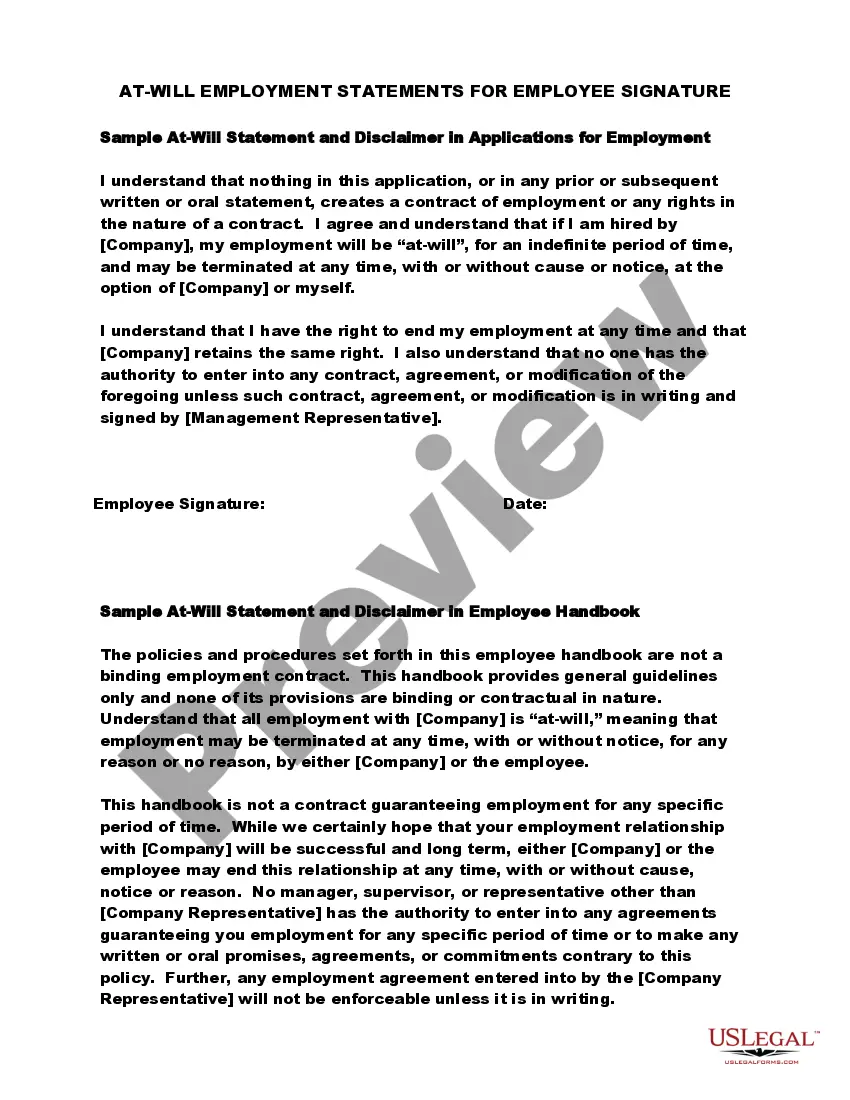
There's no legal obligation to do so. In fact, most workers in the United States do not have contracts. They are just considered at-will employees. As long as they want to work for the business and you want to continue employing them, the working relationship continues.
If there is no written record of the terms of the employment, it makes it harder to prove the existence of certain terms if action is taken against the employer. The lack of a contract can also prevent the employment relationship being legally binding between both the employer and the employee.
Under the laws of the United States, there are no minimum requirements for an employment contract. Also, in most states, no written memorialisation of any terms is required. An employment relationship in the United States is presumed to be “at-will,” i.e., terminable by either party, with or without cause or notice.
True. Very few workers have contracts, unless they're a pro athlete, consultant/freelancer, or sometimes very high level executives. Normal workers do not have contracts, and can be fired or can quit at will.
Working without a written contract exposes your business to legal and commercial risks-including disputes, unclear obligations, and difficulty enforcing your rights. Verbal promises or email exchanges may not stand up in court-written, signed contracts offer clarity and reliable protection.
Not All Employment in the USA Requires a Contract Rather, at-will employment means that either the employer or the employee can terminate the employment at any time and without cause.
Utah is an employment-at-will state, which means that without a written employee contract, employees can be terminated for any reason at any time, provided that the reason is not discriminatory and that the employer is not retaliating against the employee for a rightful action.
If you don't have an employment contract when starting a new job, it is important to ask for one as soon as possible. If your employer refuses to provide one or does not respond to your request, then you must document any verbal agreements that were made regarding your job duties or working conditions.
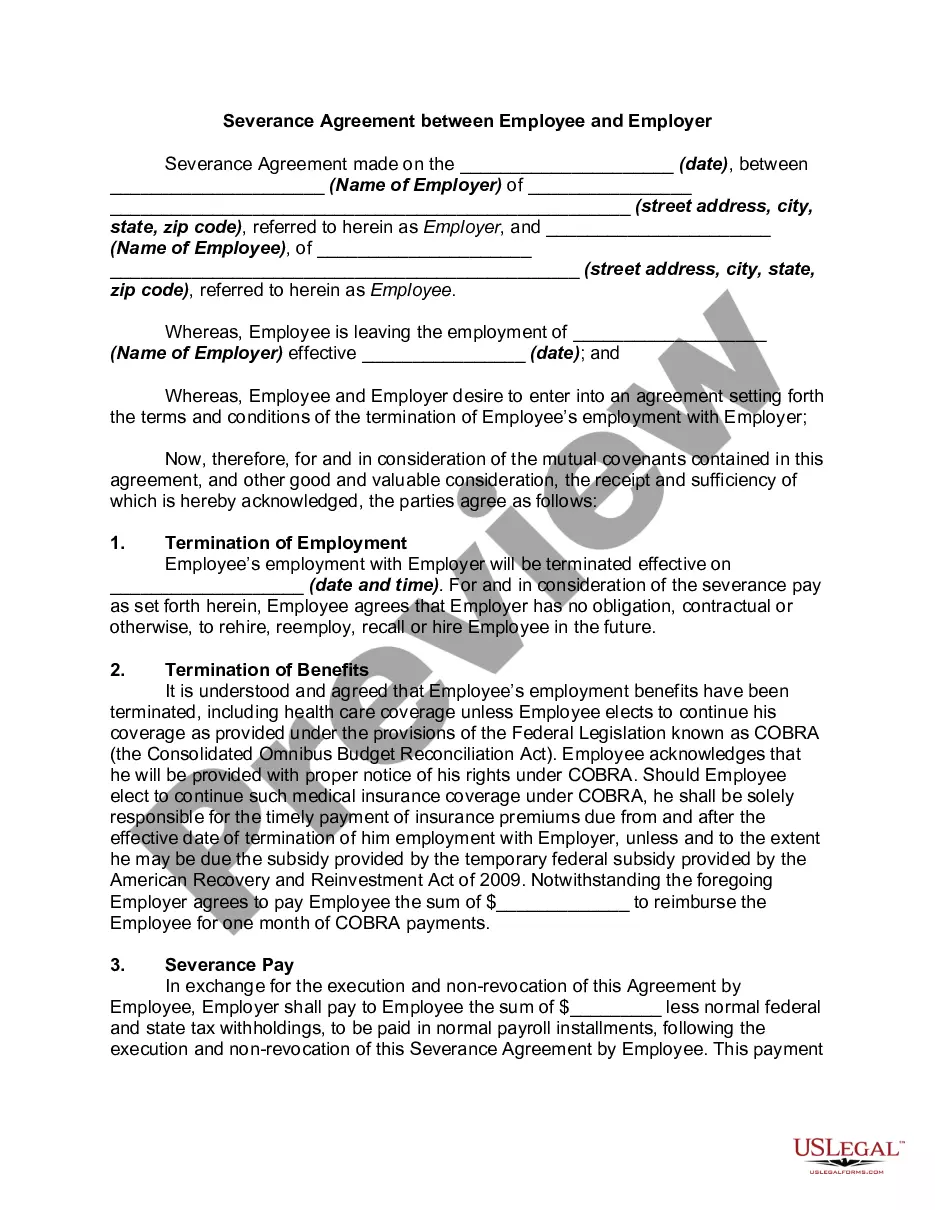
Title 34 Chapter 28 Notice of paydays -- Failure to notify a misdemeanor. Separation from payroll -- Resignation -- Cessation because of industrial dispute. Dispute over wages -- Notice and payment. Payment at more frequent intervals permitted -- Agreements to contravene chapter prohibited unless approved by division.
Utah operates under the “at-will” employment doctrine. This means employers in Utah have the flexibility to terminate employees for any reason—or no reason at all—without needing to provide advance notice.