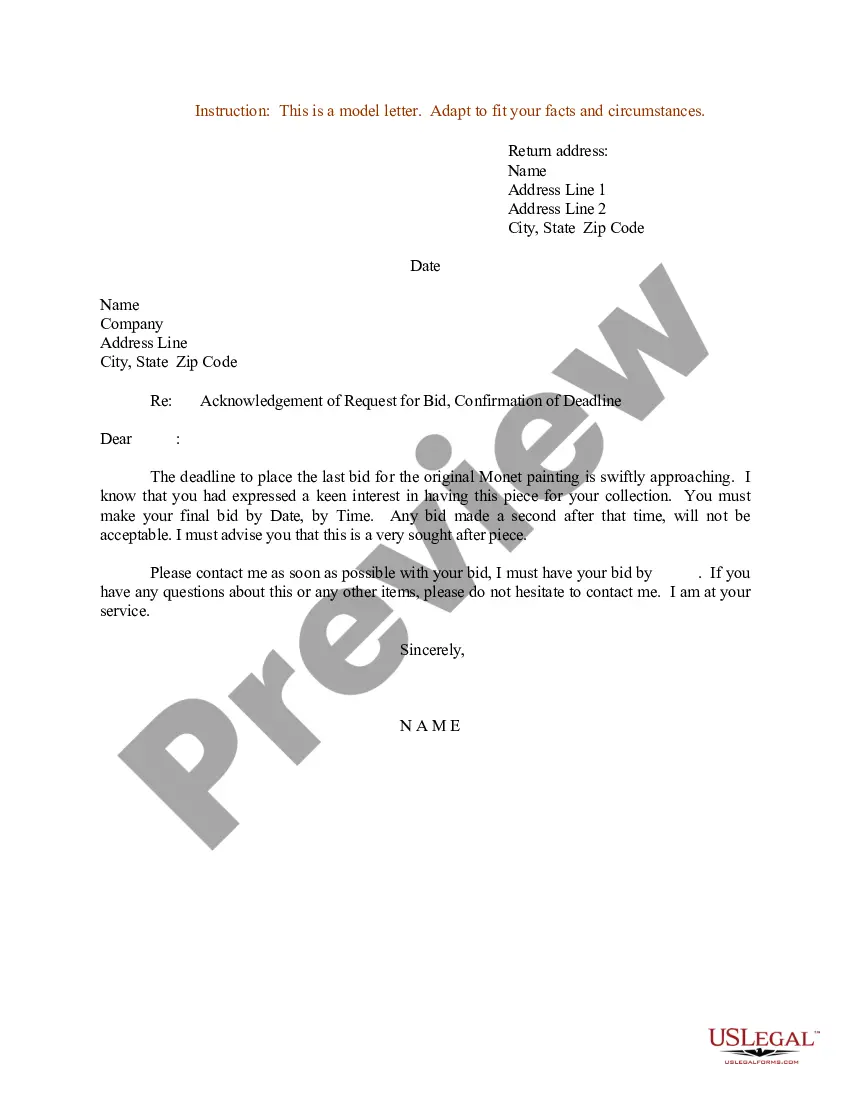
Request For Bid In San Diego
Description


Get your form ready online
Our built-in tools help you complete, sign, share, and store your documents in one place.
Make edits, fill in missing information, and update formatting in US Legal Forms—just like you would in MS Word.
Download a copy, print it, send it by email, or mail it via USPS—whatever works best for your next step.
Sign and collect signatures with our SignNow integration. Send to multiple recipients, set reminders, and more. Go Premium to unlock E-Sign.
If this form requires notarization, complete it online through a secure video call—no need to meet a notary in person or wait for an appointment.
We protect your documents and personal data by following strict security and privacy standards.

Make edits, fill in missing information, and update formatting in US Legal Forms—just like you would in MS Word.

Download a copy, print it, send it by email, or mail it via USPS—whatever works best for your next step.

Sign and collect signatures with our SignNow integration. Send to multiple recipients, set reminders, and more. Go Premium to unlock E-Sign.

If this form requires notarization, complete it online through a secure video call—no need to meet a notary in person or wait for an appointment.

We protect your documents and personal data by following strict security and privacy standards.
Looking for another form?






Form popularity
FAQ
The RFP process allows more flexibility than the sealed bid process in the evaluation process. The evaluation committee first evaluates proposals for compliance to the specifications and requirements in the RFP and creates a list of those firms whose proposals meet mandatory requirements.
Be as Specific as Possible. A key factor in getting accurate bids is to start off by being as specific as possible. It's crucial that the owner and the design team first work out the details of the project, specifying the materials and methods they'd like to be utilized on their project.
LinkedIn is the most popular social network for finding RFPs, but you will also see some on Twitter. Luckily, the search functionality on these networks makes RFPs easy to find. Simply search your industry and 'RFP' to browse through the results and find the latest open opportunities.
It's not unusual. If you are not comfortable tell them you are willing to do 50% upon delivery of materials, balance upon completion.
5 Steps to Making Successful Bids Decide If You Want the Project. Just because you receive an RFP or a prospective customer asks you to bid on a job doesn't mean you have to. Set Up A Meeting With The Client. Calculate Costs and Check Profit Margins. Check All the Details. Send and Pitch Your Bid.
Step 1: Find a Project. Find a project you want to bid on. Step 2: Carefully Examine the Bid. Carefully examine and be familiar with the bidding and contract documents, and bidder qualifications. Step 3: Visit the Site. Step 4: Prepare Your Bid. Step 5: Submit Your Bid. Step 6: Award of Contract.
A bid should be personalised for the client Bid writing should not be a template-driven process or an exercise in copy and paste. You'll need to do your homework and create a bid that's completely tailored for the client. This means you need to put in some solid research before you can even write a word.
Let's break down how the project bidding process works on Upwork. Get started by clicking on “Apply Now” ... Set the terms for the project. Specify the duration. Write your cover letter. Answer any additional questions. Upload attachments. Add profile highlights. Boost your proposal.
Just below the project details, you can place your bid. (1) Enter your bid amount, (2) enter the number of days for delivery, (3) describe your proposal, (4) list milestones or tasks and set a Milestone Payment® for each task, (5) choose an optional upgrade if you wish, and click Place Bid.
LinkedIn is the most popular social network for finding RFPs, but you will also see some on Twitter. Luckily, the search functionality on these networks makes RFPs easy to find. Simply search your industry and 'RFP' to browse through the results and find the latest open opportunities.