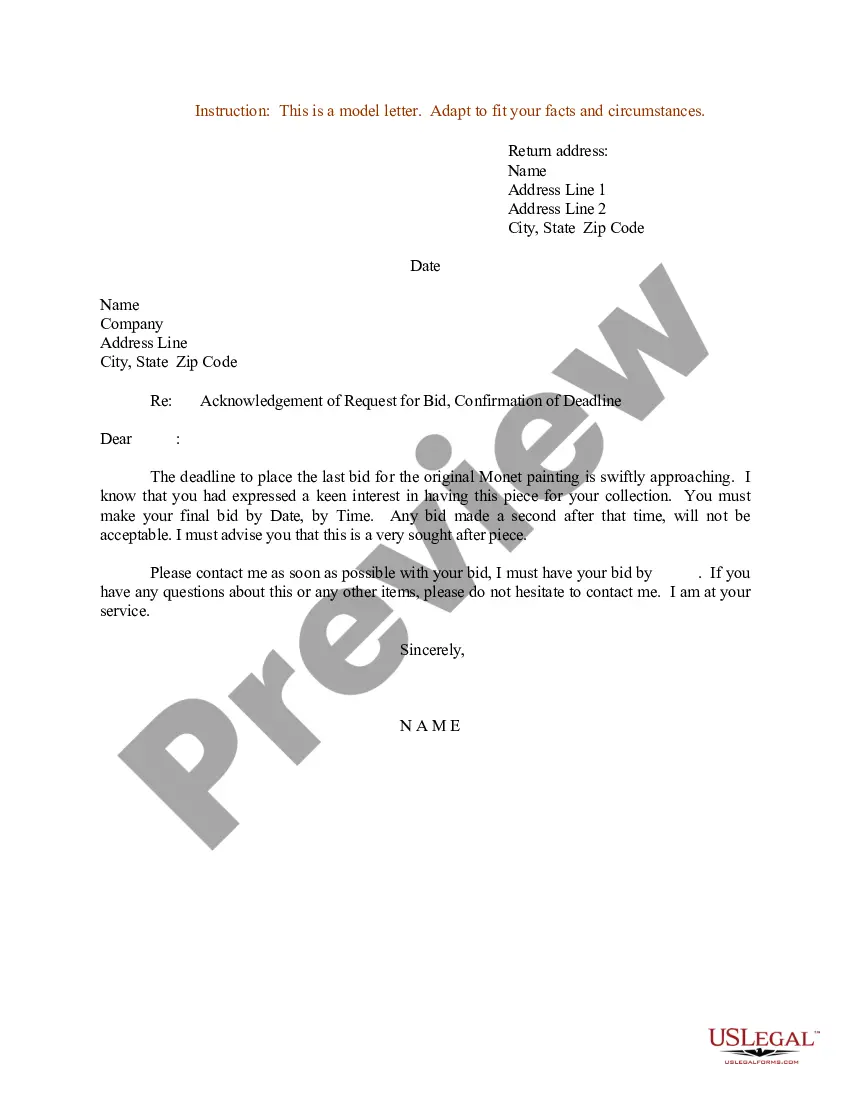
Request For Bid Meaning In Maryland
Description


Get your form ready online
Our built-in tools help you complete, sign, share, and store your documents in one place.
Make edits, fill in missing information, and update formatting in US Legal Forms—just like you would in MS Word.
Download a copy, print it, send it by email, or mail it via USPS—whatever works best for your next step.
Sign and collect signatures with our SignNow integration. Send to multiple recipients, set reminders, and more. Go Premium to unlock E-Sign.
If this form requires notarization, complete it online through a secure video call—no need to meet a notary in person or wait for an appointment.
We protect your documents and personal data by following strict security and privacy standards.

Make edits, fill in missing information, and update formatting in US Legal Forms—just like you would in MS Word.

Download a copy, print it, send it by email, or mail it via USPS—whatever works best for your next step.

Sign and collect signatures with our SignNow integration. Send to multiple recipients, set reminders, and more. Go Premium to unlock E-Sign.

If this form requires notarization, complete it online through a secure video call—no need to meet a notary in person or wait for an appointment.

We protect your documents and personal data by following strict security and privacy standards.
Looking for another form?






Form popularity
FAQ
A Letter of Intent to Bid (or LOI for short) is a very simple business letter a vendor sends to the RFP's procurement contact notifying them of your “intention to bid” on their RFP.
A letter of intent to bid is a formal way for prospective vendors to communicate their desire to submit a response to a request for proposal (RFP). Often, a buyer will request a letter of intent from interested vendors as part of the RFP process.
A bid request is a piece of code used to sell display ads and inventory details. It allows visitors to see ads most suited to them, and for multiple advertisers to utilize the same ad spot on a given publisher's platform.
The bid process includes developing and publicizing bid documents, bidder conferences, and letting a bidder. After the analysis is complete, the project team will be able to determine the nature of the contractual relationship needed with a vendor. It is then time to identify potential vendors.
A bid request is a piece of code used to sell display ads and inventory details. It allows visitors to see ads most suited to them, and for multiple advertisers to utilize the same ad spot on a given publisher's platform.
The Bidding Process Step 1: Request for proposals. Step 2: Bid preparation and submission. Step 3: Bid evaluation and selection. Step 4: Contract negotiation. Step 5: Project delivery.
How to write an RFP in 7 steps. Introduce the company and project. Outline project background. Provide bid deadline and proposal timeline. Specify budget. Outline project scope. Express concerns or roadblocks. Explain evaluation criteria.
LOI best practices Begin the letter by clearly stating your intention to bid and basic company information. Include contact information for the person who will manage the proposal process. This is the person the buyer should contact if they have questions, need more information or want to begin negotiations.
The Four Stages of a Bid. All projects pass through four stages: initiation, planning, execution, and closeout, or as I like to refer to them: deciding to bid, planning the bid, preparing the bid, and finalizing and submitting the bid.
The typical bidding process for a seller is as follows: getting qualified to send proposals; reviewing the terms of the RFP and determining if they are qualified; creating and sending a proposal that satisfies the requirements of the RFP; and getting a response as to whether they won or lost the bidding.