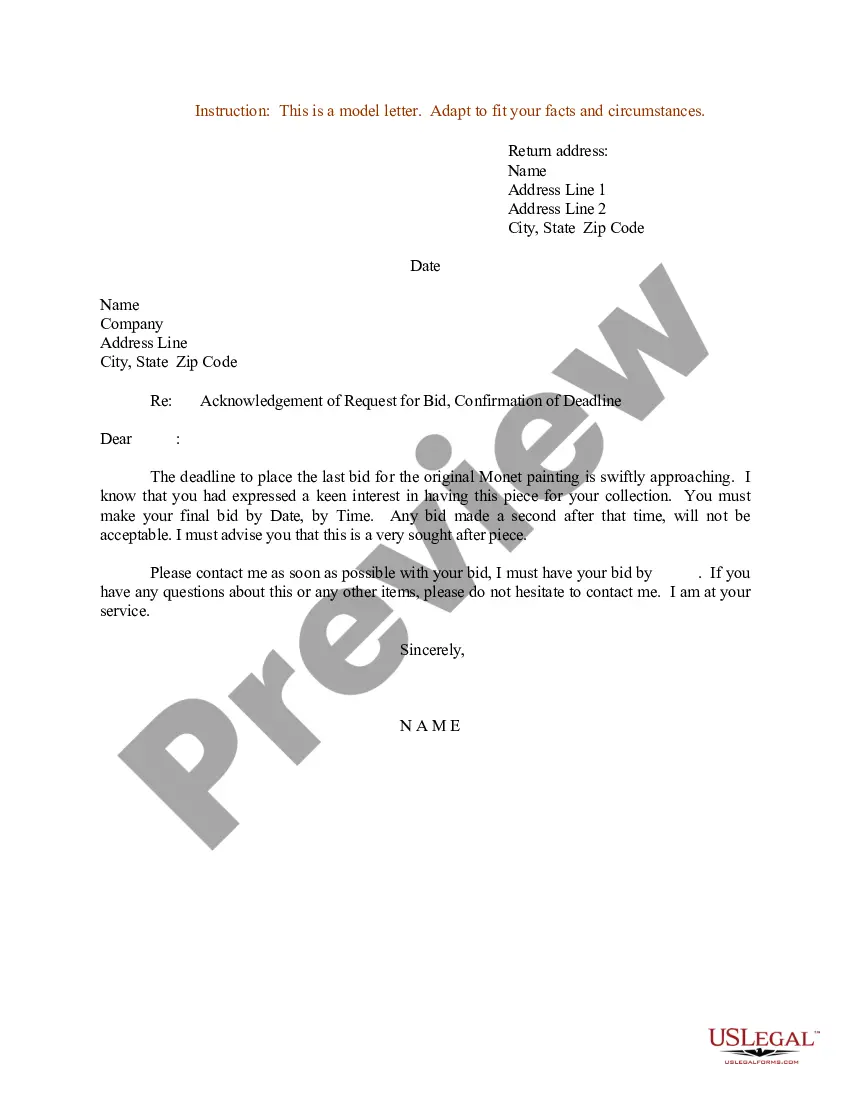
Request For Bid Rfb In Hennepin
Description


Get your form ready online
Our built-in tools help you complete, sign, share, and store your documents in one place.
Make edits, fill in missing information, and update formatting in US Legal Forms—just like you would in MS Word.
Download a copy, print it, send it by email, or mail it via USPS—whatever works best for your next step.
Sign and collect signatures with our SignNow integration. Send to multiple recipients, set reminders, and more. Go Premium to unlock E-Sign.
If this form requires notarization, complete it online through a secure video call—no need to meet a notary in person or wait for an appointment.
We protect your documents and personal data by following strict security and privacy standards.

Make edits, fill in missing information, and update formatting in US Legal Forms—just like you would in MS Word.

Download a copy, print it, send it by email, or mail it via USPS—whatever works best for your next step.

Sign and collect signatures with our SignNow integration. Send to multiple recipients, set reminders, and more. Go Premium to unlock E-Sign.

If this form requires notarization, complete it online through a secure video call—no need to meet a notary in person or wait for an appointment.

We protect your documents and personal data by following strict security and privacy standards.
Looking for another form?








Form popularity
FAQ
LinkedIn is the most popular social network for finding RFPs, but you will also see some on Twitter. Luckily, the search functionality on these networks makes RFPs easy to find. Simply search your industry and 'RFP' to browse through the results and find the latest open opportunities.
Bid bonds are a type of three-party financial arrangement whereby an obligee (typically the developer or government agency doing the project) requires a principal (the contractor) to obtain a bond, usually from a surety which in practice is often an insurance company.
What are the 7 steps in writing an RFP? Introduce the company and project. Outline project background. Provide bid deadline and proposal timeline. Specify budget. Outline project scope. Express concerns or roadblocks. Explain evaluation criteria.
The bidding process Step 1: Bid solicitation. Step 2: Bid preparation and submission. Step 3: Bid evaluation and selection. Step 4: Contract negotiation. Step 5: Project delivery.
For example, a business that wants to change its reporting process from a paper-based system to a computer-based system may put in a request for proposal for hardware, software, and a user training program to establish and integrate the new system into the business.
How to write an RFP in 7 steps. Introduce the company and project. Outline project background. Provide bid deadline and proposal timeline. Specify budget. Outline project scope. Express concerns or roadblocks. Explain evaluation criteria.
5 tips for crafting RFP bids that win Centralize your proposal content. Assign proposal tasks early. Make the issuer's job as easy as possible. Highlight how you are different, but don't give away your secret sauce. Leverage purpose-made RFP software.
The RFP bid process Opportunity Identification: Identify potential projects or services that require an RFP. Spend Analysis: Analyze past expenditures and the market value of similar projects to determine the budget.
The Request for Bid (RFB) is a type of line item BP. RFBs are unique in that the business process requires participation from personnel outside your company.
The RFP process allows more flexibility than the sealed bid process in the evaluation process. The evaluation committee first evaluates proposals for compliance to the specifications and requirements in the RFP and creates a list of those firms whose proposals meet mandatory requirements.