Federal Habeas Corpus For State Prisoners In Virginia
Description

Get your form ready online
Our built-in tools help you complete, sign, share, and store your documents in one place.
Make edits, fill in missing information, and update formatting in US Legal Forms—just like you would in MS Word.
Download a copy, print it, send it by email, or mail it via USPS—whatever works best for your next step.
Sign and collect signatures with our SignNow integration. Send to multiple recipients, set reminders, and more. Go Premium to unlock E-Sign.
If this form requires notarization, complete it online through a secure video call—no need to meet a notary in person or wait for an appointment.
We protect your documents and personal data by following strict security and privacy standards.

Make edits, fill in missing information, and update formatting in US Legal Forms—just like you would in MS Word.

Download a copy, print it, send it by email, or mail it via USPS—whatever works best for your next step.

Sign and collect signatures with our SignNow integration. Send to multiple recipients, set reminders, and more. Go Premium to unlock E-Sign.

If this form requires notarization, complete it online through a secure video call—no need to meet a notary in person or wait for an appointment.

We protect your documents and personal data by following strict security and privacy standards.
Looking for another form?


Form popularity
FAQ
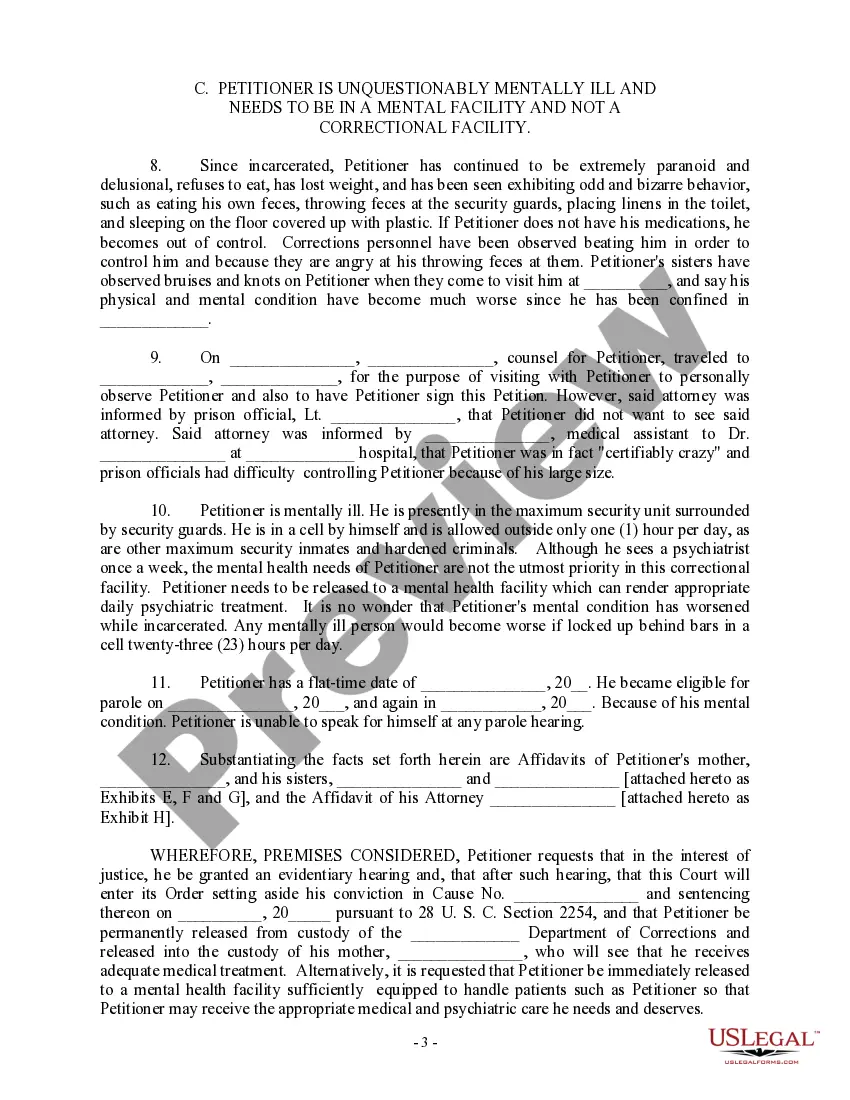
The following are some common grounds for writ of habeas corpus petitions: Introduction of new evidence that points to your innocence. Changes in the law. Incompetency during trial. Ineffective assistance of counsel. Conviction under unconstitutional law. Prosecutorial misconduct. No jurisdiction.
Unlike capital cases, there is no prescribed, fixed time period in which to seek state habeas corpus relief in a non-capital criminal case. Instead, the general rule is that such relief must be sought in a “timely fashion,” “reasonably promptly.”
A habeas corpus petition attacking a criminal conviction or sentence shall be filed within two years from the date of final judgment in the trial court or within one year from either final disposition of the direct appeal in state court or the time for filing such appeal has expired, whichever is later.
There are no “fixed statutory deadlines to determine the timeliness of a state prisoner's petition for habeas corpus. Instead, California directs petitioners to file known claims as promptly as the circumstances allow.” Walker v.
A petition for a writ of habeas corpus ad subjiciendum may be filed in the Supreme Court or any circuit court showing by affidavits or other evidence that the petitioner is detained without lawful authority.
The petition for a writ of habeas corpus challenging a criminal conviction or sentence, except as provided in Rule A for cases in which the death penalty has been imposed, shall be filed within two years from the date of the final judgment in the trial court or within one year from either final disposition of the ...
A. A party may file a petition for reconsideration of an agency's final decision made pursuant to § 2.2-4020. The petition shall be filed with the agency not later than 15 days after service of the final decision and shall state the specific grounds on which relief is requested.