Habeas Corpus Petition Form With Attorney General In Massachusetts
Description

Get your form ready online
Our built-in tools help you complete, sign, share, and store your documents in one place.
Make edits, fill in missing information, and update formatting in US Legal Forms—just like you would in MS Word.
Download a copy, print it, send it by email, or mail it via USPS—whatever works best for your next step.
Sign and collect signatures with our SignNow integration. Send to multiple recipients, set reminders, and more. Go Premium to unlock E-Sign.
If this form requires notarization, complete it online through a secure video call—no need to meet a notary in person or wait for an appointment.
We protect your documents and personal data by following strict security and privacy standards.

Make edits, fill in missing information, and update formatting in US Legal Forms—just like you would in MS Word.

Download a copy, print it, send it by email, or mail it via USPS—whatever works best for your next step.

Sign and collect signatures with our SignNow integration. Send to multiple recipients, set reminders, and more. Go Premium to unlock E-Sign.

If this form requires notarization, complete it online through a secure video call—no need to meet a notary in person or wait for an appointment.

We protect your documents and personal data by following strict security and privacy standards.
Looking for another form?









Form popularity
FAQ
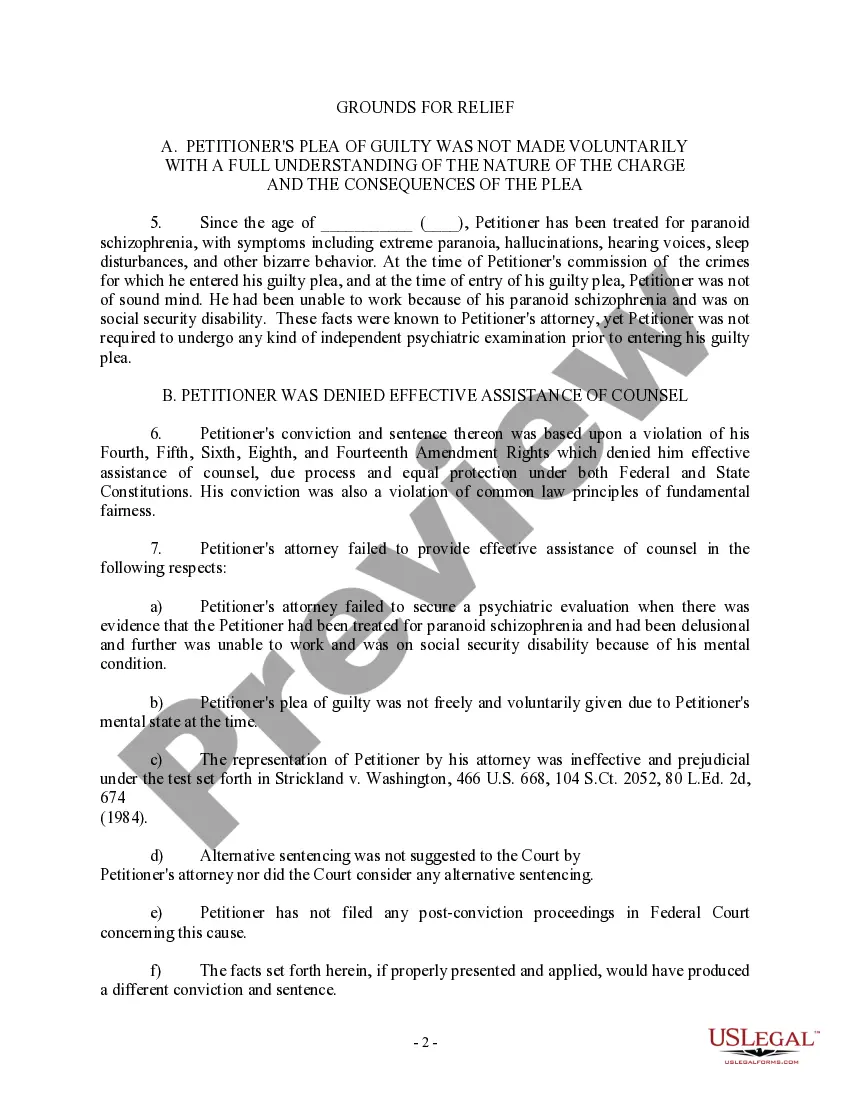
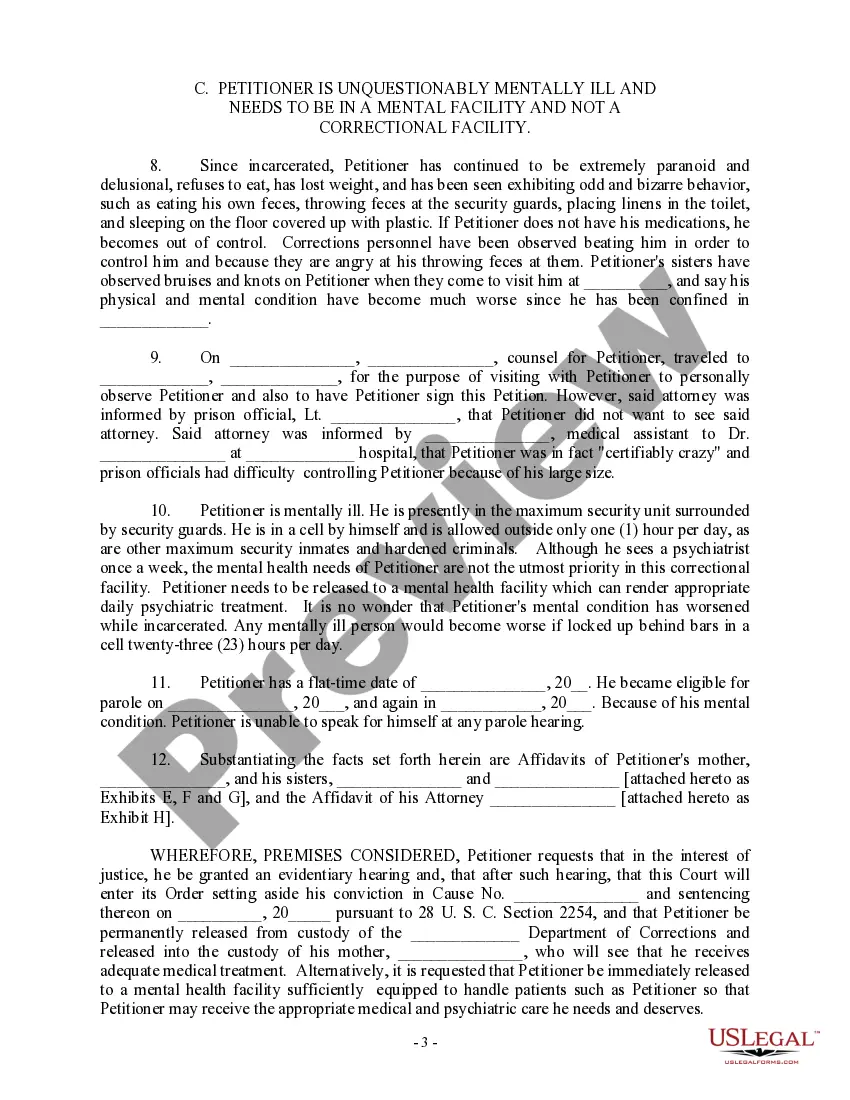
State every ground (reason) that supports your claim that you are being held in violation of the Constitution, laws, or treaties of the United States. Attach additional pages if you have more than four grounds. State the facts supporting each ground. Any legal arguments must be submitted in a separate memorandum.
The right to file a petition for writ of habeas corpus is guaranteed by the California constitution. In order to be eligible to petition for such relief, the petitioner must be “in custody,” either actually or constructively.
Ask the court for a writ of habeas corpus (a court order telling a public official, like a prison warden, to bring you to the court and show a legal reason for holding you) to challenge your criminal conviction or commitment to another facility or the conditions under which you are being held.
Section 2241 of Title 28 of the United States Code (“28 U.S.C. § 2241”) permits courts to issue writs of habeas corpus where a prisoner establishes that he is in custody in violation of the Constitution or laws or treaties of the United States.
A writ of habeas corpus in California is where an inmate challenges their conviction or sentencing. A writ of habeas corpus is a legal petition presented to judges in criminal cases by inmates in custody where they are challenging their conviction or sentencing conditions.
In essence, when you file for a Writ of Habeas Corpus, you are invoking your right to challenge your unlawful or incorrect imprisonment and you're seeking the court's ability to make an order to the government agency.
State prisoners can petition Federal courts to review the validity of their convictions and sentences; these petitions, commonly called habeas corpus petitions, allege that criminal proceedings and resulting convictions and/or sentences violated the constitutional rights of prisoners.
The Supreme Court, ajustice thereof, a circuit judge, or a district court shall enter- tain an application for a writ of habeas corpus in behalf of a person in custody pursuant to the judgment of a State court only on the ground that he is in custody in violation of the Constitution or laws or treaties of the United ...
The literal meaning of habeas corpus is "you should have the body"—that is, the judge or court should (and must) have any person who is being detained brought forward so that the legality of that person's detention can be assessed.
PETITION FOR WRIT OF HABEAS CORPUS BY A PERSON IN FEDERAL CUSTODY UNDER 28 U.S.C.
