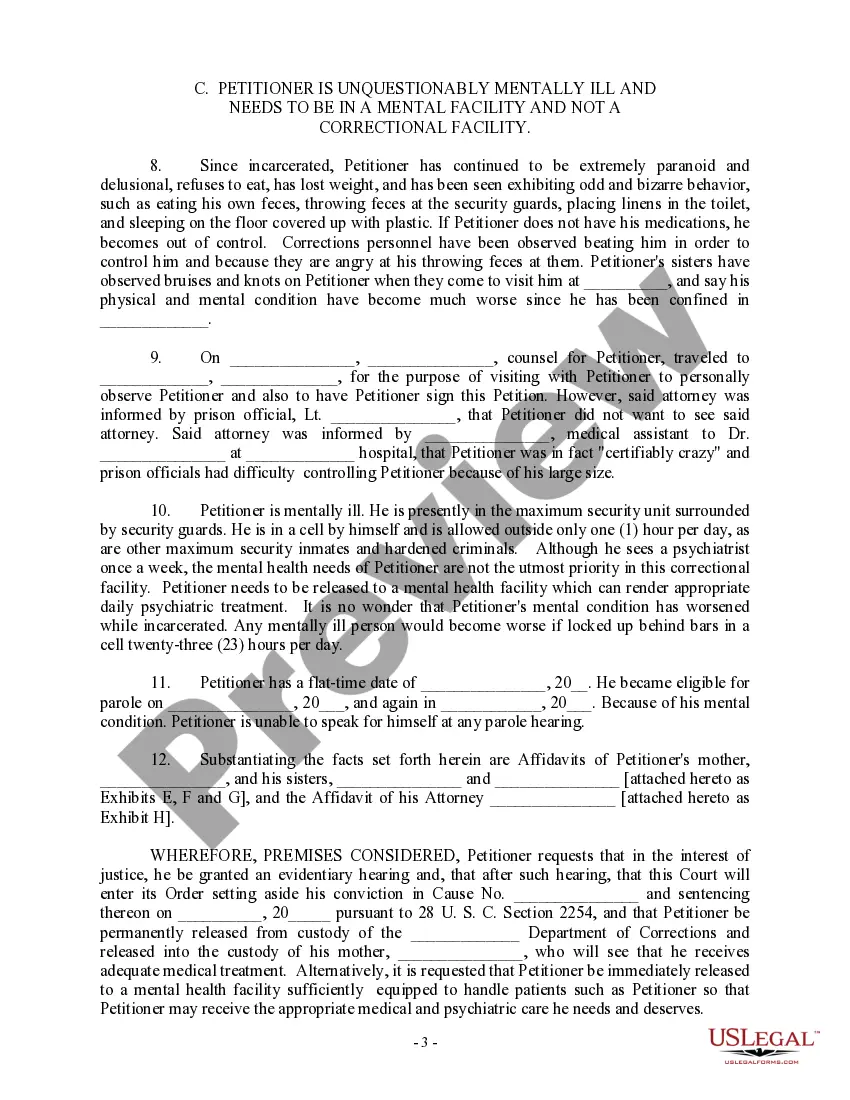
Federal Habeas Corpus Time Limit In Maryland
Description

Get your form ready online
Our built-in tools help you complete, sign, share, and store your documents in one place.
Make edits, fill in missing information, and update formatting in US Legal Forms—just like you would in MS Word.
Download a copy, print it, send it by email, or mail it via USPS—whatever works best for your next step.
Sign and collect signatures with our SignNow integration. Send to multiple recipients, set reminders, and more. Go Premium to unlock E-Sign.
If this form requires notarization, complete it online through a secure video call—no need to meet a notary in person or wait for an appointment.
We protect your documents and personal data by following strict security and privacy standards.

Make edits, fill in missing information, and update formatting in US Legal Forms—just like you would in MS Word.

Download a copy, print it, send it by email, or mail it via USPS—whatever works best for your next step.

Sign and collect signatures with our SignNow integration. Send to multiple recipients, set reminders, and more. Go Premium to unlock E-Sign.

If this form requires notarization, complete it online through a secure video call—no need to meet a notary in person or wait for an appointment.

We protect your documents and personal data by following strict security and privacy standards.
Looking for another form?




Form popularity
FAQ
§3–303. (v) commit the crime in connection with a burglary in the first, second, or third degree. (b) A person may not violate subsection (a) of this section while also violating § 3–503(a)(2) of this title involving a victim who is a child under the age of 16 years.
In other words, the writ of habeas corpus only functions to test jurisdictional defects that may invalidate the legal authority to detain the person, and the reviewing court only examines the power and authority of the governmental authority to detain the person, and does not review the correctness of the authorities' ...
28 U.S.C. § 2244(d)(1) provides for a one-year statute of limitations (deadline) for filing federal habeas corpus petitions.
HABEAS CORPUS. "'The writ of habeas corpus is a high prerogative writ, given by the common law, and made effective and enforced by statute, the great object of which is the liberation of parties who may be imprisoned or detained without sufficient cause.
The writ of habeas corpus has been suspended four times since the Constitution was ratified: throughout the entire country during the Civil War; in eleven South Carolina counties overrun by the Ku Klux Klan during Reconstruction; in two provinces of the Philippines during a 1905 insurrection; and in Hawaii after the ...
Unlike many other statutes of limitation, the one-year federal habeas corpus statute of limitations can start and stop several times, depending on whether state court collateral filings are pending or concluded. However, when it starts again, it does not start over with a full year remaining.
The Suspension Clause of the Constitution (Article I, Section 9, Clause 2) , states: “The Privileges of the Writ of Habeas Corpus shall not be suspended unless when in Cases of Rebellion or Invasion the public Safety may require it.” Although the Constitution does not specifically create the right to habeas corpus ...
Whether you are a state or federal prisoner, a federal habeas petition claims that your imprisonment is illegal because your arrest, trial, or sentence violated federal law. This would be true if any aspect of your arrest, trial, or actual sentence violated a federal statute, treaty, or the U.S. Constitution.
The "Great Writ" of habeas corpus is a fundamental right in the Constitution that protects against unlawful and indefinite imprisonment. Translated from Latin it means "show me the body." Habeas corpus has historically been an important instrument to safeguard individual freedom against arbitrary executive power.