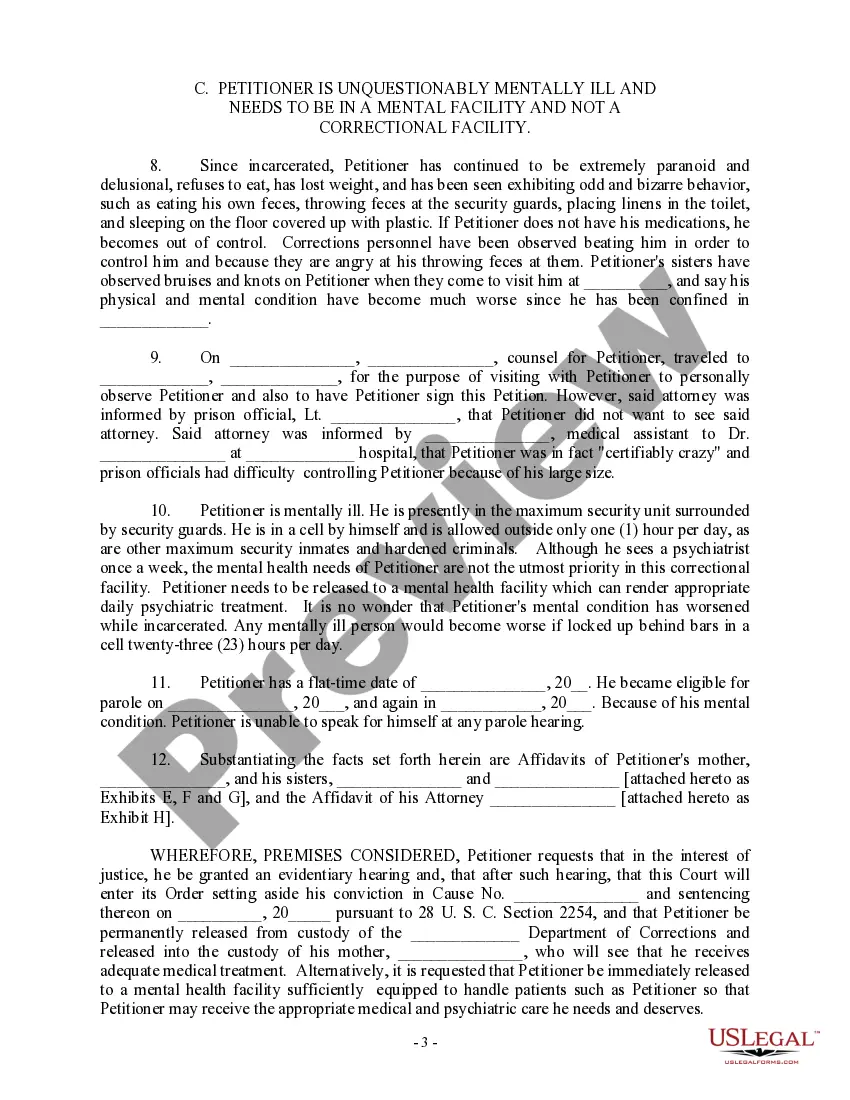
Federal Habeas Corpus Form 2241 In Bexar
Description

Get your form ready online
Our built-in tools help you complete, sign, share, and store your documents in one place.
Make edits, fill in missing information, and update formatting in US Legal Forms—just like you would in MS Word.
Download a copy, print it, send it by email, or mail it via USPS—whatever works best for your next step.
Sign and collect signatures with our SignNow integration. Send to multiple recipients, set reminders, and more. Go Premium to unlock E-Sign.
If this form requires notarization, complete it online through a secure video call—no need to meet a notary in person or wait for an appointment.
We protect your documents and personal data by following strict security and privacy standards.

Make edits, fill in missing information, and update formatting in US Legal Forms—just like you would in MS Word.

Download a copy, print it, send it by email, or mail it via USPS—whatever works best for your next step.

Sign and collect signatures with our SignNow integration. Send to multiple recipients, set reminders, and more. Go Premium to unlock E-Sign.

If this form requires notarization, complete it online through a secure video call—no need to meet a notary in person or wait for an appointment.

We protect your documents and personal data by following strict security and privacy standards.
Looking for another form?
Form popularity
FAQ
A Writ of Habeas Corpus is usually filed by submitting a Petition, a Memorandum of Points and Authorities, a Declaration from the defendant, and other evidence which supports the Writ of Habeas Corpus. The Memorandum of Points of Authorities is a legal memorandum, which contains the legal arguments of the defendant.
(b) An application for writ of habeas corpus filed after final conviction in a felony case, other than a case in which the death penalty is imposed, must be filed with the clerk of the court in which the conviction being challenged was obtained, and the clerk shall assign the application to that court.
Habeas Corpus petitions are filed in a California court by inmates or, more specifically, their attorneys, claiming they have been unlawfully detained or imprisoned. It is considered a last legal resort after other legal remedies and appeals have been exhausted.
(a) Writs of habeas corpus may be granted by the Supreme Court, any justice thereof, the district courts and any circuit judge within their respective jurisdictions. The order of a circuit judge shall be entered in the records of the district court of the district wherein the restraint complained of is had.
The court must rule on a petition for writ of habeas corpus within 60 days after the petition is filed. (B) If the court fails to rule on the petition within 60 days of its filing, the petitioner may file a notice and request for ruling.
Today, habeas corpus is mainly used as a post-conviction remedy for state or federal prisoners who challenge the legality of the application of federal laws that were used in the judicial proceedings that resulted in their detention.
A federal petition for writ of habeas corpus under 28 U.S.C. § 2254 is used by a (1) state prisoner (2) being held in state custody (3) to challenge the validity of a state criminal conviction or sentence (4) for the purpose of obtaining release from custody.
You should use this form if • you are a federal prisoner and you wish to challenge the way your sentence is being carried out (for example, you claim that the Bureau of Prisons miscalculated your sentence or failed to properly award good time credits); • you are in federal or state custody because of something other ...