Sample Motion For Judgment On The Pleadings California In Michigan
Description




Get your form ready online
Our built-in tools help you complete, sign, share, and store your documents in one place.
Make edits, fill in missing information, and update formatting in US Legal Forms—just like you would in MS Word.
Download a copy, print it, send it by email, or mail it via USPS—whatever works best for your next step.
Sign and collect signatures with our SignNow integration. Send to multiple recipients, set reminders, and more. Go Premium to unlock E-Sign.
If this form requires notarization, complete it online through a secure video call—no need to meet a notary in person or wait for an appointment.
We protect your documents and personal data by following strict security and privacy standards.

Make edits, fill in missing information, and update formatting in US Legal Forms—just like you would in MS Word.

Download a copy, print it, send it by email, or mail it via USPS—whatever works best for your next step.

Sign and collect signatures with our SignNow integration. Send to multiple recipients, set reminders, and more. Go Premium to unlock E-Sign.

If this form requires notarization, complete it online through a secure video call—no need to meet a notary in person or wait for an appointment.

We protect your documents and personal data by following strict security and privacy standards.
Looking for another form?






Form popularity
FAQ
For example, a party can make a motion to ask to allow him or her not to give the other side the discovery that was asked for. If a party thinks that a subpoena asks for documents that have nothing to do with the case, or asks for too much information, the party can make a motion to quash the subpoena.
This type of motion is typically made when the outcome of the case depends on the court's interpretation of the law. Example: In a lawsuit involving a breach of contract, the defendant may file a motion for judgment on the pleadings if they believe that the plaintiff has failed to state a valid claim.
(f) The motion provided for in this section may be made only after one of the following conditions has occurred: (1) If the moving party is a plaintiff, and the defendant has already filed his or her answer to the complaint and the time for the plaintiff to demur to the answer has expired.
Legal Reasoning—A writing sample must demonstrate your legal reasoning and analytical skills, i.e., apply law to facts, and distinguish cases on their facts. Thus, an academic survey of case law or a note that summarizes a recently published decision is not the best choice as it does not include legal analysis.
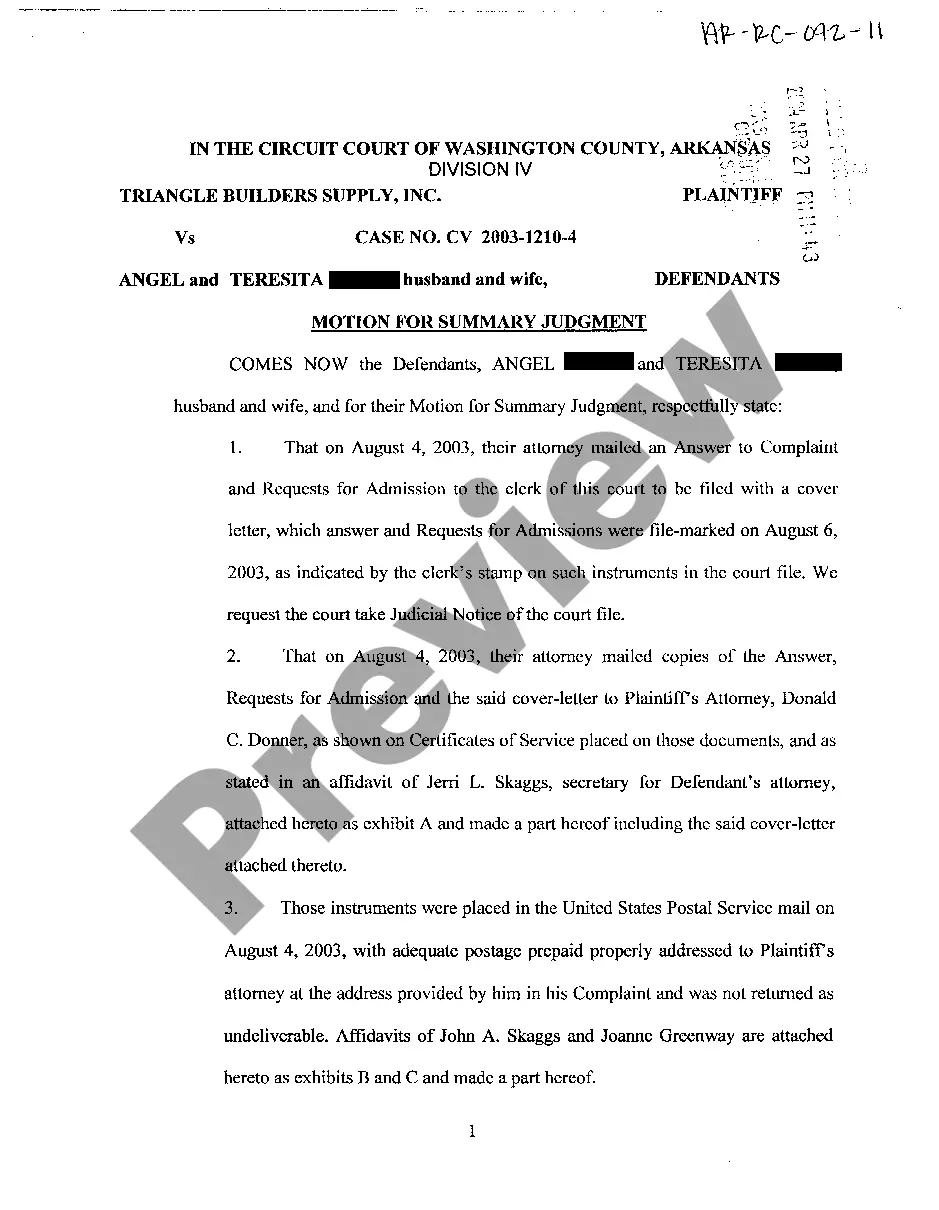
General format - each motion generally consists of a case caption, a title that briefly identifies the relief sought, a series of numbered paragraphs that explains -- in a logical way -- why you are entitled to that relief, a prayer for relief, a signature block, a certification that a copy of the motion was sent to ...
Rule 2.313 - Failure to Serve Disclosure or to Provide or to Permit Discovery; Sanctions (A) Motion for Order Compelling Disclosure or Discovery. A party, on reasonable notice to other parties and all persons affected, may apply for an order compelling disclosure or discovery as follows: (1) Appropriate Court.
Steps Check if the court has blank motion forms. Some courts have "check the boxes" or "fill in the blank" motion forms. Create your caption. Title your motion. Draft the introductory paragraph to the body of the motion. Request relief. Lay out the applicable facts. Make your legal argument. Insert a signature block.
Begin with a concise and neutral statement of the relevant facts of the case. Present the facts in a way that supports your motion. Be sure to cite to the record or evidence when necessary. This is the heart of your brief and should contain your legal arguments supporting the motion.
October 2023) In law, a summary judgment, also referred to as judgment as a matter of law or summary disposition, is a judgment entered by a court for one party and against another party summarily, i.e., without a full trial.

