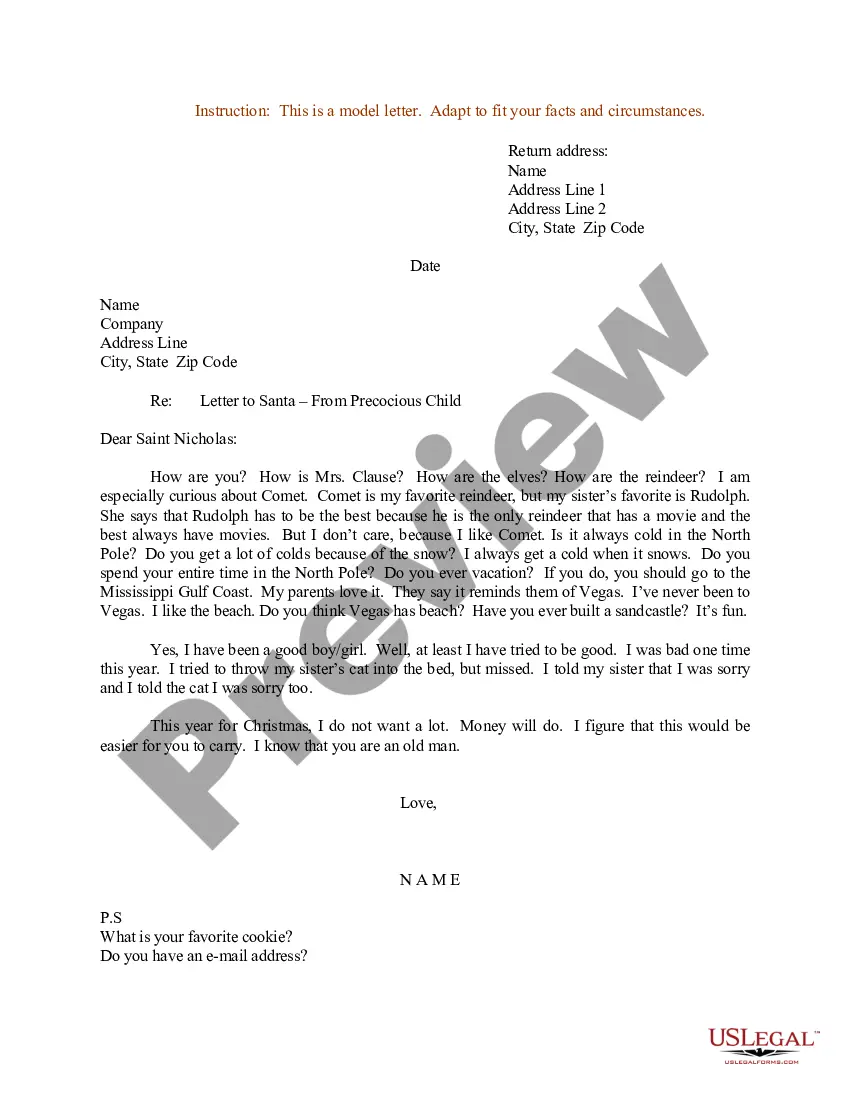
Santa Letter Examples For Older Child In Suffolk
Description

Get your form ready online
Our built-in tools help you complete, sign, share, and store your documents in one place.
Make edits, fill in missing information, and update formatting in US Legal Forms—just like you would in MS Word.
Download a copy, print it, send it by email, or mail it via USPS—whatever works best for your next step.
Sign and collect signatures with our SignNow integration. Send to multiple recipients, set reminders, and more. Go Premium to unlock E-Sign.
If this form requires notarization, complete it online through a secure video call—no need to meet a notary in person or wait for an appointment.
We protect your documents and personal data by following strict security and privacy standards.

Make edits, fill in missing information, and update formatting in US Legal Forms—just like you would in MS Word.

Download a copy, print it, send it by email, or mail it via USPS—whatever works best for your next step.

Sign and collect signatures with our SignNow integration. Send to multiple recipients, set reminders, and more. Go Premium to unlock E-Sign.

If this form requires notarization, complete it online through a secure video call—no need to meet a notary in person or wait for an appointment.

We protect your documents and personal data by following strict security and privacy standards.
Looking for another form?






Form popularity
FAQ
Hello Santa, My name is _____ and I am ___yrs old. I live at ______ - My favourite things to do are ____ and my favourite toy is ____, This year I did ____ which I really loved.
Letters may be sent to the district Consumer Affairs office. Local businesses and major corporations are recruited to volunteer their services to answer those letters in a non-committal manner. Some Post Offices™ participate in Operation Santa™ during the holidays to respond to letters.
The truth is that Santa Claus isn't a person, it is an idea. Think of all of the presents Santa gave you over the years.
Start with a greeting for example, Dear Santa or Dear Father Christmas. Step 5. Remember to include your name at the beginning of the letter, Santa receives many letters each year and he needs to know it's from you.
Anyone can write a letter! The Postal Service receives tens of thousands of letters each year written by children and adults.
How can I submit a letter for the USPS Operation Santa® Program? A letter to Santa should be placed into an envelope with a postage stamp, and sent to 123 Elf Road, North Pole, 88888.
The USPS Operation Santa® program invites everyone in the continental U.S., Hawaii, Puerto Rico and the U.S. Virgin Islands to write letters to Santa. Letters will be posted on USPSOperationSanta without personal identifying information, so others can respond to the holiday wishes.
It's fine to type your letter just as you would type an email, but print it out and mail it with postage to Santa Claus, 123 Elf Road, North Pole 88888. The USPS® accepts letters for the website every year starting in mid-October. Check the USPS Operation Santa® to get updates of the dates.
“Santa Claus lives in the North Pole. Each year on Christmas Eve, he loads up his big, red sleigh and delivers the toys to every house. Even though these presents are so special, the most important thing about Santa is the excitement and kindness he spreads. That's the real magic of Santa Claus!”
When a child asks you if Santa is real, a good response is to ask, `` What do you think?'' And then ask the child to explain WHY they believe or not believe. Then listen, don't judge. That will help you understand where she is developmentally, and it gives her an opportunity to reason out an answer for herself.