Default Prove Up Hearing With Attorney In Middlesex
Description

Get your form ready online
Our built-in tools help you complete, sign, share, and store your documents in one place.
Make edits, fill in missing information, and update formatting in US Legal Forms—just like you would in MS Word.
Download a copy, print it, send it by email, or mail it via USPS—whatever works best for your next step.
Sign and collect signatures with our SignNow integration. Send to multiple recipients, set reminders, and more. Go Premium to unlock E-Sign.
If this form requires notarization, complete it online through a secure video call—no need to meet a notary in person or wait for an appointment.
We protect your documents and personal data by following strict security and privacy standards.

Make edits, fill in missing information, and update formatting in US Legal Forms—just like you would in MS Word.

Download a copy, print it, send it by email, or mail it via USPS—whatever works best for your next step.

Sign and collect signatures with our SignNow integration. Send to multiple recipients, set reminders, and more. Go Premium to unlock E-Sign.

If this form requires notarization, complete it online through a secure video call—no need to meet a notary in person or wait for an appointment.

We protect your documents and personal data by following strict security and privacy standards.
Looking for another form?






Form popularity
FAQ
In this process, a judge (rather than a clerk) determines how much the plaintiff can collect after reviewing the amount requested by the plaintiff, which may require a court hearing. Once the default prove-up process is finished and a ruling by the judge is provided, the case is complete.
As of July 1, 2022, the jurisdictional limit of Small Claims court was increased from $3,000 to $5,000. The jurisdictional limit for the Special Civil Part was increased from $15,000.00 to $20,000.00. Any claims of $20,000.01 or more will be filed in the Law Division.
After a default judgment has been entered in the court record, the Office of the Special Civil Part will mail you a postcard that shows the date and amount of the judgment entered by the court against the defendant.
Depending on whether your pleading was verified, or not, this can be as quick as a few days in cases where the clerk can enter default, or as long as a few weeks in the event a hearing is necessary in order to secure a default judgment.
To set aside a default judgment, the defendant must demonstrate that its failure to answer or otherwise appear and defend was due to excusable neglect under the circumstances and that it has a meritorious defense either to the cause of action itself or the quantum of damages assessed.
As further bad news, default judgments do not simply vanish. The lien of a default judgment lasts five years and may be easily and repeatedly revived and transferred to other counties or states.
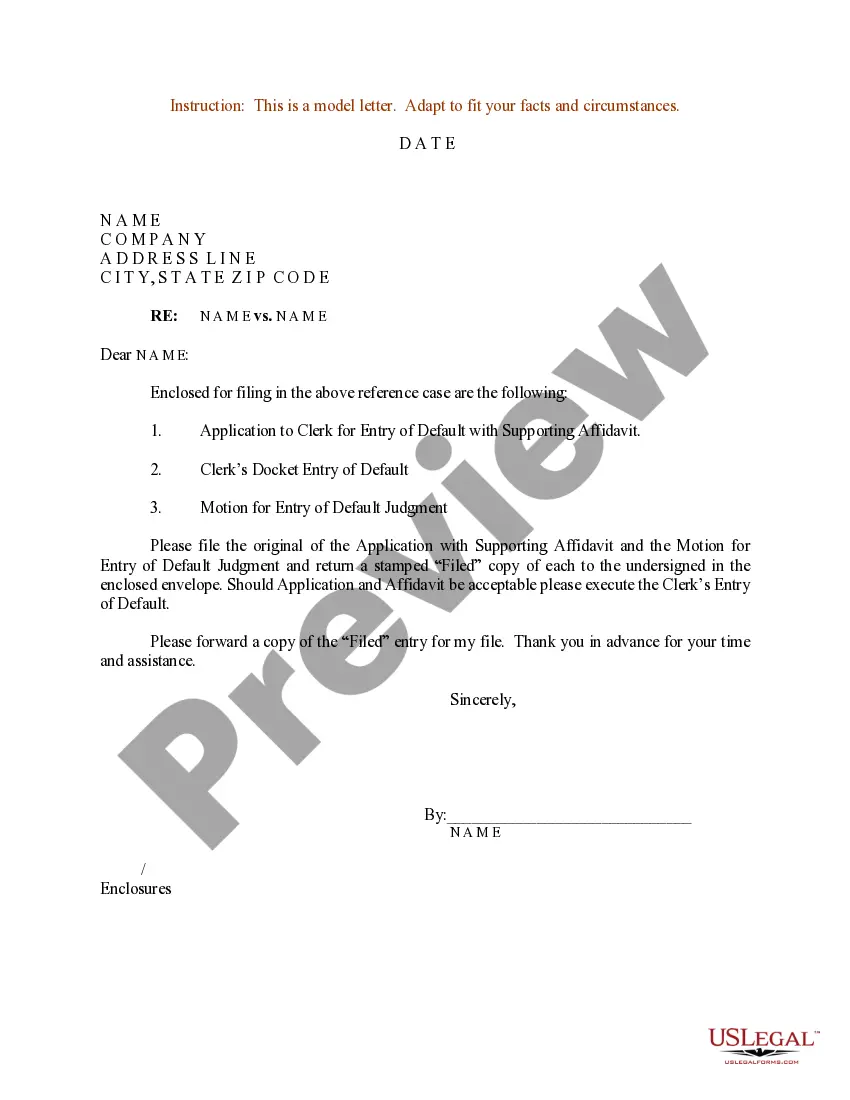
STEP 1: Determine whether or not the defendant (judgment debtor) is a member on. STEP 2: Compile all the documentation and proof you have to support the entry of. STEP 3: Complete and Sign the attached form: Certification of Proof. STEP 4: File the completed form, with all attachments, with the Office of the Special Civil.
Yes, but somebody had to go to court to get the judgement. If you were legally served with a Summons & Complaint and didn't show up in Court a ``Default Judgement'' would be entered based on the Plaintiff's case. Being ``legally'' served doesn't always mean it was personally handed to you.
