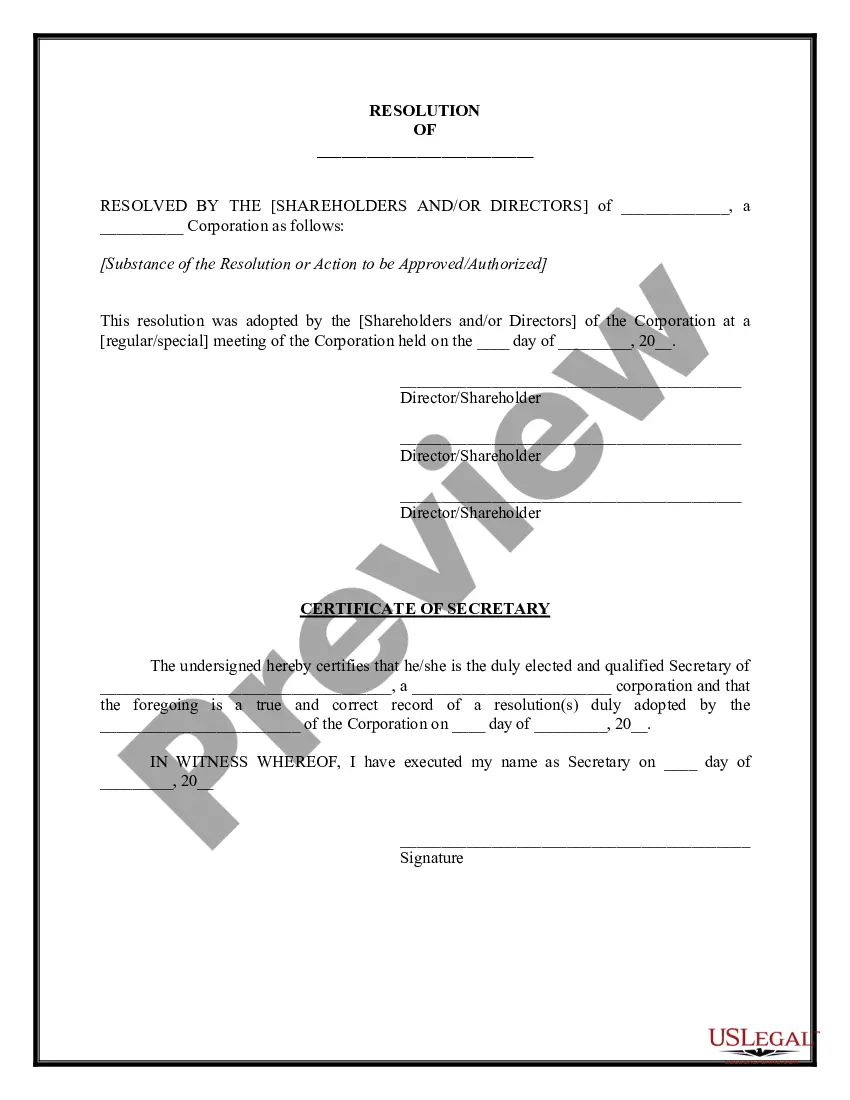
Board Resolution To Add Director In Washington
Description




Get your form ready online
Our built-in tools help you complete, sign, share, and store your documents in one place.
Make edits, fill in missing information, and update formatting in US Legal Forms—just like you would in MS Word.
Download a copy, print it, send it by email, or mail it via USPS—whatever works best for your next step.
Sign and collect signatures with our SignNow integration. Send to multiple recipients, set reminders, and more. Go Premium to unlock E-Sign.
If this form requires notarization, complete it online through a secure video call—no need to meet a notary in person or wait for an appointment.
We protect your documents and personal data by following strict security and privacy standards.

Make edits, fill in missing information, and update formatting in US Legal Forms—just like you would in MS Word.

Download a copy, print it, send it by email, or mail it via USPS—whatever works best for your next step.

Sign and collect signatures with our SignNow integration. Send to multiple recipients, set reminders, and more. Go Premium to unlock E-Sign.

If this form requires notarization, complete it online through a secure video call—no need to meet a notary in person or wait for an appointment.

We protect your documents and personal data by following strict security and privacy standards.
Looking for another form?









Form popularity
FAQ
Ordinary resolutions are key to an efficient day-to-day decision-making process in a company. They provide a structured and transparent approach to shareholders for voting on routine matters like changes in the company's name, appointment or removal of directors, appointment of auditors, issue of shares, and so on.
Typically, you'll have to follow these basic steps when adding a new board member: Hold a meeting of the board of directors. Draft a resolution to add a member. Make sure you have a quorum (the minimum number of directors who must be present to hold an official vote, which should be specified in your bylaws)
After incorporation, director appointments need to be carried out using a formal process. For this, the director should sign a letter of consent confirming they wish to act as director for the company, and a majority of members must approve the appointment of a new company director by passing an ordinary resolution.
7 steps for writing a resolution Put the date and resolution number at the top. Give the resolution a title that relates to the decision. Use formal language. Continue writing out each critical statement. Wrap up the heart of the resolution in the last statement.
How to fill out a resolution of the board of directors? Date, time, and location of the meeting. Title that describes the board's decision to be made. Statement of majority or unanimous decision. Resolution of the decision, including any necessary actions. Officers responsible for carrying out the resolution.
The board resolution for appointment of director in company must identify the names of the director (s), their designation, the entity, and their consent. It must be two-staged. The resolution must be approved by the meeting to cover any future disputes.
Resolved that: The shareholders appoint insert name as a director of the Company with effect from the date of this resolutioninsert date. Signed for and on behalf of the shareholders of name of Company: User note: Use the following signature block for each shareholder that is an individual.
Get approval to appoint a new director In the case of companies that have adopted Model articles, the appointment of a new director can be approved by way of a simple majority of votes at a board meeting. Alternatively, a written resolution can achieve the same result, but it must be unanimous.
The board resolution for appointment of director in company must identify the names of the director (s), their designation, the entity, and their consent. It must be two-staged. The resolution must be approved by the meeting to cover any future disputes.
A Directors' Resolution to Appoint Director(s) and/or Acknowledge Resignation of Director(s) is a resolution passed by the directors of a company to appoint a new director, typically to fill a casual vacancy on the board after a resignation. Once appointed, the board will send a Director's Appointment Letter.