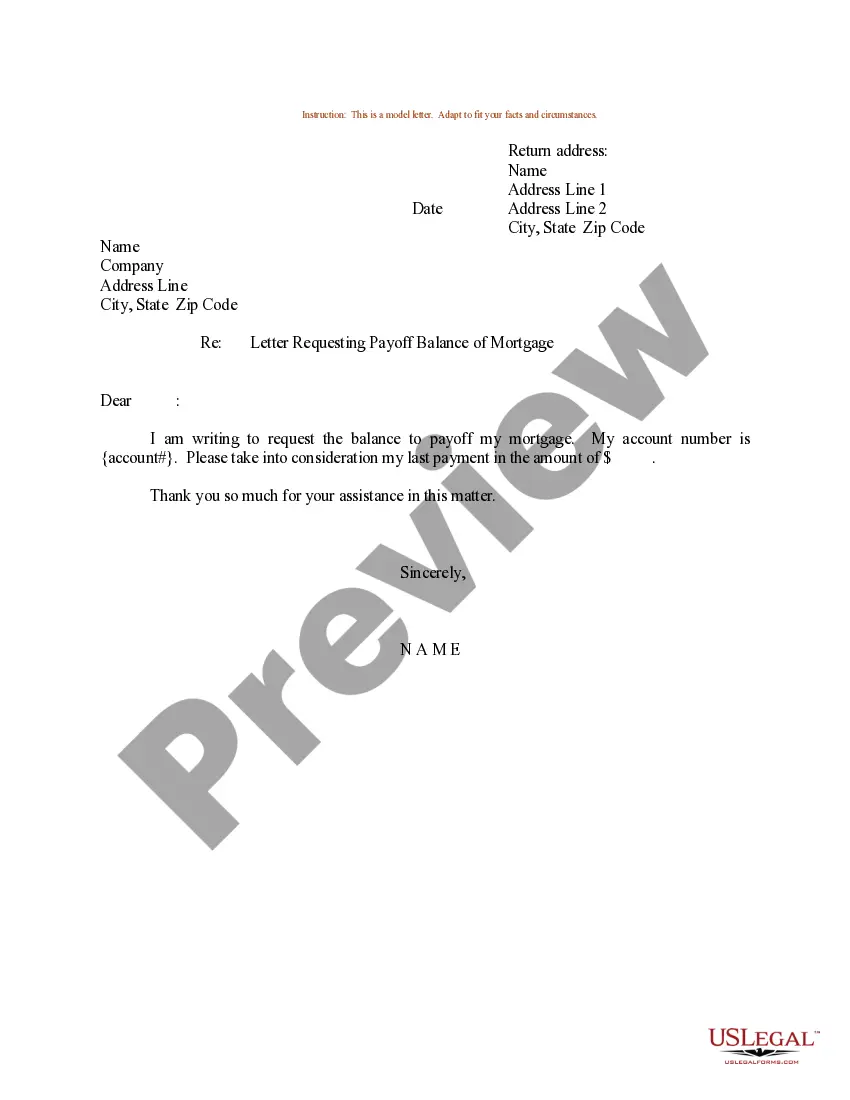
Loan Payoff Letter Format Foreclosure In Miami-Dade
Description
Get your form ready online
Our built-in tools help you complete, sign, share, and store your documents in one place.
Make edits, fill in missing information, and update formatting in US Legal Forms—just like you would in MS Word.
Download a copy, print it, send it by email, or mail it via USPS—whatever works best for your next step.
Sign and collect signatures with our SignNow integration. Send to multiple recipients, set reminders, and more. Go Premium to unlock E-Sign.
If this form requires notarization, complete it online through a secure video call—no need to meet a notary in person or wait for an appointment.
We protect your documents and personal data by following strict security and privacy standards.

Make edits, fill in missing information, and update formatting in US Legal Forms—just like you would in MS Word.

Download a copy, print it, send it by email, or mail it via USPS—whatever works best for your next step.

Sign and collect signatures with our SignNow integration. Send to multiple recipients, set reminders, and more. Go Premium to unlock E-Sign.

If this form requires notarization, complete it online through a secure video call—no need to meet a notary in person or wait for an appointment.

We protect your documents and personal data by following strict security and privacy standards.
Looking for another form?





Form popularity
FAQ
How to Dispute a Wage Garnishment in Florida Determine Whether Grounds to Object Exist. Before a debtor spends time pursuing an objection to a wage garnishment, it is important to establish whether grounds to do so are present. File a Written Objection. Attend the Garnishment Hearing.
Interest Rates on Final Judgments - October 1, 2023 - December 31, 2023 - 8.54%
A creditor can garnish 25% of your disposable income or the amount by which your disposable income exceeds 30 times the federal minimum wage, whichever is less. In Florida, if your disposable income is less than 30 times the federal minimum wage, your wages can't be garnished at all.
After you have redeemed your property, you will receive a “Clerk's Certificate of Satisfaction of Final Judgment of Foreclosure” which will be recorded in the Public Records at the County Recorder's Office – 22 NW 1st Street, Miami, Florida, 33128, phone # (305) 275-1155.
Steps to file a mechanics lien in Miami-Dade County Step 1: Get The Right Form & Meet Margin Requirements. Step 2: Calculating Your Miami-Dade County Filing Fees. Step 3: Serve the Mechanics Lien. Step 4: File your lien with the Miami-Dade County Clerk.
To attach a lien, the creditor must record the judgment with the county recorder in any Florida county where the debtor owns real estate now or may own real estate in future. For liens on personal property, the creditor files the judgment with the Florida Department of State.
Steps to file a mechanics lien in Miami-Dade County Step 1: Get The Right Form & Meet Margin Requirements. Step 2: Calculating Your Miami-Dade County Filing Fees. Step 3: Serve the Mechanics Lien. Step 4: File your lien with the Miami-Dade County Clerk.
Recorded: These notices are filed with the county recorder offices in the county where the construction project is located.
Generally, you will file the Notice of Commencement with the county where the project is located or the state construction registry. Depending on your filing location, you may have the option to file in person, by mail, or electronically.

