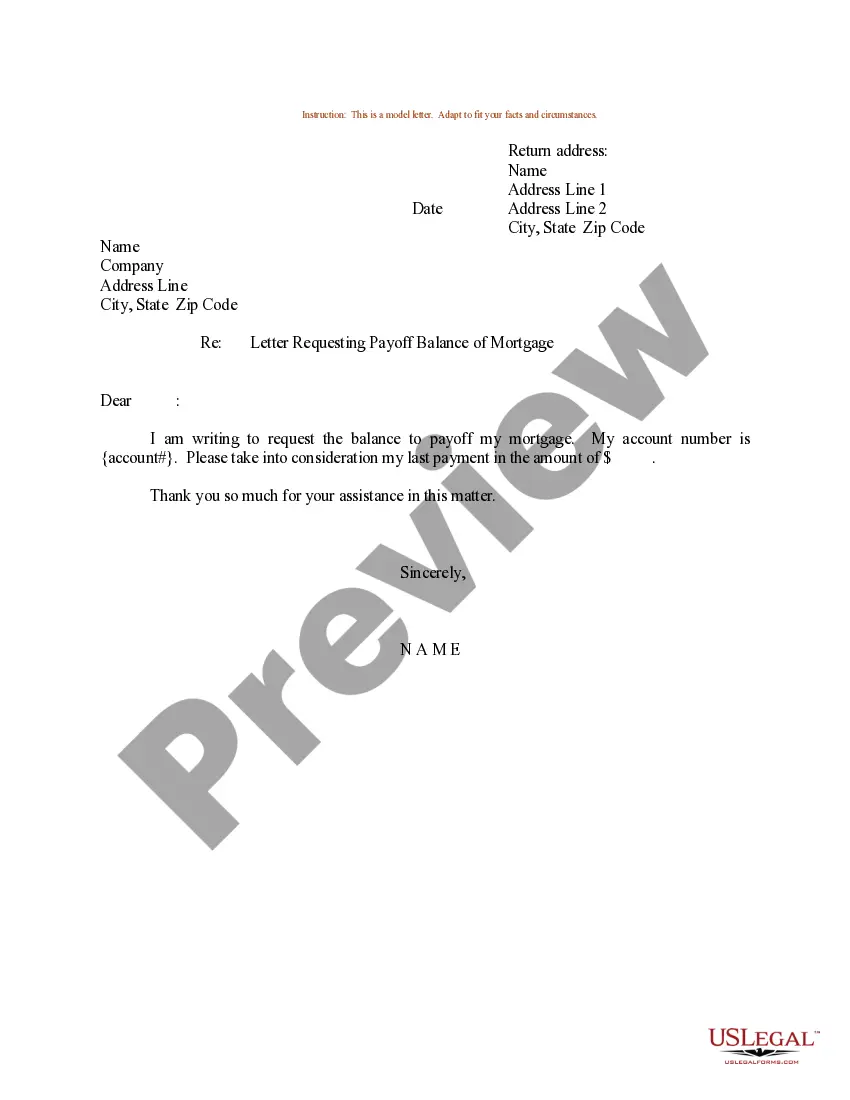
Loan Payoff Letter Example With Interest In Illinois
Description
Get your form ready online
Our built-in tools help you complete, sign, share, and store your documents in one place.
Make edits, fill in missing information, and update formatting in US Legal Forms—just like you would in MS Word.
Download a copy, print it, send it by email, or mail it via USPS—whatever works best for your next step.
Sign and collect signatures with our SignNow integration. Send to multiple recipients, set reminders, and more. Go Premium to unlock E-Sign.
If this form requires notarization, complete it online through a secure video call—no need to meet a notary in person or wait for an appointment.
We protect your documents and personal data by following strict security and privacy standards.

Make edits, fill in missing information, and update formatting in US Legal Forms—just like you would in MS Word.

Download a copy, print it, send it by email, or mail it via USPS—whatever works best for your next step.

Sign and collect signatures with our SignNow integration. Send to multiple recipients, set reminders, and more. Go Premium to unlock E-Sign.

If this form requires notarization, complete it online through a secure video call—no need to meet a notary in person or wait for an appointment.

We protect your documents and personal data by following strict security and privacy standards.
Looking for another form?









Form popularity
FAQ
The payment of a salary, debt, wager, etc. the time at which such payment is made. the consequence, outcome, or final sequence in a series of events, actions, or circumstances: The payoff was when they fired him.
Most debt settlement letters include: The date, name, and address of the credit card company. A notation after the address that this is regarding a hardship letter. The credit card number and amount of the debt. A short statement of your financial situation, why you're in that situation, and why full payment is a hardship.
We're all familiar with the basic concept of setup and payoffs: early on in your screenplay, you set up some detail/scenario that may seem irrelevant, but later on will yield a result that hopefully your audience wasn't anticipating (the payoff).
A letter of intent (also known as an LOI) is often written to initiate a business transaction and help define expectations with customers, partners, and vendors before creating a binding agreement.
A letter of intent is a document outlining the intentions of two or more parties to do business together; it is often non-binding unless the language in the document specifies that the companies are legally bound to the terms.
Lenders multiply your outstanding balance by your annual interest rate but divide by 12 because you're making monthly payments. So if you owe $300,000 on your mortgage and your rate is 4%, you'll initially owe $1,000 in interest per month ($300,000 x 0.04 ÷ 12).

