Private Loan Payoff Letter Template With Payment Plan In Hennepin
Description
Get your form ready online
Our built-in tools help you complete, sign, share, and store your documents in one place.
Make edits, fill in missing information, and update formatting in US Legal Forms—just like you would in MS Word.
Download a copy, print it, send it by email, or mail it via USPS—whatever works best for your next step.
Sign and collect signatures with our SignNow integration. Send to multiple recipients, set reminders, and more. Go Premium to unlock E-Sign.
If this form requires notarization, complete it online through a secure video call—no need to meet a notary in person or wait for an appointment.
We protect your documents and personal data by following strict security and privacy standards.

Make edits, fill in missing information, and update formatting in US Legal Forms—just like you would in MS Word.

Download a copy, print it, send it by email, or mail it via USPS—whatever works best for your next step.

Sign and collect signatures with our SignNow integration. Send to multiple recipients, set reminders, and more. Go Premium to unlock E-Sign.

If this form requires notarization, complete it online through a secure video call—no need to meet a notary in person or wait for an appointment.

We protect your documents and personal data by following strict security and privacy standards.
Looking for another form?




Form popularity
FAQ
Under federal law, the servicer must generally send you a payoff statement within seven business days of your request, subject to a few exceptions. (12 C.F.R. § 1026.36.)
A property owner can choose to place a lien on their property. A voluntary lien is a claim over the property that a homeowner agrees to give to a creditor as security for the payment of a debt. A mortgage lien is the most common type of voluntary real estate lien, also called a deed of trust lien in some states.
In Minnesota, a mechanics lien must generally be filed with the county recorder. However, if the lien is claimed against registered land, it must be recorded with the Registrar of Titles (in some counties, the Registrar and Recorder are the same person).
In Minnesota, a mechanics lien must generally be filed with the county recorder. However, if the lien is claimed against registered land, it must be recorded with the Registrar of Titles (in some counties, the Registrar and Recorder are the same person).
How to File a Quitclaim Deed in Minnesota Step 1: Locate the Current Property Deed. Step 2: Find the Property's Legal Description. Step 3: Complete the Quitclaim Form. Step 4: Complete Disclosures. Step 5: Sign Before a Notary. Step 6: File the Deed With the County Recorder's Office.
Tax, and interest and penalties imposed with respect thereto, including any recording fees, sheriff fees, or court costs that may accrue, shall become a lien upon all the property within this state, both real and personal, of the person liable for the payment or collection of the tax, except property exempt under ...
A lien expires after 10 years. We can renew it before it expires and continue to take collection actions. These time limits are part of Minnesota Statute 270C.
Broadly speaking a letter of direction (letter of instruction)1 is any letter that gives instruction and guidance to a recipient. Letters of direction are also common in situations when somebody has passed away, and the executor requires documentation to prove they are in control of the deceased's estate.
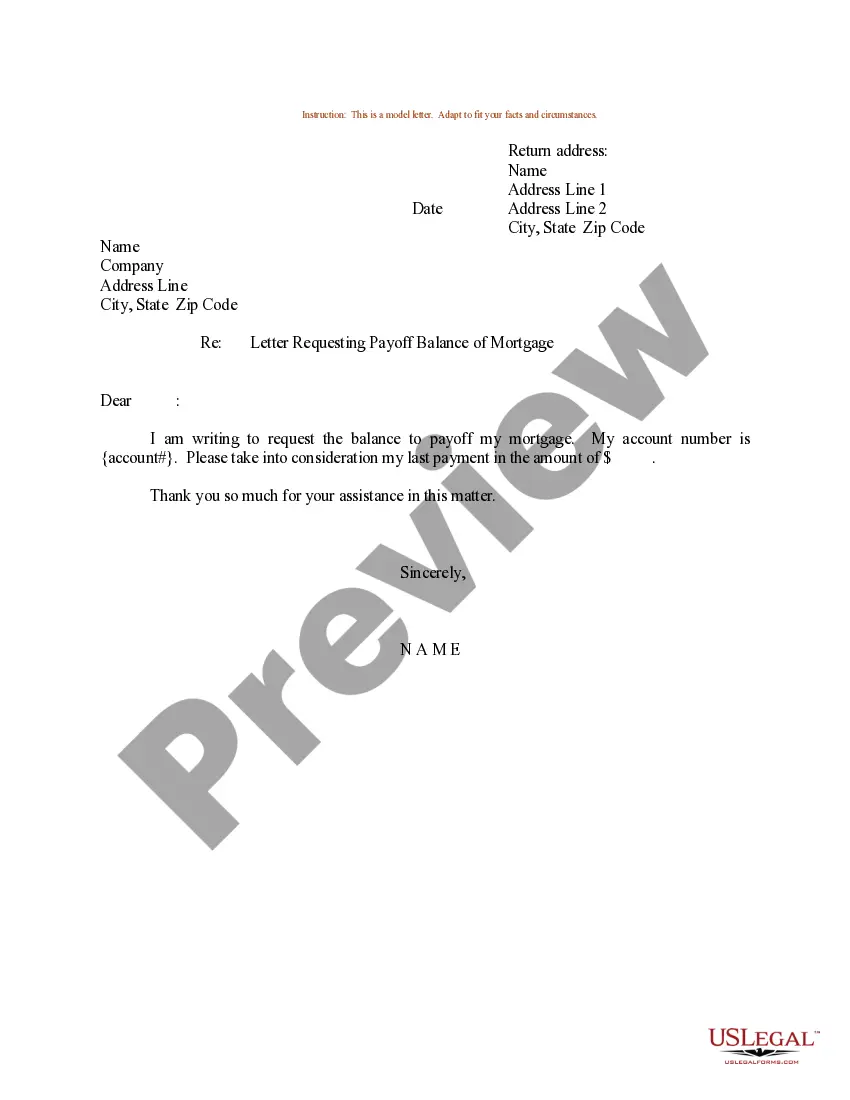
To get a payoff letter, ask your lender for an official payoff statement. Call or write to customer service or make the request online. While logged into your account, look for options to request or calculate a payoff amount, and provide details such as your desired payoff date.

