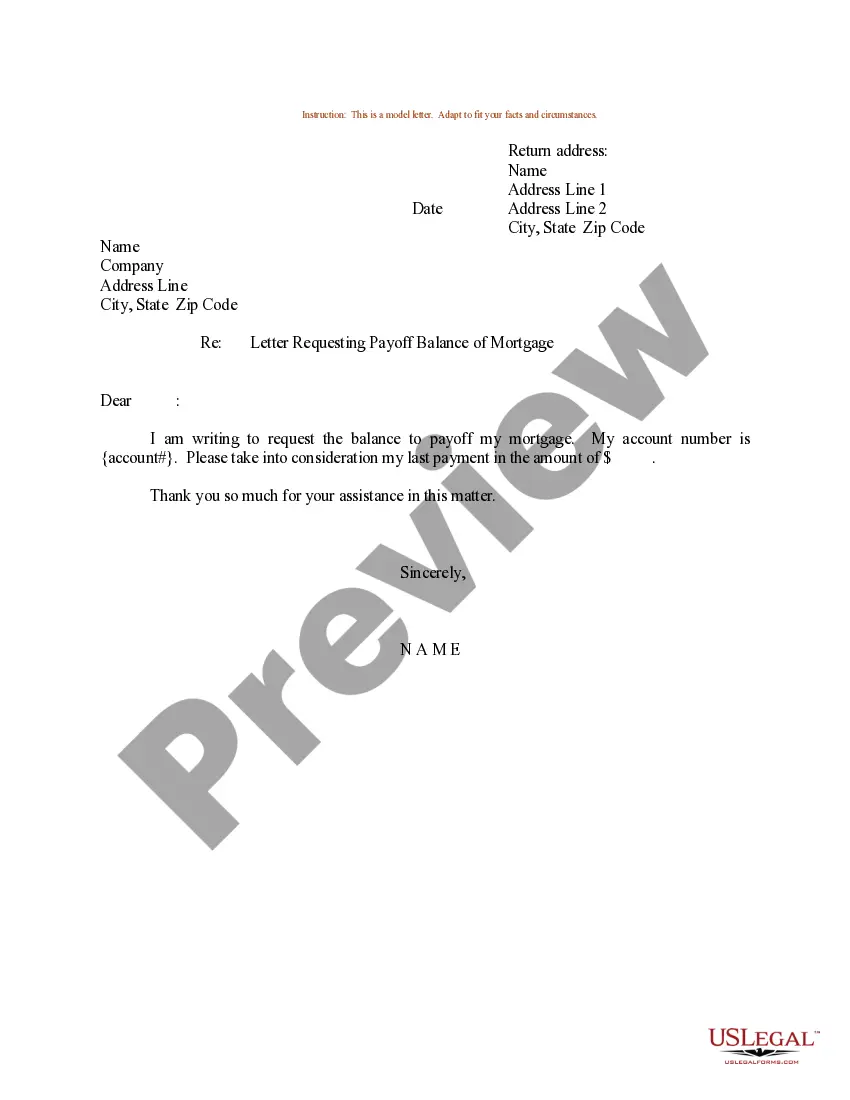
Loan Payoff Letter Sample With Reason In Fairfax
Description
Get your form ready online
Our built-in tools help you complete, sign, share, and store your documents in one place.
Make edits, fill in missing information, and update formatting in US Legal Forms—just like you would in MS Word.
Download a copy, print it, send it by email, or mail it via USPS—whatever works best for your next step.
Sign and collect signatures with our SignNow integration. Send to multiple recipients, set reminders, and more. Go Premium to unlock E-Sign.
If this form requires notarization, complete it online through a secure video call—no need to meet a notary in person or wait for an appointment.
We protect your documents and personal data by following strict security and privacy standards.

Make edits, fill in missing information, and update formatting in US Legal Forms—just like you would in MS Word.

Download a copy, print it, send it by email, or mail it via USPS—whatever works best for your next step.

Sign and collect signatures with our SignNow integration. Send to multiple recipients, set reminders, and more. Go Premium to unlock E-Sign.

If this form requires notarization, complete it online through a secure video call—no need to meet a notary in person or wait for an appointment.

We protect your documents and personal data by following strict security and privacy standards.
Looking for another form?








Form popularity
FAQ
Under federal law, the servicer must generally send you a payoff statement within seven business days of your request, subject to a few exceptions. (12 C.F.R. § 1026.36.)
The statement is provided by the mortgage servicer and can be requested at any time. Accurate payoff information is crucial for managing financial decisions related to property ownership.
Rule . — All final judgments, orders, and decrees, irrespective of terms of court, remain under the control of the trial court and may be modified, vacated, or suspended for twenty-one days after the date of entry, and no longer.
If you wish to start a civil action in federal court, but do not have an attorney to represent you, you may bring your case on your own. Bringing a case on your own is called proceeding "pro se".
Notwithstanding any provision of law to the contrary, the small claims court shall have jurisdiction, concurrent with that of the general district court, over the civil action specified in § 16.1-77 (1) when the amount claimed does not exceed $5,000, exclusive of interest.
If you don't have the current tax year's Notice of Assessment Change, you can get the Web Control Number by calling, 703-222-8234 (TTY 711) (Monday - Friday, a.m. - p.m.), or using our online Contact Us form.
Exceptions to Civil Statutes of Limitations Injury to PersonTwo years (Refer to §8.01-243(A).) Libel/Slander Two years (Refer to§8.01-243(A).) Fraud Two years (Refer to §8.01-243(A).) Injury to Personal Property Five years (Refer to §8.01-243(B).)6 more rows
Qualify for Personal Property Tax Relief Per the Code of Virginia §58.1-3524, personal property tax relief (PPTR) gives tax relief on the taxes due for the first $20,000 in assessed value on qualified personal vehicles. No relief is given on any assessment amounts over $20,000.
You need the Virginia State's Division of Motor Vehicles website. How can I obtain information about personal property taxes? You can call the Personal Property Tax Division at (804) 501-4263 or visit the Department of Finance website .
Real Estate tax bills are due in two installments on July 28 and December 5 of each calendar year. If the due date falls on a weekend, the due date moves to the next business day.
