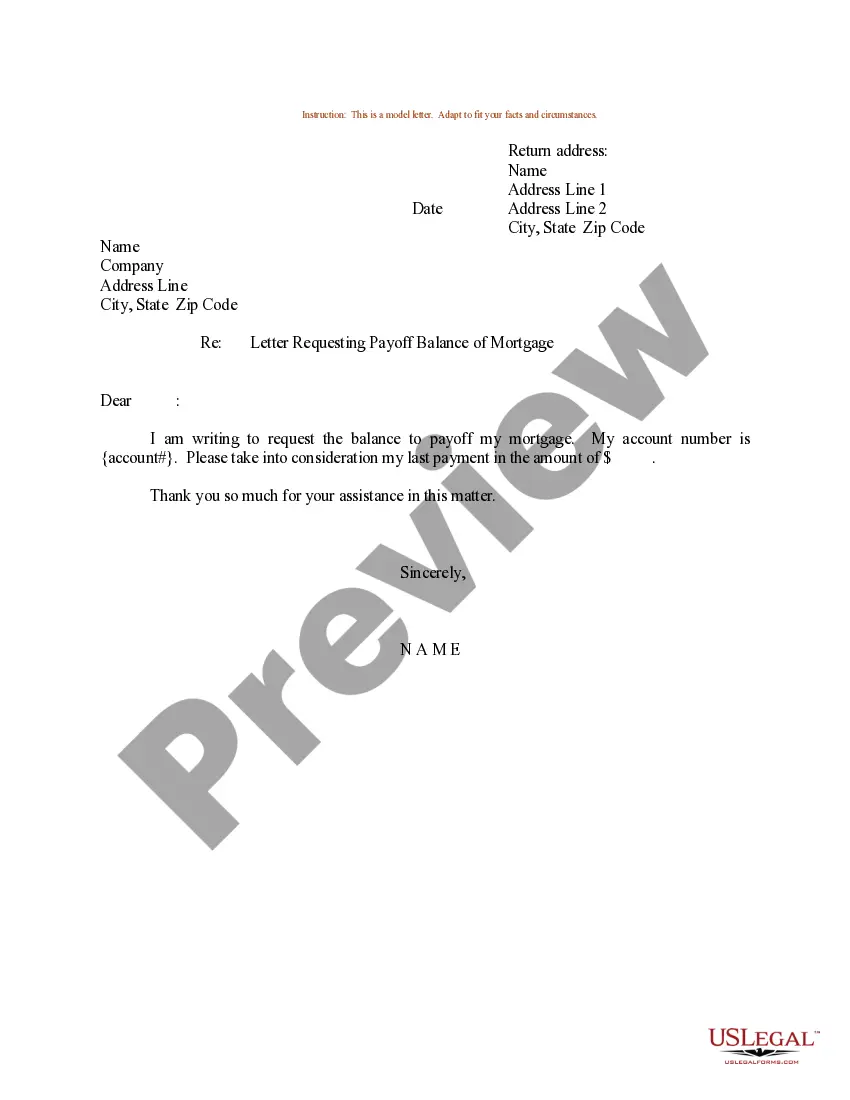
Loan Payoff Letter Format For Audit In Contra Costa
Description
Get your form ready online
Our built-in tools help you complete, sign, share, and store your documents in one place.
Make edits, fill in missing information, and update formatting in US Legal Forms—just like you would in MS Word.
Download a copy, print it, send it by email, or mail it via USPS—whatever works best for your next step.
Sign and collect signatures with our SignNow integration. Send to multiple recipients, set reminders, and more. Go Premium to unlock E-Sign.
If this form requires notarization, complete it online through a secure video call—no need to meet a notary in person or wait for an appointment.
We protect your documents and personal data by following strict security and privacy standards.

Make edits, fill in missing information, and update formatting in US Legal Forms—just like you would in MS Word.

Download a copy, print it, send it by email, or mail it via USPS—whatever works best for your next step.

Sign and collect signatures with our SignNow integration. Send to multiple recipients, set reminders, and more. Go Premium to unlock E-Sign.

If this form requires notarization, complete it online through a secure video call—no need to meet a notary in person or wait for an appointment.

We protect your documents and personal data by following strict security and privacy standards.
Looking for another form?




Form popularity
FAQ
Audit team reports frequently adhere to the rule of the “Five C's” of data sharing and communication, and a thorough summary in a report will include each of these elements. The “Five C's” are criteria, condition, cause, consequence, and corrective action.
A financial audit is a thorough, detailed examination of a company's financial statements and accounts. A dispassionate third-party auditor conducts the audit and develops an audit opinion based on the most recent financial statements. This information helps guide decision-making and controls.
Steps for conducting a financial audit Understand your goals. Decide what to include in your audit. Gather and organise your materials. Begin data analysis. Consider financial security. Examine tax reporting status. Compile a report.
A typical external or internal audit has four stages – planning, fieldwork, reporting, and follow-up. The accounting audit process is designed to ensure that the financial statements are examined thoroughly and accurately, providing stakeholders with confidence in the reliability of the financial information.
The Public Company Accounting Oversight Board oversees the audits of public companies and SEC-registered brokers and dealers.
Please email Contra Costa County Communications Director Kristi Jourdan at Kristi.Jourdan@contracostatv or call 925-313-1180 if you need assistance finding the right department or person.
The Audited Financial Statement may be filed with the BIR manually or online. Filing manually means physically attending at your local Regional District Office (RDO) of the BIR and filing hard copies of the AFS at the counter.
Creation: Any accountant can create an unaudited financial statement. Only a CPA can create an audited financial statement.
Statutory Audit: The statutory audit must be done before the AGM of the company is conducted. The statutory auditor needs to submit the audit report to the board before the conduct of AGM. The audit report should be attached with the company's financial statements and filed with the ROC.

