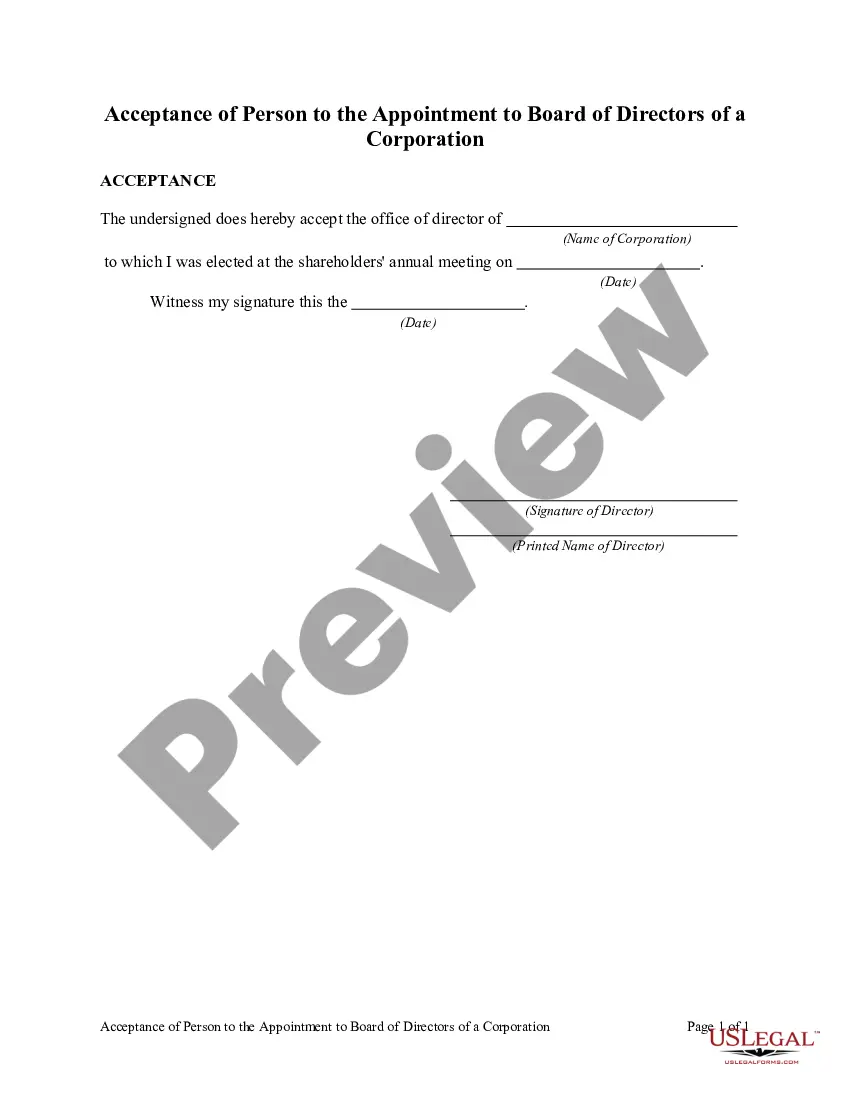
Directors Appointment And Removal In Maryland
Description


Get your form ready online
Our built-in tools help you complete, sign, share, and store your documents in one place.
Make edits, fill in missing information, and update formatting in US Legal Forms—just like you would in MS Word.
Download a copy, print it, send it by email, or mail it via USPS—whatever works best for your next step.
Sign and collect signatures with our SignNow integration. Send to multiple recipients, set reminders, and more. Go Premium to unlock E-Sign.
If this form requires notarization, complete it online through a secure video call—no need to meet a notary in person or wait for an appointment.
We protect your documents and personal data by following strict security and privacy standards.

Make edits, fill in missing information, and update formatting in US Legal Forms—just like you would in MS Word.

Download a copy, print it, send it by email, or mail it via USPS—whatever works best for your next step.

Sign and collect signatures with our SignNow integration. Send to multiple recipients, set reminders, and more. Go Premium to unlock E-Sign.

If this form requires notarization, complete it online through a secure video call—no need to meet a notary in person or wait for an appointment.

We protect your documents and personal data by following strict security and privacy standards.
Looking for another form?





Form popularity
FAQ
The statutory procedure allows any director to be removed by ordinary resolution of the shareholders in general meetings (i.e., the holders of more than 50% of the voting shares must agree). This right of removal by the shareholders cannot be excluded by the Articles or by any agreement.
A resolution for removing a director must be passed in the general meeting of shareholders after giving the director an opportunity of being heard. After passing the resolution, form DIR-12 must be filed with the ROC. After filing the form, the director's name would be struck off from the MCA website.
How is a director removed in a public company? Members (shareholders) can remove a director by resolution (s 203D (1)). This is despite anything in the company's constitution, an agreement between the company and the director or an agreement between any or all members of the company and the director.
A shareholder wishing to propose a resolution to remove a director must give special notice of his intention to the company. On receipt of this special notice, the board of directors must call a general meeting of the shareholders of the company to consider the proposed resolution.
Pass an Ordinary Resolution During the meeting, shareholders can vote on a resolution to remove the director. This process follows the principle of majority rule, with an ordinary resolution being passed when the majority of shareholders vote in favor.
Removal for Cause means the removal of a Director upon an intentional failure to perform stated duties, personal dishonesty which results in loss to the Company or one of its Affiliates or willful violation of any law, rules or regulation (other than traffic violations or similar offenses) or final cease-and-desist ...
Unless there is a special provision in the company's Articles of Association a director cannot be removed from office by the Board of Directors, and only the shareholders can remove a director. The Articles may provide a procedure for this; otherwise the statutory procedure must be used.
They resign. a majority of the company shareholders vote them out by ordinary resolution. they're stopped from being a director by a court or in law.
If the director resigns; if the director becomes bankrupt or makes any compromise or arrangement with his or her creditors generally; if the director suffers from mental disorder; if the director is prohibited by law from being a director (which includes disqualification);