360 Feedback Examples For Leadership In Suffolk
Description

Get your form ready online
Our built-in tools help you complete, sign, share, and store your documents in one place.
Make edits, fill in missing information, and update formatting in US Legal Forms—just like you would in MS Word.
Download a copy, print it, send it by email, or mail it via USPS—whatever works best for your next step.
Sign and collect signatures with our SignNow integration. Send to multiple recipients, set reminders, and more. Go Premium to unlock E-Sign.
If this form requires notarization, complete it online through a secure video call—no need to meet a notary in person or wait for an appointment.
We protect your documents and personal data by following strict security and privacy standards.

Make edits, fill in missing information, and update formatting in US Legal Forms—just like you would in MS Word.

Download a copy, print it, send it by email, or mail it via USPS—whatever works best for your next step.

Sign and collect signatures with our SignNow integration. Send to multiple recipients, set reminders, and more. Go Premium to unlock E-Sign.

If this form requires notarization, complete it online through a secure video call—no need to meet a notary in person or wait for an appointment.

We protect your documents and personal data by following strict security and privacy standards.
Looking for another form?








Form popularity
FAQ
How 360-Degree Feedback Works Selection of participants. Survey distribution. Data collection and analysis. Feedback review session. Action planning. Follow-up. Comprehensive feedback. Increases self-awareness.
360° feedback is a developmental tool for managers and leaders. The purpose of 360° feedback is to provide feedback on the participant's skills, attributes and other relevant characteristics and thus help to build a richer, more complete and accurate picture than would be obtained from a single source.
Here are examples of positive leadership feedback: “I've been really impressed with the way you've fostered collaboration within the team. Your open communication style and active listening have created a work environment where everyone feels valued and heard.
Hi coworker's name, I'm in the process of gathering feedback for my 360 degree review. As my coworker, your input will be extremely helpful to my understanding of my overall performance. It would also be great if you could include any specific comments you have about my performance.
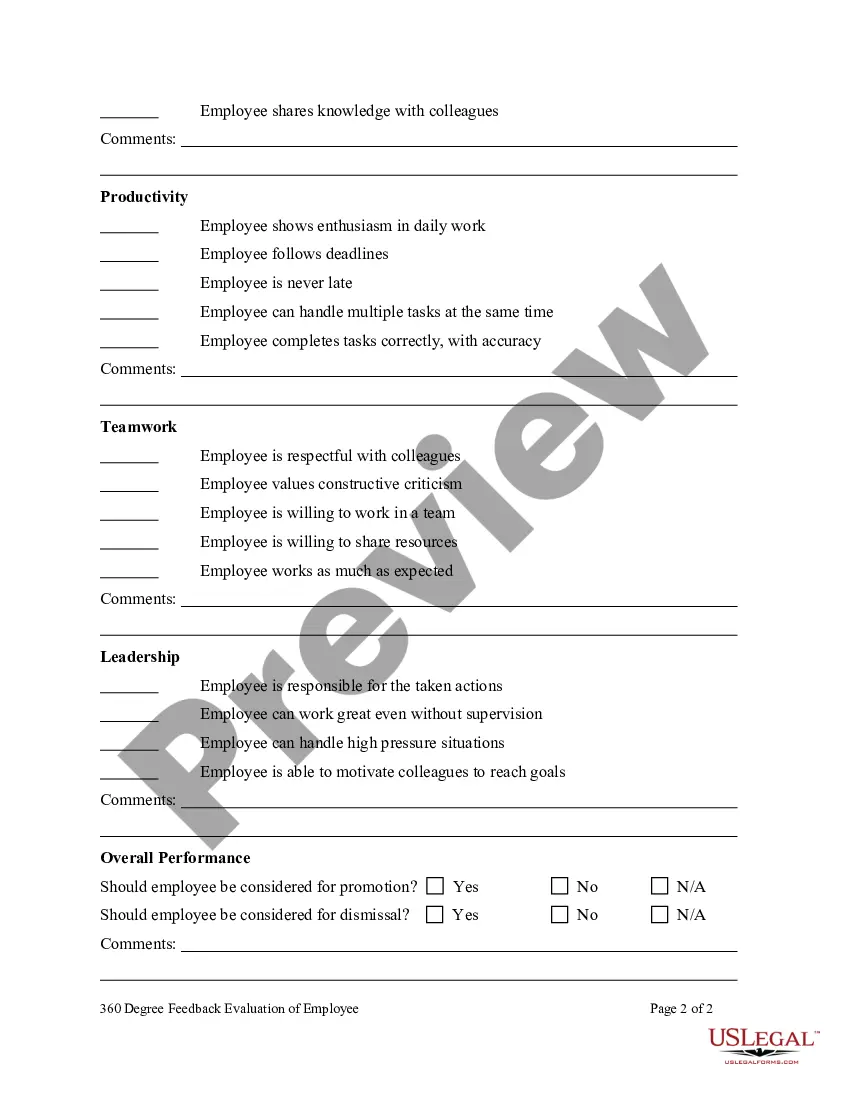
A 360 degree leadership assessment is a form of feedback for leaders in which their skills, effectiveness and influence as an executive, leader or manager are evaluated. With this sort of evaluation, the leadership in a company receives feedback from a set of colleagues.
Undertaking a 360 qualitative assessment of my leadership abilities What is your understanding of my role as a leader? What have you experienced that I do well in my role? What feedback can you provide me about how I could become more effective in my role? What other feedback would you like to give me?
Position, Permission, Production, People Development and Pinnacle are the 5 stages developed by John Maxwell that you should know to improve your leadership skills. Leadership is more necessary today than ever before as talent is needed to face the uncertainty of the markets.
How to give 360 feedback to your boss Start with positive feedback. When giving 360-degree feedback, it's good to lead with a positive appraisal of your manager's performance. Review your relationship. Give examples. Be objective. Plan your feedback. Be empathetic. Practise.
The 360-Degree Feedback Process Multiple individuals (bosses, peers, direct reports, the employee himself or herself, and others such as customers, boss's boss) provide ratings for the employee. The raters assess the employee's on-the-job behaviors and other attributes using a numerical rating scale.
Positive Feedback Examples “I've been really impressed with the way you've fostered collaboration within the team. Your open communication style and active listening have created a work environment where everyone feels valued and heard. “Your decision-making during the recent project challenges was commendable.
