360 Feedback Examples For Leadership In Hennepin
Description

Get your form ready online
Our built-in tools help you complete, sign, share, and store your documents in one place.
Make edits, fill in missing information, and update formatting in US Legal Forms—just like you would in MS Word.
Download a copy, print it, send it by email, or mail it via USPS—whatever works best for your next step.
Sign and collect signatures with our SignNow integration. Send to multiple recipients, set reminders, and more. Go Premium to unlock E-Sign.
If this form requires notarization, complete it online through a secure video call—no need to meet a notary in person or wait for an appointment.
We protect your documents and personal data by following strict security and privacy standards.

Make edits, fill in missing information, and update formatting in US Legal Forms—just like you would in MS Word.

Download a copy, print it, send it by email, or mail it via USPS—whatever works best for your next step.

Sign and collect signatures with our SignNow integration. Send to multiple recipients, set reminders, and more. Go Premium to unlock E-Sign.

If this form requires notarization, complete it online through a secure video call—no need to meet a notary in person or wait for an appointment.

We protect your documents and personal data by following strict security and privacy standards.
Looking for another form?








Form popularity
FAQ
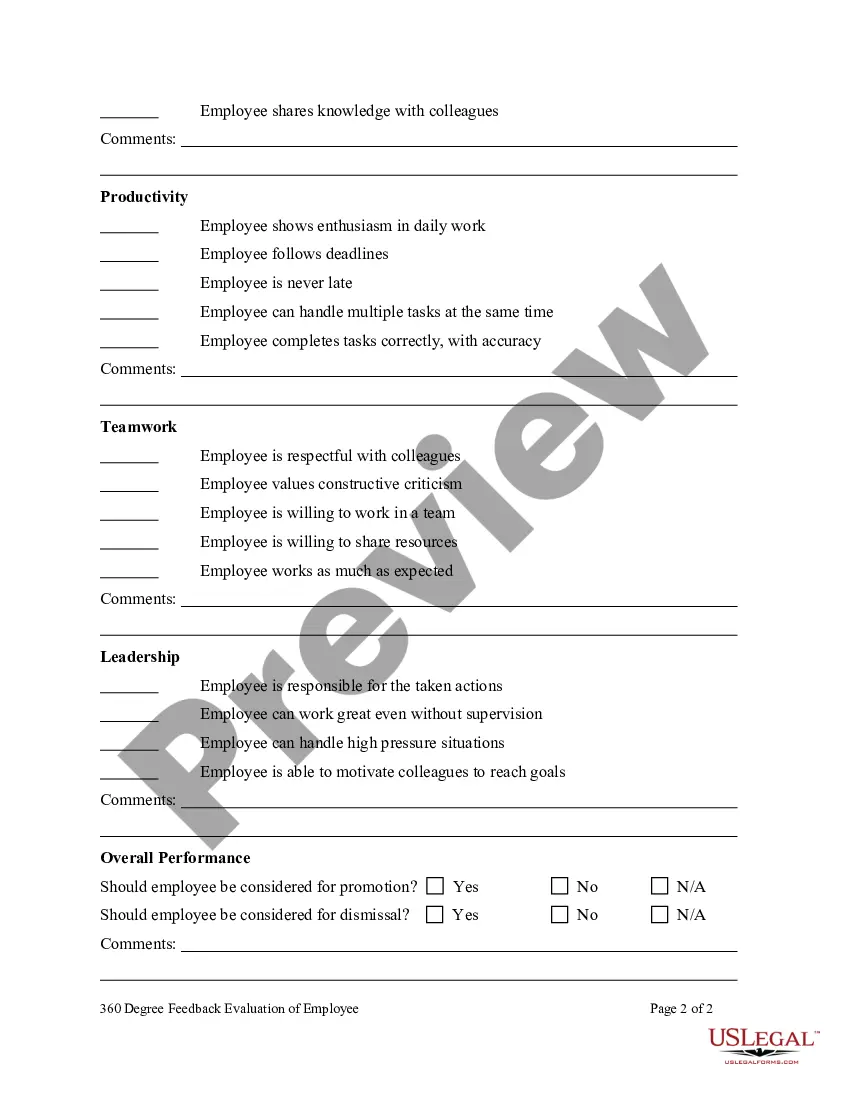
360-degree feedback is a method of employee performance assessment that gathers input and ratings from multiple stakeholders, including peers, managers, and direct reports.
Here are examples of positive leadership feedback: “I've been really impressed with the way you've fostered collaboration within the team. Your open communication style and active listening have created a work environment where everyone feels valued and heard.
“I appreciate how you always listen to our ideas and encourage open communication within the team. It makes us feel valued and respected.” Highlighting this behaviour reinforces its positive impact on team morale.
What should be included in 360-degree feedback? Communication skills. Interpersonal/soft skills. Collaboration and teamwork. Leadership and management capabilities. Innovation and creative abilities. Business goals/desired culture being lived out.
360 degree feedback (also known as multi-source or multi rater feedback assessment) is a way for individuals to understand their personal strengths and weaknesses, using the constructive feedback of others who work with them the most.
360-degree evaluations go by several names, including 360-degree feedback, 360-degree assessment, and 360-degree performance review. Essentially, it is a process for measuring employee performance by utilizing feedback from peers, employees, clients, supervisors, and members of other teams.
How to give 360 feedback to your boss Start with positive feedback. When giving 360-degree feedback, it's good to lead with a positive appraisal of your manager's performance. Review your relationship. Give examples. Be objective. Plan your feedback. Be empathetic. Practise.
A 360-degree assessment is a method that systematically collects feedback about an individual's performance from peers, direct reports, colleagues, and superiors within the organization. Overall, it provides a comprehensive, 360-degree view of a leader's strengths and opportunities for growth.
Positive leadership review sample phrases. “Your ability to foresee and plan for potential future obstacles is impressive.” “You consistently demonstrate strong strategic thinking in aligning team efforts with company goals.” “Your creative solutions to complex problems showcase your strategic mindset.”
Highlight his strengths to boost his confidence before communicating your concerns. Example of constructive feedback: "Joe, you have impressive time management skills. You complete tasks quicker than most of the team and rarely turn in your work late. However, I would like to see you focus on the content of your work.
