Special Meeting Sample With Action Items In Ohio
Description



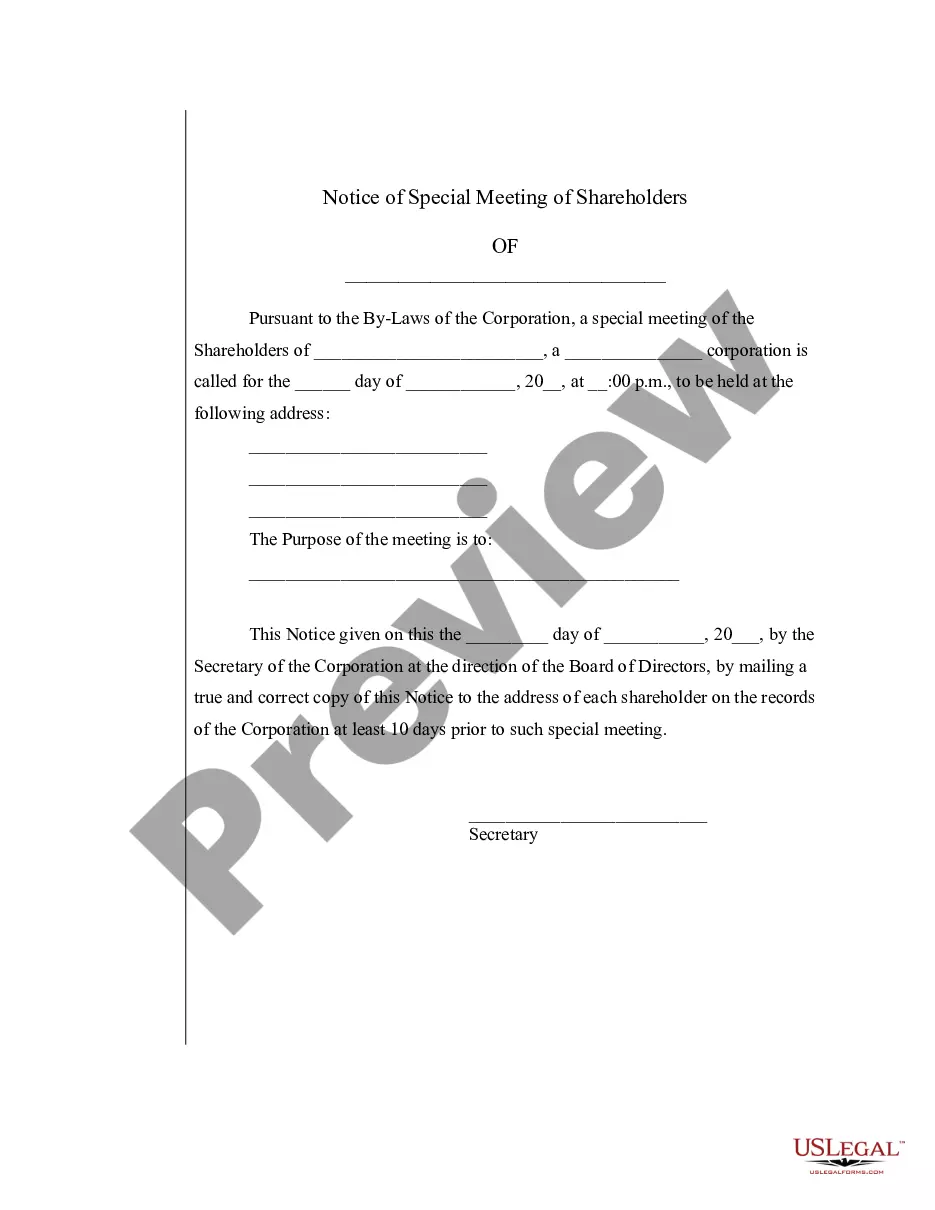
Get your form ready online
Our built-in tools help you complete, sign, share, and store your documents in one place.
Make edits, fill in missing information, and update formatting in US Legal Forms—just like you would in MS Word.
Download a copy, print it, send it by email, or mail it via USPS—whatever works best for your next step.
Sign and collect signatures with our SignNow integration. Send to multiple recipients, set reminders, and more. Go Premium to unlock E-Sign.
If this form requires notarization, complete it online through a secure video call—no need to meet a notary in person or wait for an appointment.
We protect your documents and personal data by following strict security and privacy standards.

Make edits, fill in missing information, and update formatting in US Legal Forms—just like you would in MS Word.

Download a copy, print it, send it by email, or mail it via USPS—whatever works best for your next step.

Sign and collect signatures with our SignNow integration. Send to multiple recipients, set reminders, and more. Go Premium to unlock E-Sign.

If this form requires notarization, complete it online through a secure video call—no need to meet a notary in person or wait for an appointment.

We protect your documents and personal data by following strict security and privacy standards.
Looking for another form?










Form popularity
FAQ
(C) All meetings of any public body are declared to be public meetings open to the public at all times. A member of a public body shall be present in person at a meeting open to the public to be considered present or to vote at the meeting and for purposes of determining whether a quorum is present at the meeting.
Ing to Ohio Revised Code Section 4117.01(B), a "Public Employer" means any of the following: The State or any political subdivision of the State located entirely within the State. Any municipal corporation with a population of at least five thousand ing to the most recent federal decennial census. Counties.
For example, a company may call a special meeting to discuss a major decision, such as a merger or acquisition. A school board may call a special meeting to address a specific issue, such as a budget shortfall.
What is a public body, as defined in the Ohio Open Meetings Act? Public bodies are decision-making groups of state or local government agencies or institutions. Examples of these bodies include school boards, city councils, and boards of trustees.
Section 121.22 | Public meetings - exceptions. (A) This section shall be liberally construed to require public officials to take official action and to conduct all deliberations upon official business only in open meetings unless the subject matter is specifically excepted by law.
Records that document the organization, functions, policies, decisions, procedures, operations, and other activities of the public office are “public records” under the Public Records Act.
A public body shall not hold a special meeting unless it gives at least twenty-four hours' advance notice to the news media that have requested notification, except in the event of an emergency requiring immediate official action.
As used in this chapter, "public body" means any county, city, district, or any other political subdivision of the State. Ca.
Accountability: By recording decisions and action items, minutes hold participants accountable for their commitments, creating a sense of responsibility and urgency. Communication: Minutes can be shared with stakeholders who were not present at the meeting, helping them stay informed about key developments.
In contrast, a special board meeting is a meeting that is not scheduled well in advance and is called by someone – authorized either under the law or the organization's bylaws – for a special purpose.

